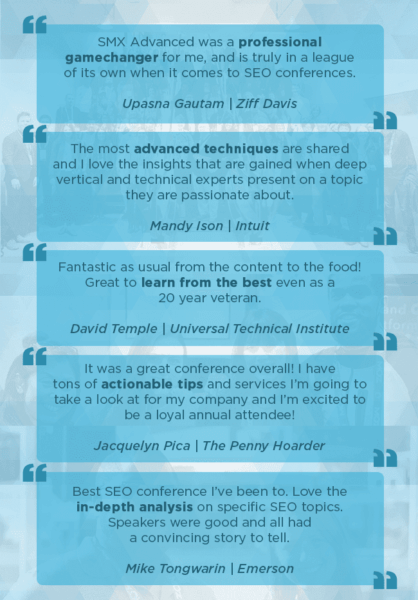
Last week, we shared with you 10 great reasons why you should attend SMX® Advanced, June 3-5 in Seattle — and I could sling another ten at you today. But instead, I’m going to let some of your peers do the talking…
So there you have it. If you want expert-led discussions on the SEO and SEM topics that matter most to your company, advanced techniques that will help drive awareness and conversions, and a chance to connect with the best and brightest search marketers on the planet, come to SMX Advanced.
Don’t wait. Super Early Bird rates (up to $900 off on-site prices) expire March 16. Register now!
Psst… Attend with your team for an unforgettable team-building opportunity and even more savings!
Opinions expressed in this article are those of the guest author and not necessarily Marketing Land. Staff authors are listed here.
About The Author
Marketing Land is a daily publication covering digital marketing industry news, trends, strategies and tactics for digital marketers. Special content features, site announcements and occasional sponsor messages are posted by Marketing Land.
It’s tempting to go after broad, high-volume keywords with huge audiences (and equally huge competition). But there’s an equally large — albeit more distributed audience — to be reached by targeting lower-competition, long tail keywords.
Imagine comets flying through the SEO solar system, if the most popular keywords make up the head of the comets (‘running shoes’, for example), each comet is trailed by a tail of more specific keywords like ‘long distance trail running shoes 2018’ and ‘best running shoes for flat feet’, that are useful in niche marketing.
Strategically pursuing the right long tail keywords as part of your SEO strategy can deliver several advantages.
As they have lower search volumes, they are usually much less competitive, making it easier for your brand to rank highly in search engine results.
Also, the specificity of long tail keywords generally indicates that those web searchers are nearer to the action part of their customers’ journeys. As a result, these keywords tend to have higher conversion rates.
Therefore, long tail keywords offer the opportunity to be discovered by your target audience when they are near their crucial decision points.
If you deeply understand and satisfy their specific search intent by providing compelling information or offers, even large competitors might not stand in your way.
But knowing that you need a long tail SEO strategy is only half the battle won, you need to find those keywords which are not always obvious.
Here are eight simple techniques that will help you target and find long tail keywords that align with your business’ goals:
1. Let Google autofill suggest long tail keywords for you
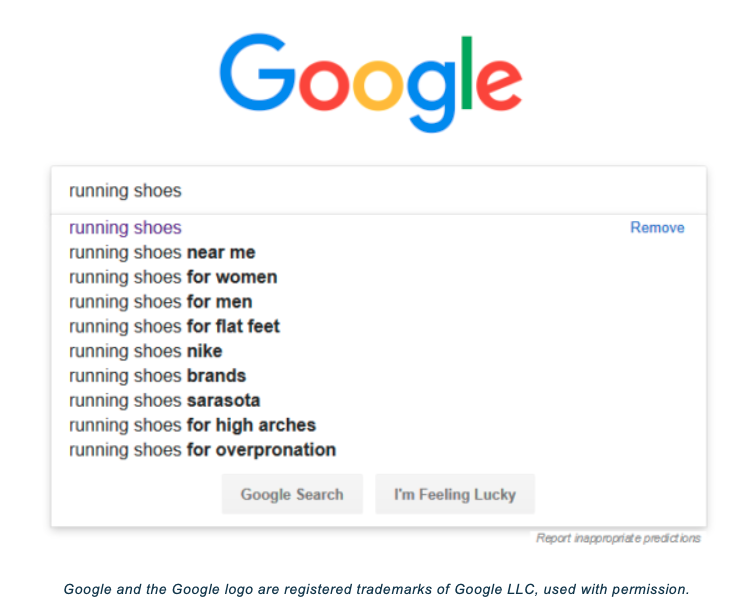
This is as simple as it seems, type a broad search term into the Google search bar and you’ll see a list of long tail keywords tuned to fit popular searches by users.
For further suggestions, you can then enter these phrases (or variations that they inspire) and view more long tail keywords to target with your SEO campaigns. For example, inputting ‘running shoes for women’ will generate a fresh list of Google auto-filled suggestions based around that (longer) keyword that get even longer tail still.
2. Leverage Google’s related searches
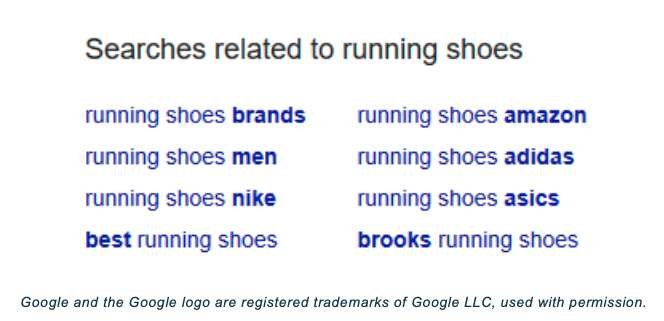
Similar to autofill, another completely free technique that leverages Google’s search engine is to look at Google’s related searches. Simply type any keyword and scroll to the bottom of the search results page to view useful long tail keyword suggestions.
3. Take suggestions from Ubersuggest
Ubersuggest is a tool you can use to find long tail keywords. Simply enter a term to receive a list of top suggestions.
4. Generate suggestions with the LSIGraph keyword generator
While the LSIGraph keyword generator helps you discover latent semantic indexing (LSI) keywords for semantic SEO, most LSI keywords can double as long tail keywords once you know how to recognize them.
5. Find long tail keywords in question forms with Answer The Public
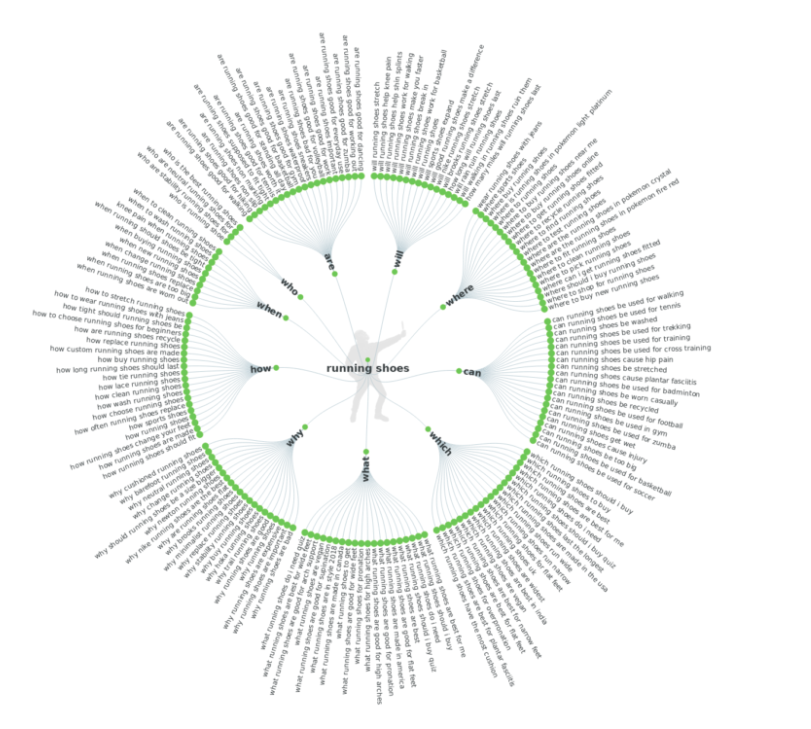
Answer The Public aggregates results from Google and Bing to provide the most commonly searched questions related to a given term, and in a rather compelling visual format. Because valuable long tail keywords often happen to be in the form of a question, your SEO can benefit by utilizing these targets and providing content that directly answers questions pertaining to your brand.
Share this article
Related articles
6. Search for relevant users’ questions on Quora
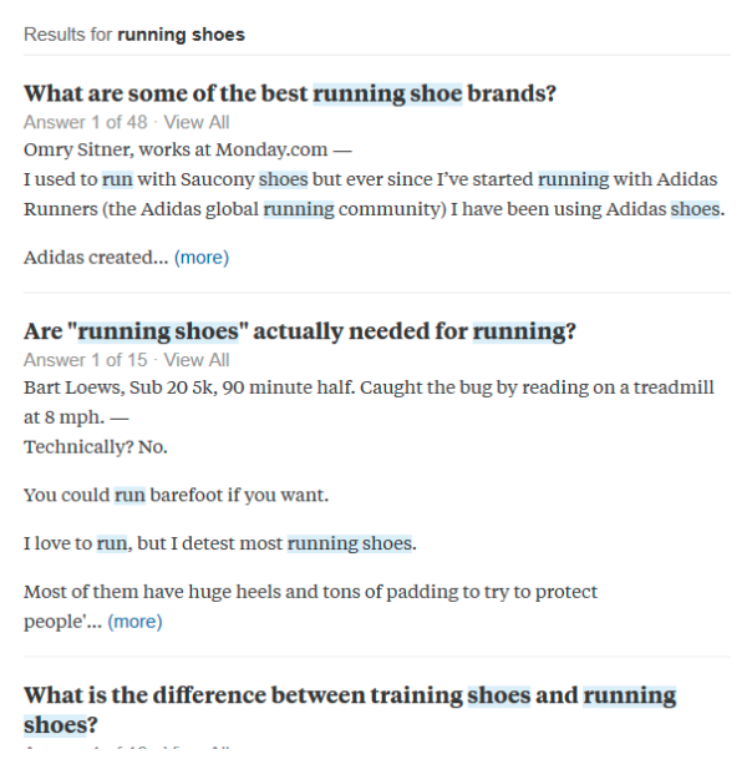
Another way to source long tail keywords in question formats is to take a look at what people are asking on Quora. For example, searching for the topic ‘running shoes’ will show questions that might be smart to target as long tail keywords (and answer with your content).
7. Check out user discussions in online forums
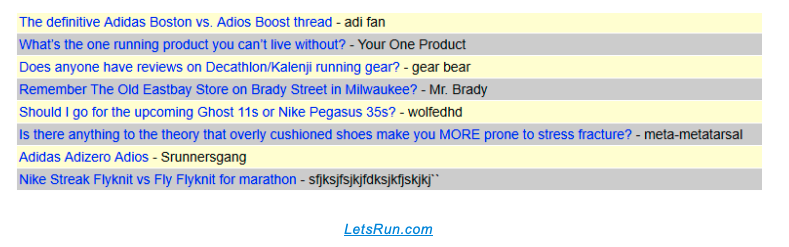
Forums can also prove informative by offering yet another window into the questions and interests that potential customers are focused on. You can leverage these more specific topics as long tail keywords, and choose those that spark the most active conversations. To locate forums that cover a particular topic, search for ‘[your broad search term] + forum’.
8. Use a Keyword Difficulty Tool
Inputting a targeted generic term into a Keyword Difficulty tool can yield numerous related-keyword opportunities, many of which will be long tail options.
Tools tracking keyword difficulty usually also provide useful metrics to help you decide which long tail keywords make the most sense to target.
These include relevance to the original keyword, the popularity of the search term, the level of competition you’ll need to overcome in order to rank for your new long tail terms, and whether that keyword competition is within your site’s competitive power.
How to turn long tail keywords into SEO success?
Once you have a solid list of long tail keywords that are appropriate candidates to consider centering (or expanding) your SEO efforts around, you’ll need to vet them with research to ensure they possess the potential to deliver value. Ultimately, they must meet the two criteria that you need to keep top of mind:
Competition on the keywords must be low enough that you have a good chance to compete and succeed.
They must be popular and searched for frequently enough to be worth your time.
Once you’re sure the long tail keywords you’ve selected are the right ones, follow SEO best practices to include the targeted terms in your content, and help maximize the likelihood for each page to rank in search engine results for the respective terms.
SEO best practices include using the long tail keyword across the following page locations:
The post title and meta title
The page’s SEO meta description
The first paragraph of the content
Naturally throughout the content (Aim for a keyword density of around two percent)
In at least one subheading
Near the end of the content
As an image alt tag for one image on the page
It’s also a best practice to use three or four LSI keywords related to the long tail keyword within your content and to create links on other pages within your site that point to each new content page.
With generic search terms ever-more-competitive and less apt for driving targeted traffic, it’s wise to pursue a diversified strategy that also utilizes long tail keywords, offering focused content to reach an audience that knows more about what it wants and is ready to be converted into customers.
Kim Kosaka is the Director of Marketing at Alexa.com.
Want to stay on top of the latest search trends?
Get top insights and news from our search experts.
Related reading
If your SEO strategy is working well, you can expect to see results in about three months. Here are ten reasons why that might not be the case.
Eight takeaways on content-led link building campaigns. James earned >2,500 links from publications including the BBC, the Guardian, USA Today, and Vogue.
Writing good content isn’t enough. Here are 4 key factors to consider when creating effectively structured SEO content, and tools to use to meet each need.
Link reclamation is a simple but efficient tactic to turn unlinked brand mentions into links. Here’s when to reach out, who to contact, and what to say.
Want to stay on top of the latest search trends?
Get top insights and news from our search experts.
Marketing executives today are in charge of dozens of martech applications to manage, analyze and act on a growing volume of first-party customer data. But instead of increasing efficiency, the emerging martech ecosystem has created problems with data redundancy, accuracy and integration. Automating customer data accuracy and integration through a customer data platform (CDP) can provide numerous benefits.
MarTech Today’s “Enterprise Customer Data Platforms: A Marketer’s Guide” examines the current market for enterprise customer data platforms (CDPs) and the considerations involved in implementing the software. This report answers the following questions:
What features do CDPs provide?
What trends are driving the adoption of CDPs?
Does my company need a CDP?
Also included in the report are profiles of 22 CDP vendors, pricing information, capabilities comparisons and recommended steps for evaluating and purchasing. Visit Digital Marketing Depot to get your copy.
About The Author
Digital Marketing Depot is a resource center for digital marketing strategies and tactics. We feature hosted white papers and E-Books, original research, and webcasts on digital marketing topics — from advertising to analytics, SEO and PPC campaign management tools to social media management software, e-commerce to e-mail marketing, and much more about internet marketing. Digital Marketing Depot is a division of Third Door Media, publisher of Search Engine Land and Marketing Land, and producer of the conference series Search Marketing Expo and MarTech. Visit us at http://digitalmarketingdepot.com.
A few weeks ago, Google published a blog post on its webmaster blog sharing some tips on how to get more success in Google News search in 2019.
2019 will be a hard fight against fake news as fake news outlets are increasing with time. Along with some social media platforms, Google is also responsible for the spreading of fake and misleading news. If you are running a clickbait rich site with a lot of crappy content, you may encounter Google’s punishment this year.
Generally, Google looks at these five factors when ranking news articles:
Freshness
Diversity
Rich textual content
Originality of content
User preferences for topics or publishers
To succeed in 2019 your news content should be original, authoritative, and should provide timely news information.
Six important tips for news content
Articles’ headlines should be clear. Keep it in the H1 tag. Headlines should be a minimum of 10 characters, between two and 22 words.
Use proper time and date. Show clear and visible time and date below the title and above the article. Use structured data.
Be transparent in your content. Fake news is a major problem on the internet, especially from the last American presidential election. Google will try to scan out fake news content in 2019. Best practice for this time is to create a very user-friendly site, not something crappy with lots of pop-ups and ads. Add detailed information, mention sources, make it authoritative.
Don’t be deceptive in your content. Don’t mislead. Misleading information in the content can ban you from Google.
Secure your website’s every page with HTTPS. A website that uses Hypertext Transfer Protocol Secure (HTTPS) confirms a secure connection between the browser and user. It protects users‘ sensitive information. For a news site, it is a very good search signal.
Don’t participate in link spam to increase your ranking. Don’t buy links.
The five ‘w’s
To write your news content, you can use this popular news writing formula. Ask yourself the five ‘w’ questions and answer them all in your first paragraph of news content. The main aim is to provide a lot of information in the first paragraph.
Internet readers have a small attention span and most people scan the content, instead of line by line reading. This is especially true for news.
Write your first paragraph answering these questions.
Who?
What?
Where?
When?
Why?
Use proper nouns in the headline
Generic nouns will not get as much attention as proper nouns in Google search. Use proper names of brands, organizations or of people related to your news in the headlines. If you can creatively use proper names where other news outlets are not, you will get a huge advantage in the Google News search.
Share this article
Related articles
Graphics, images and video content
Use graphics, images, and videos on your news content to explain your news or to provide more information. Google loves this. With engaging videos and graphics, you can attract more readers, and make your content more shareable.
But before sharing your multimedia follow the guidelines of Google.
Beware the sensational, exceptional, negative, and current (SENC)
SENC is sensational, exceptional, negative, and current events, which is a general definition of current news. But, if you follow this definition to produce your news, they will not be authentic or convey real helpful information.
Shocking, scandalous things can be viral, but these types of sensational news should not be your priority.
If you prioritize only exceptional things, your content will become misleading.
Current news is full of recency bias. The present most recent things, without much in-depth and background information. But every recent event has a root in something old and slow systematic change. In your news content, you should present the actual root cause as much as possible to make the content more authoritative. It will earn you good links and build your brand.
Your news should be foundational not sensational.
On publishing breaking news, you should not be in a hurry to publish it faster than your competitors. Instead, before publishing the content, ask yourself what new information your article will provide that is not found elsewhere.
Pay less attention to CTR, dwell time, and other UX signals on the landing page
According to recent AMA of Gary Illyes, Google webmaster trends analyst:
“RankBrain is a PR-sexy machine learning ranking component that uses historical search data to predict what would a user most likely click on for a previously unseen query. It is a really cool piece of engineering that saved our butts countless times whenever traditional algos were like, e.g. “Oh look a ‘not’ in the query string! Let’s ignore the hell out of it!”, but it’s generally just relying on (sometimes) months’ old data about what happened on the results page itself, not on the landing page. Dwell time, CTR, whatever Fishkin’s new theory is, those are generally made up crap. Search is much more simple than people think.”
This thread from a couple weeks ago caused quite a stir. Perhaps we distract ourselves too much from the “simplicity” of what is actually search?
Ps — what are your thoughts on RankBrain and UX? Leave a comment below!
Muradul Islam is a Business Analyst at WeDevs. He can be found on Twitter .
Want to stay on top of the latest search trends?
Get top insights and news from our search experts.
Related reading
Writing good content isn’t enough. Here are 4 key factors to consider when creating effectively structured SEO content, and tools to use to meet each need.
Link reclamation is a simple but efficient tactic to turn unlinked brand mentions into links. Here’s when to reach out, who to contact, and what to say.
Five things you can do for free to boost organic search results. Tip #4: How just one word in a title can cause a 59% increase in organic traffic.
For 3 out of 5 marketers, generating traffic and leads is the toughest challenge. Here are our top three tips for lead generation for ecommerce businesses.
Want to stay on top of the latest search trends?
Get top insights and news from our search experts.
Real-Time Interaction Management (RTIM) systems are designed to deliver users the best offer or next action, based on the current context and their particular needs.
In other words, RTIM solutions are meant to power the anticipated customer experiences that users increasingly expect.
But relatively few systems can smoothly integrate the massive data, broad functionality and quick intelligence needed to provide this split-second delivery of the right thing at the right time. To help marketers sort the players, Forrester Research is out with this quarter’s Forrester Wave report. (Available for free from Pegasystems, which is mentioned in the report, although registration is required.)
Now, four Leaders. Forrester has a lot of skin in this game, having covered Real-Time Interaction Management for years — first in 2012, in the context of computational decision engines, and then in a series of reports in 2015, including the first Wave on this topic, which featured this definition:
“Enterprise marketing technology that delivers contextually relevant experiences, value, and utility at the appropriate moment in the customer life cycle via preferred customer touchpoints.”
In that initial report, only two of the profiled 11 vendors achieved the top Leader category — Pegasystems and Teradata. That’s not surprising, since this kind of platform — essentially a state machine that has to immediately deliver the right offer or action on the most appropriate channel and based on many datapoints — is a high bar to clear.
But in this new report, SAS and Salesforce join Teradata and Pegasystems as Leaders. FICO, Kitewheel, Pitney Bowes, Adobe and IBM are characterized in the second-highest category of Strong Performers, while Certona and Emarsys land in Contenders. Infor is the only vendor in the bottom group of Challengers.
Pegasystems, Teradata, Salesforce. The report notes that RTIM platforms cover five segments: next best experience, cross-channel marketing, personalization, loyalty marketing and cross-channel communications. Each of the five represents a variation on the scope and timing of communication with customers, but Forrester’s report is focused primarily on next-best-experience solutions that deliver across channels.
Among the Leaders, Pegasystems is praised for its integration of digital decisioning, process automation, case management, advanced analytics, AI and support for contact centers, chatbots, mobile devices and integrated voice response.
The report points to Teradata’s Customer Journey solution, which includes real-time decisioning, and its Customer Interaction Manager for cross-channel orchestration, all based on the company’s large-scale customer data management platform.
Salesforce gets a shout-out for now positioning its RTIM around its Interaction Studio, part of its Marketing Cloud and launched in the middle of last year, instead of its past practice of embedding RTIM in its email, mobile and web modules. Interaction Studio was developed with customer engagement platform Thunderhead, which Forrester considers a Leader in journey orchestration and visioning. But the research firm notes that Interaction Studio is still rules-based, instead of relying on Salesforce’s Einstein layer of advanced AI to make decisions.
SAS, Kitewheel, Pitney Bowes, Adobe. SAS is cited for its advanced analytics for decision arbitration, measurement and optimization. The report says the platform works well for enterprises looking to make analytics a core requirement, although it notes the need to enhance digital intelligence and channel integration.
Among the others, several stand out for specific emphases. Kitewheel, for instance, is mentioned for its integration with other systems, such as marketing automation tools, and cited as “a good choice for B2C marketers (and their agency partners) whose RTIM efforts center on customer experience design and optimization.”
Pitney Bowes leverages its customer services expertise, Forrester said, with a RTIM emphasis on contact centers, face-to-face channels and outbound marketing. And Adobe, with its huge portfolio of modules in Experience Cloud, has a strength in personalizing customer experience across channels, although it doesn’t offer the centralized decisioning of the other providers.
Why you should care. RTIM is, essentially, the delivered maximal vision of digital marketing, where a brand gives you what you really want, when you want it, on the best channel and in real time.
With such a large vision of customer experience, the category encompasses a wide range of platforms and integrations. Forrester’s emphasis on next-best-offer or action gives the report a focus so that it can only address a dozen vendors, but the range of solutions is potentially much larger.
Like Customer Data Platforms, Real-Time Interaction Management is a developing solution that addresses the real-time, personalized delivery needs of modern marketing, but has emerged as its own category only in recent years.
This story first appeared on MarTech Today. For more on marketing technology, click here.
About The Author
Barry Levine covers marketing technology for Third Door Media. Previously, he covered this space as a Senior Writer for VentureBeat, and he has written about these and other tech subjects for such publications as CMSWire and NewsFactor. He founded and led the web site/unit at PBS station Thirteen/WNET; worked as an online Senior Producer/writer for Viacom; created a successful interactive game, PLAY IT BY EAR: The First CD Game; founded and led an independent film showcase, CENTER SCREEN, based at Harvard and M.I.T.; and served over five years as a consultant to the M.I.T. Media Lab. You can find him at LinkedIn, and on Twitter at xBarryLevine.
It is no secret that Google and other search engines like quality links and consider them as one of the top ranking factors. Search engines are getting smarter and better at identifying unnatural link building. Updated algorithms can assess the brand’s strength and content’s usefulness at a glance.
This results in higher requirements for the quality of links and content you use for your SEO. Fortunately, there is a way to create engaging content and build quality links from authority sites simultaneously. The solution is to align SEO efforts with PR. Public Relations puts a business in the spotlight, creating brand awareness and reputation through press coverage. Mentions about the company boost the quality of SEO as well.
I came up with this strategy based on a video Rand Fishkin had created on ‘The Marketing Flywheel.’ It’s an old Whiteboard Friday that still resonates today.
Rand’s video explains strategies that can impact and scale your link building. I had to find a solution as many of us are in our assigned positions, we are a team of one. So I had to make friends, and fast!
In this article, we will take a look at how scaling PR is one of the best link building strategies that can scale your efforts and brand your business fast.
What is an online PR strategy?
A highly cost-effective marketing technique, online PR is a way to spread a word about your brand on the web. A good PR strategy is really important in this modern age. It does not just help you start influencing people but also gains trust and reputation quickly.
I started reading books from Ryan Holiday, a successful marketer and American Eagle executive that has pulled a lot of crazy stunts to scale earned media.
He does not focus on SEO as he is more on branding and growth hacking, but his strategies are unconventional and allow you to think out of the box.
Connecting with quality influencers and journalists
You already do it with guest posting, why not do this by finding journalists and other influencers with blogs?
The payoff for building these relationships is organic backlinks. Connecting with high authority journalists and influencers in the industry or general media can work wonders for your SEO.
The key is to come up with something that can attract their attention, we used a scholarship mixed with a need and based on current priorities that the manufacturing industry had, this is how we recently landed a sweet article on IndustryWeek.
It is important to understand that there is no one-size-fits-all solution to using an online PR strategy for link building. You should develop a PR scaling plan that suits your company needs.
Here are some useful tips to do link building with PR for your business
1. Media relations
Public relations is different from guest blogging and is about developing healthy relations resulting in high-quality opportunities for the placement of content. Building relations with journalists, bloggers, publishers, and influencers is important.
Focus on quality rather than quantity and take time to build these relations. Begin by targeting a few people and nurture a relationship with them. Do some research and find writers, journalists, and influencers in your niche and start engaging with them. Know them and listen to what they say before asking them for links.
Like and comment on what they post on social media. Send some useful information to them, even if it is not about you. This will create a positive impression about you in their minds. This way, they will be ready to work with you when the time comes.
2. Priority of online reputation management (ORM)
Your online business reputation has to be on point. One suggestion to create fast, positive feedback is to email potential influencers in your industry with some free products and ask for feedback. Seven out of ten times, they will write about you on their blog or create a video endorsing your product. Bloggers love free stuff and this is a quick way to gain positive feedback and reviews on your brand and products.
Don’t make your own products? That’s okay! Gift cards work as well with a focus on asking for feedback on your user experience or app. It works both ways.
Share this article
Related articles
3. Use of press releases
Press releases have evolved over the years and a good press release which catches the attention of journalists gives a great opportunity for social media coverage and organic links.
Consider our example in introducing a scholarship program to bridge the skills gap in the manufacturing industry. This initiative helped us get some great PR and we built trust and reputation within the industry in a matter of a few months.
4. .EDU links help
It also helped us fuel our acquisition of .EDU Links. We targeted media and industry sites first and then with the trust in place, we contacted schools and universities offering manufacturing courses.
We pitched our scholarships and included these articles with links of the stories about the scholarship. The result we got from these efforts were awesome. In less than four months, we went from DA 17 to DA 30 and still growing with over 15 .EDUs and 1200 backlinks which we acquired in just a few weeks.
Rather than distributing the press release through syndicated websites with no-follow links, consider distributing it on social media and use some keywords that help influencers and journalists find it easily. You can make it appealing by sending it to influencers before releasing it.
5. Timely content
Try to tie your content to a current event to make it appealing to high-quality sites. Most SEO pros write a story around something timely and pitch it before their competitors do. This is also referred to as newsjacking, it works with the right pitch and data but may backfire if you get too controversial.
Doing this right requires that you stay updated on the local and national news and events, and always be ready to give the expert opinion. Such commentary comes with a mention and possibly a link. You can set up Google Alerts for topics and people in your niche to know whenever a big story is up.
6. Use of social media
Social media is one of the most powerful tools for public relations. Social media platforms such as Instagram and Facebook make it easy for brands to get introduced to influencers and build relations. By using social media to boost your SEO, you get more people to read your content. Always ensure you are visible where you should be and you don’t miss out on anything. Don’t share your content on social media just to get clicks.
Encourage the audience to share your content, comment on it, mention to their contacts and use other ways to spread it across the internet. This is how social media can help you generate new, organic links.
7. Buy your PR team some doughnuts
PR has a valuable place in SEO and vice versa. When the two industries work together, the results are amazing. As you can see here, there are numerous benefits of scaling PR with link building.
Links do matter but where you get them from is more important. Building relations and connections are imperative to success. With the bar of link quality going up at a constant rate, make sure you use PR strategies in your SEO campaigns to generate organic links from high-authority sites.
How would you use PR to boost your link building? Let us know in the comments section below.
Jonathan Alonso is Director of Digital Marketing at CNCMachines.Net. He can be found on Twitter at @jongeek.
Want to stay on top of the latest search trends?
Get top insights and news from our search experts.
Related reading
Most of our search activity is mobile now and most of our video viewing is too. How should this affect the way we approach SEO for our video content?
Over 600 million users visit FB business pages every day. 52% of consumers have discovered a brand there. Why and how to optimize for Facebook local search.
(According to experienced SEOs.) We asked SEO experts which plugins and extensions they use for easier, more productive work. Here are their top 17 answers.
Websites suffer an average of 58 attacks every day. Here is a very thorough, careful overview of how these attacks can seriously impact on your SEO.
Want to stay on top of the latest search trends?
Get top insights and news from our search experts.
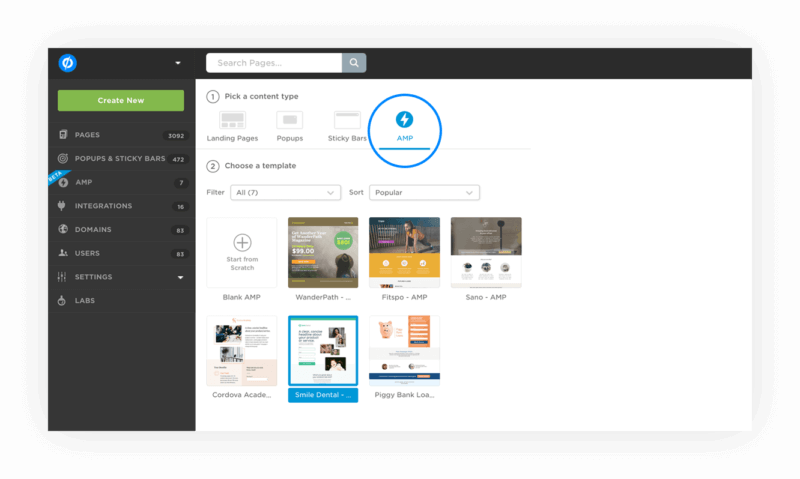
Unbounce has built a drag-and-drop feature for creating AMP landing pages that removes the need for HTML or JavaScript coding expertise.
Why you should care
Accelerated Mobile Pages effectively reduce mobile page load times and optimize the overall user experience on mobile devices, but creating AMP content can be time-intensive and usually takes the expertise of a developer. Unbounce’s new feature is designed for marketers who are in need of AMP landing pages, but lack the time, resources or developer skills to invest in AMP initiatives.
The drag-in-drop tool makes it possible to create AMP landing pages using templates or a fully customizable page offered in Unbounce’s Premium and Enterprise paid plans. Marcel Heymuth, the senior performance marketing manager for Exporo, said his team was thrilled with the new offering: “All of our landing page specialists can build AMP pages quickly and easily without having to resort to IT resources.”
Unbounce recently reported only 40 percent of 750 consumers it surveyed were willing to wait more than seven seconds for a page to load. This is a conservative number compared to Google’s findings last year that 53 percent of mobile site visits result in a bounce if it takes longer than three seconds to load. The primary benefit of Unbounce’s feature is that marketers and website owners can create an optimal mobile experience without having to rely on a developer to create AMP content.
More on the news
Unbounce’s drag-and-drop feature for building AMP pages is included in the Premium plan that costs $159 a month or the Enterprise plan which is $399 a month. (The company does offer a free-trial.)
The feature includes a “Validate” function to verify the landing page meets all of Google’s AMP requirements.
The feature is designed to simplify the AMP landing page creation process, but marketers do have the option to add AMP-compatible HTML, CSS or JavaScript elements.
This story first appeared on MarTech Today. For more on marketing technology, click here.
About The Author
Amy Gesenhues is Third Door Media’s General Assignment Reporter, covering the latest news and updates for Marketing Land and Search Engine Land. From 2009 to 2012, she was an award-winning syndicated columnist for a number of daily newspapers from New York to Texas. With more than ten years of marketing management experience, she has contributed to a variety of traditional and online publications, including MarketingProfs.com, SoftwareCEO.com, and Sales and Marketing Management Magazine. Read more of Amy’s articles.
We’ve been working together with our sister site, ClickZ, to honor the best and brightest marketing technology companies today (which includes some SEO-related tools).
These Marketing Technology Awards are voted on 50/50 by the community and by a panel of judges. The ceremony will be hosted by Scott Brinker, and will take place on the night of March 21 in Tribeca, New York.
We’ve been raising quite a bit more hubbub about it on ClickZ, which more directly covers all marketing technology.
But since our SEW name is on there too, we wanted to make sure everyone here was in the loop as well. (You’ve probably seen it in the newsletters!)
Categories span across various types of marketing technology, including CDPs, ABMs, call analytics, conversational bots, and a dozen more.
And of course, a handful of more SEO type things such as search tools, location-based marketing, mobile marketing, etc.
Categories also include “Use of Technologies” (best campaigns, best tech stack), as well as “People” (martech CEO and CMO).
The awards were free to enter, and anyone who has used any of the platforms (excluding employees) could vote on them, rating the tools on things like ease of use, integration, innovation, value for money, customer service, etc.
Finalists were determined based 50% by community votes, and 50% by these judges.
Announcing the finalists
So for 2019, we want to thank everyone who has entered, nominated, voted, scored, and otherwise provided your valuable insights and experience.
We’d like to announce the list of finalists for this year, and offer a huge congratulations to everyone on this list.
We can’t wait to celebrate you and your great work at this event.
Here’s the full list:
Technologies
Best Account Based Marketing Tool
Demandbase
Jabmo
Uberflip
Best Analytics Platform
AT INTERNET
Interana
Pathmatics
TapClicks
Best Attribution Platform
Fospha
Marketing Evolution
Best Call Analytics Platform
DialogTech
Infinity
Invoca
Marchex
Best Chat/Conversationsal Bot/Tool
Drift
Smooch
Wizu
Best Content Marketing Tool
Acrolinx
Percolate
Turtl
Best Conversion Rate Optimization Tool/Technology
CoolTool
Lucky Orange
WEVO
Best Customer Data Platform (CDP)
Adlucent
Arm Treasure Data
Fospha
Tealium
Best Customer Relationship Management Platform (CRM)
Crowdvocate
Erply
Zaius
Best Data Privacy/GDPR Tool/Technology
Isatis CyberSoft
Sourcepoint
Best Data Visualization Tool
Adobe
DashThis
Best Demand Side Platform (DSP)
Amobee
SmartyAds
The Trade Desk
Best Digital Asset Management Platform (DAM)
Canto
Widen
Best Email Service Provider (ESP)
Epsilon
GetResponse
MessageGears
Upland Adestra
Best Influencer Marketing Platform
CreatorIQ
HYPR
IZEA Worldwide Inc.
Best Location Based Marketing Platform
Brandify
Chatmeter
Rio SEO
Yext
Share this article
Related articles
Best Marketing Automation Platform (MAP)
Maropost
Omnisend
Salesforce
Swrve
Best Mobile Marketing Platform
Attentive
Urban Airship
Best Paid Media/Bid Management Tool
Adlucent
Kenshoo (Kenshoo Search)
SmartyAds
Best Personalization Platform
Certona
Monetate
RichRelevance
Sitecore
Yieldify
Best Predictive Analytics Platform
Keen Decision Systems
SmartyAds
Best Sales Enablement Technology
Clari
Highspot
List Partners LLC
Seismic
Best SEO Tool
Conductor
OnCrawl
Best Social Media Marketing & Monitoring Company
Kenshoo (Kenshoo Social)
Rascasse
Overall – Marketing Technology Company of the Year
To be announced from the list of finalist at the awards dinner
Use of technologies
Best Customer Experience Campaign
Nestlé (Nestlé China)
Ogilvy (H&M & Ogilvy)
Best Data Enablement Campaign
Adobe (Adobe)
Catalyst (Catalyst & Tauck)
Idomoo (Fairmont Hotels & Resorts)
Marketing Evolution (Marketing Evolution)
Best Marketing Technology Stack
Catalyst
Kenshoo Inc.
Best Personalization Campaign
Conversant (Swanson Health)
Location3 (Mountain Mike’s Pizza)
Selligent Marketing Cloud (OPEL NETHERLANDS)
Sitecore (Herschend Family Entertainment (Dollywood.com))
Velocity Worldwide (The Belfast Classic/Sport Changes Life)
Best Technology Combination
Akamai
Glisser
Merkle (Globe Life and Accident Insurance)
TVTY
Best Use of Marketing Technology
Adobe (Adobe & Adobe Advertising Cloud)
Ogilvy (H&M & Ogilvy)
SAP (SAP & MSIGHTS, Inc.)
People
Marketing Technology CEO Award
Conductor (Seth Besmertnik, CEO, Conductor)
Marketing Evolution (Rex Briggs, CEO, Marketing Evolution)
The Trade Desk (Susan Vobejda, CMO, The Trade Desk)
Yieldify (Hannah Nakano Stewart, CMO, Yeildify)
Again, a huge congratulations to all of these fantastic companies and people! For inquiries about the ceremony, please see more information and contact info here.
Want to stay on top of the latest search trends?
Get top insights and news from our search experts.
Related reading
7 expert strategies on Amazon Advertising, and how to use AMS and organic impressions to get your brand seen. Tips presented by John Denny of Cavu Venture Partners (formerly Bai) and Luis Navarrete Gomez of LEGO at the Transformation of Search Summit.
Featured snippets from the Transformation of Search Summit held in NY on Oct 19, 2018. Key highlights and quotes from the full day of speakers and sessions.
New research, The Era of Ecommerce, released today in partnership with Catalyst, finds disconnect between consumer behavior and advertiser spend online.
Consumers are ignoring the mass of email and seeking out businesses on their own terms — when and where they want to look. Search marketing gets you found.
Want to stay on top of the latest search trends?
Get top insights and news from our search experts.
In a world where customers are bombarded across every possible channel with brand messages, targeting is more important than ever before. Small businesses need to be able to make their campaigns feel relevant and personal in order to keep up, but the processes involved – collecting, organizing and interpreting customer data to make it actionable – are often intimidating to small businesses and solo entrepreneurs with limited time and resources.
Collecting, organizing and learning from your customer data is critical no matter how large your team is or what stage of growth you’re in. In fact, there’s no better time to consider your processes for data than when you’re just starting out. And getting started with basic strategies for building customer relationships doesn’t have to be difficult – there are some simple steps you can take to save yourself a lot of time as your business grows and scales.
From the moment you start your business and establish an online presence, you should be laying the groundwork for effective CRM strategies. This includes: establishing a single-source of truth for your customer data, being thoughtful and organized about how you collect information and setting up the right processes to interpret that data and put it to work for your marketing. Here are some actionable steps (with examples) to take now:
Collect: Make sure you’re set up to onboard people who want to be marketed to. Whether you’re interacting online or in person, you should be collecting as many insights as possible (for example, adding a pop-up form to your website to capture visitors, or asking people about their specific interests when they sign up for your email list in store) and consolidating them so you can use them to market.
Organize: Once you have this data, make sure you’re organizing it in a way that will give you a complete picture of your customer, and make it easy to access the insights that are most important for your business to know. Creating a system where you can easily sort your contacts based on shared traits – such as geography, purchase behaviors or engagement levels – will make it much easier to target the right people with the right message.
Find insights: Find patterns in data that can spark new ideas for your marketing. For example, the realization that your most actively engaged customers are in the Pacific Northwest could lead to a themed campaign targeting this audience, a plan for a pop-up shop in that location or even just help you plan your email sends based on that time zone.
Take action: Turn insights into action, and automate to save time. As you learn more about your audience and what works for engaging them, make sure you’re making these insights scalable by setting up automations to trigger personalized messages based on different demographic or behavioral data.
Doing this right won’t just result in more personalized marketing campaigns and stronger, more loyal customer relationships – it will also help you be smart about where you focus your budget and resources as you continue to grow.
Opinions expressed in this article are those of the guest author and not necessarily Marketing Land. Staff authors are listed here.
About The Author
As VP of Marketing, Darcy Kurtz leads Mailchimp’s product marketing team. Her team aligns product strategy with marketing execution to make Mailchimp’s sophisticated marketing technology accessible for small businesses worldwide. Darcy joined Mailchimp with more than 25 years of experience leading global marketing at companies like Dell, Sage and Outsystems. She has a career-long passion for serving small businesses.
As we recently reported, fresh concerns over child safety on the service came to light back on 17th February.
In a video published to the site, vlogger Matt Watson details how the service is being exploited by paedophiles who were using comment sections under innocuous videos of children to leave sexually provocative messages, to communicate with each other, and to link out to child pornography.
Of course, journalists and news sites were quick to level criticism at YouTube. Many pointed out that this wasn’t the first time child safety on the service has been called into question. Others were critical that its methods for safeguarding children were too ‘whack-a-mole’ in their approach.
And then came the actions of the advertisers – with Nestle, AT&T and Epic Games (creator of Fortnite) all pulling their ads from the service.
So how has YouTube responded? Is it doing enough?
Memo directly sent to advertisers
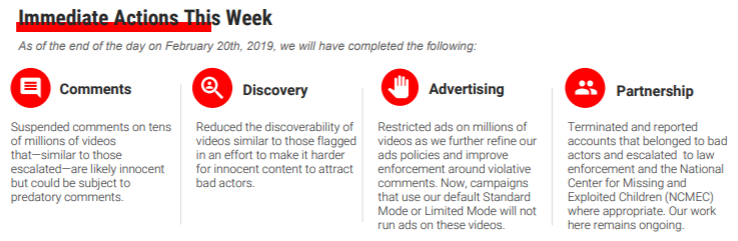
On 20th February YouTube sent out a memo to brands advertising on the service.
It detailed the ‘immediate actions’ it was taking to ensure children are safe in light of the recent allegations from Watson. These included suspending comments and reporting accounts to the NCMEC.
The memo reiterated that child safety is YouTube’s No. 1 priority, but also admitted there was more work to be done.
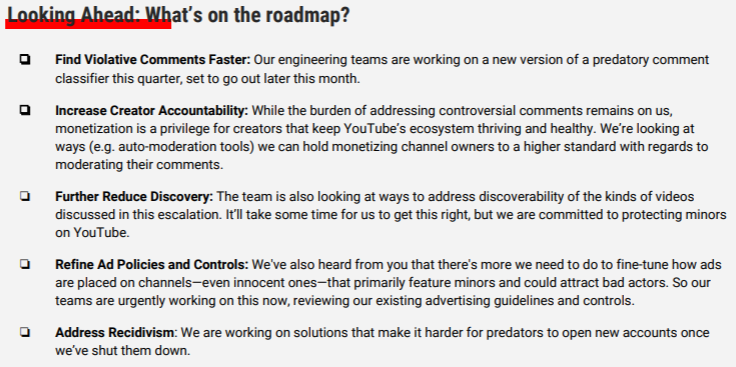
It laid out a roadmap of tweaks and improvements, including better improving the service’s ability to find predatory comments (set to be implemented this month) and potentially changing how ads are placed on channels.
Changes to Community Guidelines strikes system – are these related?
The changes – which came into force on 25th February – include a warning for users the first time their content crosses the line.
YouTube says: ‘Although the content will be removed, there will be no other penalty on the channel. There will be only one warning and unlike strikes, the warning will not reset after 90 days.’
The ‘three strike’ system still exists but is stricter and more straightforward. Now a first strike results in a one-week freeze on the ability to upload any new content to the service. Previously, first strikes just resulted in a freeze on live-streaming.
A second strike in any 90-day period will result in a two-week freeze on the ability to upload any new content. Ultimately, a third strike in any 90-day period will result in channel termination.
That YouTube has taken this opportunity to address its creator community directly is interesting.
The Guardian has reported that the fallout from Watson’s video resulted in a number of prominent YouTube users criticizing him, rather than the service. Their reasoning was that it was overreactive and a deliberate attempt to drive advertisers away.
Additionally, a report at ABC News shed light on stories from creators who have been the victims of false claims and extortion attempts by bad actors who promise to remove strikes only after they’ve received payment via PayPal or BitCoin.
With this in mind, we can see that YouTube have been quite diplomatic in how they’ve rolled this Community Guideline change out. Imposing stricter penalties against a backdrop of better transparency and simpler rules is quite laudable.
Share this article
Related articles
Further questions over safety since
In the wake of Watson’s video, further news stories have emerged which relate directly and indirectly to child safety on YouTube.
On 24th February, pediatrician Free Hess exposed that some children’s videos available on YouTube Kids had hidden footage detailing how to commit suicide spliced into them (as reported at The Washington Post).
Additionally, on 25th February the BBC reported that the service was stopping adverts being shown on channels which showed anti-vaccination content.
And the past couple days, widespread internet concern has raged over “The Momo Challenge,” a supposed challenge encouraging minors to do dangerous / potentially self-harming acts.
However, this morning The Atlantic reported that this has been a digital hoax. And that it has followed similar cycles as the so-called Blue Whale challenge, teens eating toxic Tide Pods, and the cinnamon challenge — all of which were found to have no reported deaths/injuries associated.
And yesterday, YouTube tweeted this:
We want to clear something up regarding the Momo Challenge: We’ve seen no recent evidence of videos promoting the Momo Challenge on YouTube. Videos encouraging harmful and dangerous challenges are against our policies.
In it, they summarize “the main steps we’ve taken to improve child safety on YouTube since our update last Friday.”
These steps include:
Disabling comments on videos featuring minors
Launching a new comments classifier
Taking action on creators who cause egregious harm to the community
It does seem that they are moving quickly to remedy the problems. But I think anyone would agree — they’ve had quite the month.
So the challenge is certainly ongoing…
All this does highlight the difficulty YouTube has in keeping all its millions of viewers, creators, and advertisers safe and happy.
We know the service is constantly updating its algorithm across its search function and its recommendations in order to give users better – more trustworthy – content.
We can also be quite sure that there has been a fair amount of activity in protecting minors on the service since 2017 when unsuitable content featuring Disney and Marvel characters was being found to be available on YouTube Kids. This timeframe is in line with the aforementioned memo which assures that the service has been working hard to improve in this regard for the past 18 months.
I’m not sure it’s entirely fair, then, to call YouTube’s approach to safeguarding children a ‘whack-a-mole approach’ or one which only sees the site take action when the instances gain media attention.
The sheer amount of content and users on the service is so massive, it depends on the community to produce the content and – at times – to monitor how it is used. In this instance, a user flagged an issue up and YouTube worked very quickly indeed. The service is always improving. But changes, tweaks, and improvements are not always newsworthy. The same can be said for Google.
Yes, there is more to be done. As online video continues to boom and the creator community continues to grow, we can expect issues to arise.
But I think it is unlikely that YouTube wouldn’t be proactive here. After all, its very existence depends on having great videos, trustworthy content, a safe community of users who are having a positive experience on the site, and an ecosystem where advertisers want to be.
Want to stay on top of the latest search trends?
Get top insights and news from our search experts.
Related reading
2018 was an eventful year for Google Ads, and 2019 looks to bring even more changes. Here are the key things to expect this year.
Interview with SEMrush CEO on where the company is headed, what they’re working on, pain points as an SEO, diversity in tech, and much more.
Most of our search activity is mobile now and most of our video viewing is too. How should this affect the way we approach SEO for our video content?
Over 600 million users visit FB business pages every day. 52% of consumers have discovered a brand there. Why and how to optimize for Facebook local search.
Want to stay on top of the latest search trends?
Get top insights and news from our search experts.