Google Continuous Scrolling: How Will it Affect SEO?

In mid-October 2021, Google began gradually rolling out continuous scrolling for mobile search results for English-language searches in the U.S. Mirroring the user experience on sites like Instagram and Pinterest where users scroll through results infinitely, continuous scroll will automatically load results beyond the first page – the first ten organic results – in mobile SERPs (search engine results pages). According to Google, a searcher will be able to scroll through roughly four pages of results before they are presented with a “see more” button.  

While it is early in the rollout, it stands to reason that continuous scrolling will impact SEO. For starters, it blurs the lines between page one and page two (and beyond) results. Few people click on page two results partly because they may find what they need on page one, but also because they have been conditioned to perceive results beyond the first page as being low quality. Google reasons that searchers do, in fact, want to explore results beyond the first page. Currently, page 2 results produce an average click-through rate (CTR) of less than 1%. With continuous scrolling, what may previously have been a low-performing page two or three search result will likely reach more people. To measure the impact of continuous scrolling on your website, it will be valuable to measure if and how CTRs and other engagement metrics change for your mobile audience. 

What is less clear right now, is how the presentation of results in a continuous scroll will change the rank of results. If Google is right and engagement improves beyond what was traditionally the first page of results, the increase in engagement, which is a ranking factor, will feasibly shake up the algorithmic rankings pushing some results further up in the SERP and others further down. At a minimum, by removing the inherent bias in presenting results in a paginated format, users will likely focus more on the perceived quality of the result vs. its position on the SERP.  

How to Optimize for Continuous Scrolling 

From a user’s perspective, because continuous scrolling places greater emphasis on the quality of the search result you will need to take extra care to ensure your content is created and optimized to meet a specific need. In other words, your content should be tailored to address a specific search intent for a specific audience. This way, you are creating personalized, quality content with the purpose of engaging with the audience you are attempting to target (vs. creating thin content for the sake of creating content).  

Additionally, your content will need to be optimized impeccably (i.e., meta titles and descriptions optimized correctly with target keywords) to attract the attention of your target audience and be seen as click-worthy, because again, searchers may no longer see page rankings as the major determining factor in what they click on – it will be content relevance.  

Key Takeaways 

Overall, continuous scrolling reaffirms Google’s efforts to encourage the creation of relevant, focused and engaging content as judged by visitors to the search engine. It will take some time to discern the impact of continuous scrolling, but as always, brands should monitor anomalous changes in search rankings – up or down – especially for high-value content. If all works as Google intends, we expect that continuous scrolling will be a net positive with clicks being distributed more evenly across the top 40 results in mobile search.   

Google Priority Hints – More Firepower to Support Core Web Vitals

In Mid-June, Google began rolling out Core Web Vitals as part of its Page Experience update. Page Experience is aimed at improving the user experience according to three metrics – known as Core Web Vitals:  

  • Largest Contentful Paint (LCP), which measures loading performance. 
  • First Input Delay (FID), which pertains to how quickly a visitor can interact with a page. 
  • Cumulative Layout Shift (CLS), which measures visual stability.  

By prioritizing these page performance metrics as ranking factors, Google is incentivizing website owners to improve the user experience. High-performing pages are rewarded with greater consideration for high search ranks, and poor-performing pages are penalized in the quest for high search rankings. 

In a recent article, Google drew attention to an experimental markup-based signal called Priority Hints to help web developers control how page elements load. In simple terms, Priority Hints better enables developers to instruct the browser as to which resources are important, and which are not. By helping control how elements are loaded in the browser, Priority Hints can directly improve page performance and Core Web Vitals metrics.   

Developers can employ the tag <link rel=preload> and the attributes async and defer to manage the downloading and execution of scripts. Priority Hints goes a step further, effectively controlling the loading of other elements. Currently, Priority Hints can apply an “importance” attribute of high, low or auto to four-page elements: 

  • link  
  • img 
  • script 
  • iframe 

According to Google, Priority Hints can help: 

“1. Boost the priority of the LCP image by specifying importance=”high” on the image element, causing LCP to happen sooner. 

2. Increase the priority of async scripts using better semantics than the current hack that is commonly used (inserting a <link rel=”preload”> for the async script). 

3. Decrease the priority of late-body scripts to allow for better sequencing with images.” 

Priority Hints Improve Core Web Vitals 

Priority Hints give developers more granular control over the downloading of resources than existing tools like “preload,” “async,” and “defer.” 

While “preload” will tell a browser to prioritize downloading images as a category, for example, the experimental “importance” attribute can tell a browser which images to load first by marking their importance “high” while marking other images as “low” importance. It’s important to note that Priority Hints are precisely that, hints, and not directives to the browser. 

In practice, this can ensure that elements that are needed in the active viewport when a page is loading are loaded first, improving the Core Web Vitals largest contentful paint and first input delay. It can also improve the Core Web Vital metric, cumulative layout shift. Layout shifts generally happen when an element is loaded after the page becomes interactive. When that happens, the content a visitor is interacting with can move, disrupting the flow of interaction. As the visitor is reading a block of copy, for example, it suddenly moves down the page as an image above it is loaded, or the link they are about to click suddenly shifts away from the cursor. Priority Hints help minimize disruption to the browsing experience. 


What’s Good for Page Experience is Good for SEO 

Because Core Web Vitals are ranking factors, any opportunity to improve these key metrics in page performance also improves a page’s ability to rank highly for relevant searches. While Core Web Vitals are just several of many ranking factors, they have a significant impact, especially for e-commerce web pages. 

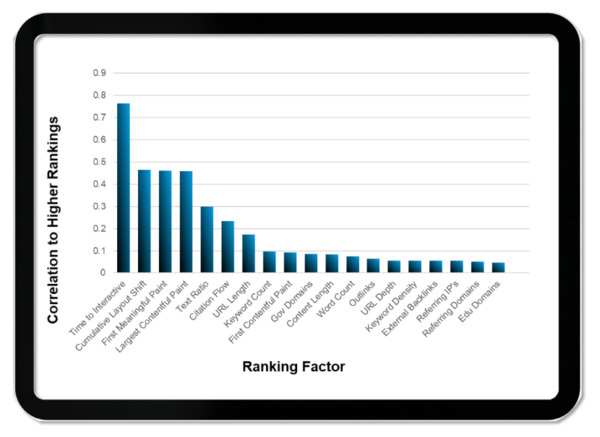
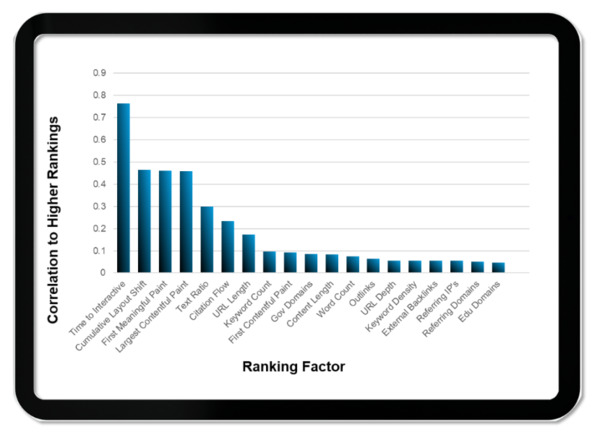
In a recent study, BrightEdge tracked 6,000 e-commerce keywords across 10 search categories over the past three years and analyzed the patterns in the data. Among a slew of ranking factors, Core Web Vitals had the greatest correlation to higher search result ranks. 

Deploying Priority Hints 

Currently, Priority Hints is in what Google calls origin trials with browser support slated to roll out with Chrome 96, which is scheduled to release on November 21, 2021. Interestingly, Google ran an origin trial for Priority Hints two years ago but received limited interest. With Core Web Vitals taking on greater importance, the participation will likely be much higher this time around. 

To participate in the origin trial, developers must register here: https://developer.chrome.com/origintrials/#/view_trial/365917469723852801

TIP: To evaluate if and how to apply the “importance” attribute, developers can check the priority assigned to different resources by using the Chrome Dev Tools network tab while loading a page and viewing the “priority” column. 


E-Commerce: Build the Perfect Category Page

What is a Category Page? 

Category pages organize products into purchase paths for the consumer. At the highest level, they typically live close to the homepage in the website hierarchy and depending on the depth of an e-commerce site’s offering, can branch into multiple levels of sub-category pages. Regardless of their position in the website hierarchy, category pages feature multiple ways of sorting products, and their primary purpose is to help the user learn and discern between products, brands, price points, etc. Put more simply, they help shoppers shop.  

Why Focus on Category Pages? 

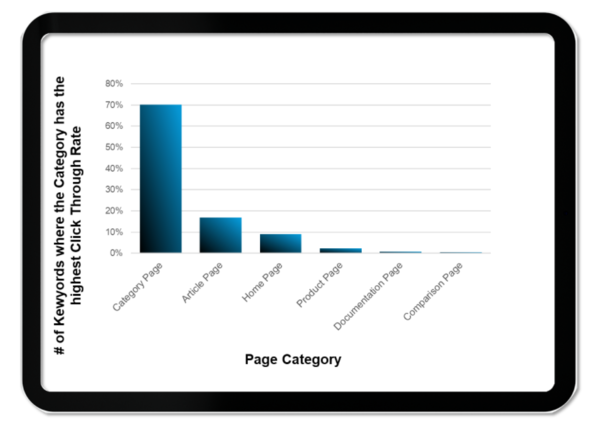
For e-commerce retailers, the ultimate goal is sales. With consumers transacting mainly on product pages, understandably, there is a lot of attention paid to the product page, its components and easing the path to a sale. So, how does a consumer find their way to a product page? If we trace back a sale to its origins, 87% of consumers start with search. In late 2021, BrightEdge published an E-Commerce Holiday Shopping Guide that gives insights into consumer search behaviors based on roughly 6,000 e-commerce keywords tracked across 10 categories over a period of three years. The study revealed that category pages – not product pages – earn the most clicks, and it’s not even close.   

How not close is it? In the customer journey for the keywords we evaluated, category pages that appeared in the results had a 70% click-through rate

The dominance of category pages in search clicks reflects a traditional search and compare shopping behavior, which differs from targeted buying behavior. Consider how consumers shop in-store at a grocery store, for example. Some portion of consumers know precisely what product and brand of that product they are looking for and go directly to purchase that item: house brand, low-fat milk, perhaps. This is a targeted product buyer. Another grocery shopper is looking to purchase a block of cheese but doesn’t have a particular variety or brand in mind. The cheese shopper will peruse the many options comparing varieties, brands, prices, etc. This is a category shopper.  

With category pages capturing the large majority of clicks in search, we can infer those consumers coming from search are largely in a search and compare mindset. Lending additional credence to this conclusion are a couple of additional data points from the research: 

  • The sites winning the most clicks don’t necessarily rank for the most keywords, which further indicates that category pages are winning more high value keywords than unique product pages 
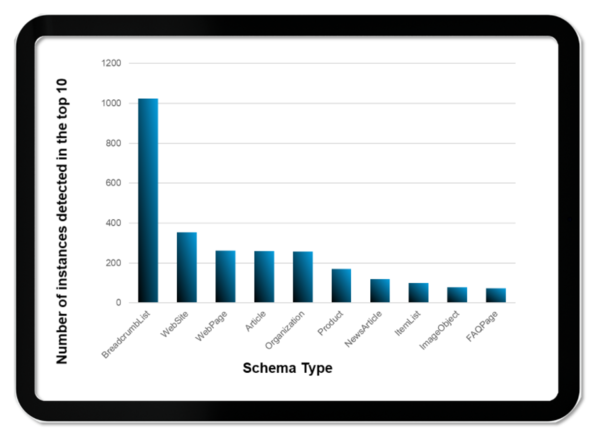
  • Among the most common schema types that are winning e-commerce rankings, breadcrumb lists – a navigational element tying product pages to and from category pages – are the most common by nearly three times the next-most common schema type. 

The Anatomy of an Effective Category Page 

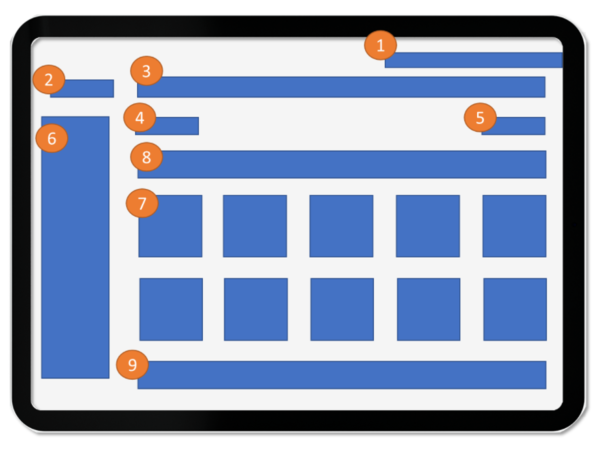
The perfect category page will depend somewhat on the unique audience and nature of the e-commerce product offering, but there are some best practices to ensure that category pages effectively secure meaningfully high search rankings for relevant keywords, and deliver an intuitive and positive customer experience. 

1. Address, phone numbers, live chat link – provides an alternative path for consumers who may prefer another method of contact or don’t immediately find what they’re searching for, helping convert sales both online and offline; From an SEO perspective, given what we know about shopping behaviors, these features could reduce click-backs and improve dwell times, which will help your SEO 

2. Breadcrumb list (with markup) – serves as a navigational trail to quickly direct consumers either back to where they came from or to a neighboring page in the website hierarchy that better matches what they’re looking for; helps the search engine understand how the contents of the page relate to other topics or categories and makes it possible for the search engine to crawl adjacent content 

3. Top level navigation for other categories – enables consumers to navigate more generally beyond the current category; helps the search engine crawl the larger site  

4. H1 tag – tells both the consumer and the search engine what the page is about  

5. Sorting option – enables the consumer to organize the contents of the page in a way that aligns with their shopping priorities; Helps with E-A-T (expertise, authoritativeness, trustworthiness) for SEO by establishing expertise for a given set of products 

6. Faceted search (by price, color, size, etc.) – enables shoppers to narrow the contents of the category page to better identify options that match their requirements; helps search engines understand the context of your page and how the user can navigate it; helps build long tail keyword relevance 

7. Categories – preset sub-categories help shoppers quickly navigate to relevant product pages (photos here can be especially helpful for the shopper who knows they need a bolt with a sharp end and a hex head, but doesn’t know that it’s called a lag bolt, for example); like with faceted search, helps search engines understand the context of your page and how the user can navigate it, and helps build long tail keyword relevance.

8. Promotions and relevant offers with hero image – while not strictly necessary, this real estate is often used to ratchet up interest from shoppers and help keep them on the site – especially for commodity categories and products – by giving them a reason to try to find what they’re looking for and purchase on the site 

9. FAQ and supplemental content – Giving shoppers answers to common questions, brand reviews, links to new or popular products in the category and the like, offers another path to fulfilling the shopper’s search; helps the site form SEO content relevancy and influences “People Also Ask” results, expanding the content’s footprint in search results pages 

Key Takeaways and Next Steps 

One final observation from the BrightEdge e-commerce research is this: product carousels in search results have declined over the three-year period from 2019 – 2021. Category pages, instead, are the new product carousel.  

To help you make the most of the upward trend in category page clicks, here are some guidelines to bear in mind as you evaluate and update your category pages: 

  1. Ensure related categories and sub-categories are easily viewable 
  2. Ensure phone numbers and store locator buttons are easy to locate on category pages 
  3. If using faceted search elements, ensure they have schema elements to help search engines understand context 
  4. Include FAQ content or easy links to it 

Finally, to better understand how consumers are shopping on your site, examine the traffic patterns across your category page links, breadcrumb lists and other navigational elements. Are you seeing people entering the website from search primarily on category pages, too? Where do they go once they reach the site? How often do they abandon the website and can you spot any patterns of abandonment that indicate a problem or opportunity? 

By implementing category page best practices, you will have a strong foundation for attracting search traffic, which in turn, can help inform tweaks and modifications that will maximize shopper interactions and transactions.  

Start Your Social Media Holiday Marketing Plan Now

Running a successful social networks marketing prepare for the holidays, now is the time to begin. The holiday is a huge deal for every single business. Americans invest an average of $ 998 on gifts throughout the holiday.

With numerous people out shopping, customizing a marketing method is important to take advantage of the spending is a terrific way to improve your service. Why Social Media? A social networks technique is one of the most important parts of a marketing prepare for businesses. In 2020, over 3.6 billion people were utilizing social networks around the world. By 2025, it is estimated that there will be 4.41 billion users. Having a reach within social media is a fantastic method to develop your brand, share promos, and educate your

audience. The key to running a successful social networks strategy is to consist of 2 important aspects- social selling and social networks marketing.

No, they are not the very same thing.

Social selling is a strategy utilized to eventually lead to sales, not direct selling. For instance, developing brand name awareness has to do with getting your name out on the planet so people will recognize it. Normally, purchasers are exposed to a name 7 times before buying from them. This is called the marketing rule of 7 for obvious reasons.

Social media is a terrific location to get leads and nurture them, which likewise falls under the social selling umbrella. Why? Because leads are not constantly direct offers. Normally it is about building that recognition and establishing a relationship.

Social network marketing is particularly about conversion. This indicates getting someone to click a link and visit your website, hopefully making a sell.

These 2 objectives of a social media technique are associated and similarly essential. Producing a vacation marketing strategy that leverages both parts can increase potential vacation offers and important organization increasing power.

Producing a Social Media Holiday Strategy

Prior to you can carry out a strategy, you must prepare one out. There are 4 basic actions we recommend utilizing to produce your technique.

Step 1: Review What You Have Already Done.

Unless you are a brand brand-new business, you need to never ever go into the holiday season blind. Collect any details from in 2015 for a better concept on how to pivot this year. Ask yourself some basic concerns:

  • Which techniques did you use?
  • What worked?
  • What did not work?
  • How typically did you publish?
  • Which images did you use?

From utilizing this information, it can help guide you plan your marketing strategy. Knowing which pages are best checked out can assist you understand if there are seo strategies you can try.

Step 2: Set Realistic Goals.

Before a business can be effective, they should identify what success will appear like. Are you wanting to offer a quantity of a specific product? Is your goal a total number in earnings? Or is your focus building up fans for the next year to press approaching items?

Keep your objectives practical so you can attain them, but also stretch yourself. Knowing what your objectives are can assist drive choices and assist groups focus. Setting them too low is unmotivating but setting them too high sets everyone up for failure. Utilize your goals to understand what instructions you wish to go and assist clear up your strategy.

Action 3: Make a Calendar with Your Strategic Content

When it comes to material and a terrific strategy, timing is everything. Take time to plan out when you will do particular posts. Are you setting up a deal for Black Friday? What about Cyber Monday?

Other things to consider include offering a last-minute holiday discount, highlighting the last day to get on-time or complimentary shipping, feature particular products each day, or publishing an informational post on how to use your items in various methods.

Another crucial action to your calendar is knowing where you will post your material. Making use of all the social networks platforms is an excellent way to spread the word during the holidays. Here are some reasons to think about each platform:

Knowing that your audience is most likely on all social networks venues implies your business must be there too. Adapt your technique to each platform to use each one most efficiently.

The majority of business struggle with what to publish beyond features or offers. Get innovative- use vacation themed or vacation inspired themes. Know your clients and attempt to get their attention. Attempt advertisements of all kinds. Use graphics and jokes, just be clever and think outside package.

Step 4: Track Your Metrics

Tracking the metrics on your strategy helps you understand what is working and what isn’t. If you observe that some social media posts are working better than others, or one platform is performing much better, you can adjust your technique. Some key metrics to see can be:

  • Comments and impressions
  • Shares, follows, and mentions
  • Reach of each post
  • Click-through rates from each platform
  • Total purchases
  • New check outs
  • Recommendation traffic and total leads
  • Landing page views

Not just can these assist you adjust your strategy throughout the holiday season, however they can likewise assist all future techniques going forward.

Getting Professional Help

Call us today for a proposal if you are still unsure how to get started or want someone to run your holiday method for you. Our SEO services consist of social media marketing and website optimization, which suggests we are SEO professionals that can assist enhance your site and strategy for ideal tactical results.

Just don’t wait too long- the faster the much better when it concerns developing an effective social networks vacation method.

Need aid discovering the right domain? We can help. Talk to a domain expert today.

or call 1-800-351-9081

< div class=”et_pb_module et_pb_text et_pb_text_5 et_pb_text_align_left et_pb_bg_layout_light” > Nullam malesuada arcu sed magna tincidunt pharetra. Praesent ut lacinia risus, a ultricies erat. Fusce a elit fringilla, aliquam ante air conditioner, tincidunt turpis. Quisque.

Lorem ipsum dolor sit amet, consectetur adipiscing elit. Ut dictum est fermentum enim hendrerit, ut rutrum ante vulputate. Fusce rhoncus, risus nec condimentum tincidunt, ligula nisi semper diam, et pretium lacus elit a/c lorem. Donec facilisis ex a ipsum porttitor laoreet. Aliquam sit amet justo justo. Phasellus feugiat porta felis eget interdum. Nunc quis suscipit sem. Nam placerat risus eget ultrices tristique. Suspendisse rhoncus egestas mi, air conditioner suscipit mauris accumsan in. Morbi nec consequat nisl.

Integer eget ante sed tortor vehicula facilisis at eget enim. Fusce cursus, libero sed maximus tristique, massa ipsum scelerisque quam, non sagittis ipsum leo eu massa. Nulla fermentum malesuada enim, porta ultrices mauris interdum nec. Nullam tellus lacus, fermentum a massa sit amet, rhoncus luctus enim. Cras commodo sapien diam, sed rutrum elit placerat a. Quisque accumsan sagittis magna, a/c suscipit mi varius vitae. Vivamus eleifend, tortor vitae lacinia auctor, sem velit porttitor augue, id congue felis justo a nibh. Donec id cursus arcu, ut imperdiet felis. Sed sollicitudin at sem nec porta. In tempor sed nulla vitae imperdiet. Ut vel ex elit. Nam sit amet leo risus. Sed sit amet luctus ipsum. Nunc risus elit, laoreet sed enim vel, iaculis sollicitudin dui.

Cras vel nisl ut mi condimentum fermentum porttitor quis risus. Quisque gravida malesuada purus, a fermentum ante semper et. Suspendisse condimentum dolor sem, at finibus nisl consectetur et. Integer ac pellentesque ante. Praesent et vulputate quam. Phasellus iaculis, quam id dignissim molestie, quam tellus luctus mi, vitae bibendum justo risus ut purus. Mauris volutpat, leo vitae porta luctus, nisl lectus facilisis leo, non dignissim libero velit ut nibh. Phasellus ultrices est sit amet accumsan posuere. Mauris nec nibh at purus tempor egestas. Sed consequat massa sed purus vestibulum, eu facilisis ipsum blandit. Donec at ante sit amet dui laoreet euismod. Suspendisse potenti. Sed pharetra sapien in tortor rhoncus finibus. Donec non sapien euismod, gravida eros nec, dignissim magna. Duis nec nulla vel erat lobortis condimentum nec at diam. Nulla lorem libero, tincidunt mattis ultrices a, volutpat eget ipsum.

Nullam malesuada arcu sed magna tincidunt pharetra. Praesent ut lacinia risus, a ultricies erat. Fusce a elit fringilla, aliquam ante air conditioning, tincidunt turpis. Quisque.

Aenean ut felis tellus. Maecenas tellus lectus, semper in scelerisque sed, dapibus lobortis urna. Sed sit amet massa tincidunt, tempor purus non, ultrices eros. Curabitur efficitur auctor justo, id dapibus leo ultricies sit amet. Vivamus scelerisque libero orci, quis ullamcorper nibh ornare non. Integer tempus, nisl et elementum dignissim, dolor metus molestie turpis, eu consectetur lectus tellus a/c dui. Vivamus ut viverra odio. Vivamus suscipit, est vel maximus commodo, felis sapien tincidunt mi, eu elementum libero magna vel mauris. Nullam tincidunt imperdiet ullamcorper.

Nullam malesuada arcu sed magna tincidunt pharetra. Praesent ut lacinia risus, a ultricies erat. Fusce a elit fringilla, aliquam ante air conditioner, tincidunt turpis. Quisque.

Proin sit amet mi a/c turpis lobortis faucibus quis sit amet metus. Etiam air conditioner tristique urna. Maecenas at viverra nisl, interdum auctor nibh. Donec finibus tortor rutrum, rhoncus mi vel, tempor massa. Vestibulum vel nunc euismod, tristique lacus a, scelerisque ligula. Integer vestibulum ipsum ut mi posuere, sollicitudin auctor elit efficitur. In efficitur massa quis eros facilisis venenatis. Vestibulum nec condimentum quam, placerat lobortis orci. Aliquam a odio eget ante suscipit consectetur iaculis in purus. Suspendisse bibendum neque at semper egestas. Maecenas tempus congue placerat. Proin aliquet arcu venenatis, molestie justo ut, viverra libero. Pellentesque at ipsum commodo, tristique metus sit amet, condimentum arcu.

How to Prepare Your Site Now for Holiday Shopping Traffic

Now is the time to start optimizing your website for all the potential holiday shopping traffic that is headed your way. While the genuine shopping season does not officially begin for a couple months, your online efforts need to begin right now in order to maximize this chance. Numerous companies count on the holiday season to reach their sales goals, but constantly wind up scrambling to manage the higher levels or traffic or frantically attempting to draw in more consumers at the last minute.

You can begin to prepare your site right now and make sure this holiday season goes as efficiently (and profitably) as possible.

Start with an SEO Audit

An SEO audit will look closely at a number foundational aspects that might have an effect on your website’s efficiency. It needs to cover everything from a range of technical concerns and structural concerns to on-page SEO performance and more.

A constructive audit will be more than simply a criticism of all the important things that aren’t rather right. It ought to likewise assist you find new chances and take advantage of the approaching capacity.

Either way, your audit needs to supply the info you require to make an actionable plan, which includes:

  • Load times— People remain in a hurry throughout the vacations. Even a second or 2 hold-up in the average load times can seriously increase customer frustration and decrease conversion rates. You can’t pay for those losses during the holiday season. Ensure your content and images are filling properly. If that doesn’t speed things up, it might be time to look deeper into the website architecture and find other ways to reduce load speeds.
  • Mobile friendliness— The variety of people going shopping online is higher than ever (thanks to particular world events), and more of these customers are likewise going to explore their options on their mobile phones. This is especially real with last-minute consumers who believe: “Oh right, I forgot to get Soandso something this year. I better order it now.” They’re going to pull out their phone and order something before it slips their mind.
  • Bounce rate— Are your visitors immediately leaving your site? Are they going without making a purchase? Are they abandoning the shopping cart, although they’ve packed it up with possible purchases? All of these things contribute to a high bounce rate, and it’s important to tackle these concerns to guarantee your holiday traffic does not have a factor to leave without buying.
  • Keyword research study— It takes time to begin ranking for brand-new keywords, however this audit can show you how you’re performing for specific words and expressions and assist you determine how a couple of simple shifts in your method can be extremely helpful for the holiday season. Start targeting the keywords that suggest the user is ready to buy, such as phrases that consist of words like “inexpensive,” “shopping,” “in stock,” “for sale,” “purchase,” “for Christmas,” etc.
  • Material chances– What content will your consumers see initially? What are they trying to find when they show up? There are numerous chances to add some brand-new content to address consumer concerns and motivate them to act.

Like the majority of other things in SEO, an audit will take some time to do it. Yes, it’s possible to get a quick list of site mistakes, dead links, and other data, however an excellent audit needs to go much further than that.

This audit has to get at the root of any problems and discover how the problems and their corrections can cause new chances for your site and organization.

Download How to Conquer a Competitive Industry with Internet Marketing

Don’t Wait to Dive Deep into Your Website SEO takes time. It requires time to find the concerns. It takes time to execute the corrections, and much more time for the online search engine to see your updates and make the proper adjustments in your rankings. It takes time to identify what’s working and put a strategy into action to construct on those successes.

Simply put, if you wish to have your website all set for holiday traffic, you required to start the other day. In a pinch, beginning today will work, too.

Be Ready for the Traffic

As you work to enhance your website and provide a variety of promos throughout the season, you’re going to get a lot of traffic.

This is great– if you’re all set for it.

You could, in fact, discover yourself with the excellent issue of having excessive traffic– so much, in fact, that it slows and even crashes your site.

If that must occur, it could quickly frustrate your clients and send them to your competition.

Check with your hosting supplier and make sure that the bandwidth is there to deal with the inbound traffic.

Make Your Products Shine– For Customers and For Search Engines

Now is the time to really enhance the titles and descriptions for your product and services. This implies the actual item descriptions and titles as well as the meta descriptions and titles. Provide any other appropriate content on the page a twice and make sure whatever will appeal to your consumers and the search engines.

Take another look at the subheadings and headings, re-read the body material, and have a look at the alt qualities of the images and ensure they’re all utilizing keywords efficiently. Ensure the anchor text in any links is detailed and reliable and use a URL that is search-engine-friendly and simple to bear in mind.

Can you find chances to consist of new keywords naturally? Can you make the entire experience more attractive to your customers? Your website SEO services should cover all these elements. But that’s not all.

Does the site design feel obsoleted? Will a holiday-related style assistance you out this year? Possibly you just need to take this opportunity to discover and execute little enhancements to make the style more easy to use, such as navigational enhancements, brand-new images, and much better calls to action.

Get Your Promotions in Order

Whether your promotions are for the Black Friday rush or as part of a prolonged holiday offer, you need to prepare your website to handle it efficiently.

And the quicker the much better.

This implies creating the pages, developing the project, prepping the social networks posts, and creating new graphics and headers that highlight the promo. Any promotion codes should likewise be checked for accuracy and functionality.

Be clear about the information of the promotion. If you can’t deliver it in time for the vacations, you need to make that clear. As soon as stock or capability goes out, you require to take the promotional page down so nobody feels the disappointment of losing on a lot even if they were a day or even a few hours late.

Even if you aren’t marking down products or creating some kind of unique sale, you can seize the day of the season and feature some of your most profitable or popular products throughout the website. Include them front and center on your homepage and advise them on other, pertinent, pages.

Produce the Perfect Landing Page for an Aggressive PPC Campaign

Google Ads and paid marketing on social media can be very effective for numerous business, particularly if they don’t have time for a full-blown SEO project. PPC gives you the opportunity to get a lot of the vacation traffic since you can target really particular audiences and guarantee they see the products they’re interested in.

Nevertheless, it’s crucial to remember that this requires careful management. Prices might quickly go up as lots of rivals quote for the exact same, financially rewarding keywords. You don’t want to get sucked into a bidding war if the results aren’t going to pay.

Once you’ve got all that down, however, you’re going to need a reliable landing page (or pages) on the website to keep these visitors approaching a purchase.

Yes, you could connect your PPC campaign to your normal item pages, and this can work well enough in lots of situations, however you can truly drive house the vacation promotion by creating landing pages particularly for the season.

A great landing page will make it easy for anyone to purchase your items. Do not weight the page down with unnecessary info. Make the headers clear, and the path to checkout even clearer. Highlight the advantages of your item, however it’s alright to assume that is somebody has actually gotten here on this page from your advertisement, they’re currently interested in the product. You just need to reveal them how to take the next step.

Start Now

If you missed the “entirely subtle” tips spread throughout this post, SEO takes time. If you wish to get your site prepared to bring in and transform all the potential vacation traffic, you require to start now.

Get preparation, get working, and get the outcomes you want. It starts with a deep audit of your site and doesn’t end till the season is over.

Video Marketing: The Definitive Guide


Template #1: The How-to Video

The How-to Video is just like it sounds…

It’s a video that shows someone how to do something, like bake a cake or do a pushup.

For many businesses, how-to videos will be your bread-and-butter. In fact, how-to videos are like a video version of blog content. They’re not designed to convert people right then and there.

But how-to videos ARE great for getting your brand in front of potential customers. So, along with product demos, I recommend using them in your video marketing.

Here’s the template:

Template: The How-to Video

Let’s break each element down.


Intro=Video Preview

The main goal of your preview is to let your viewer know they’re in the right place.

In other words:

There’s no need to tell people why your topic is important. If they landed on your video, they already know it’s important.

This is a mistake I made a lot with my early videos.

Instead of jumping right into the content, I’d go into a long backstory.

Spoiler alert: people HATED these intros. And they clicked away.

(Not to mention the fact that, again, I really needed a haircut. 🙂 )

Today, my intros are short, sweet and to-the-point.

Which has dramatically improved my average Audience Retention.

YouTube analytics – Audience retention

Steps or Tips

Now it’s time for the meat of your content.

Depending on your video, you may outline a series of steps. Or give people a list of tips.

For example, this video from my channel lists out a series of 9 traffic strategies.

On the other hand, this video outlines a specific step-by-step process.

If you watch those videos, you’ll notice that the structure is basically the same.

The only difference is that the steps are in a particular order. While the strategies can be in pretty much any order.

That said, there’s one BIG thing to keep in mind with this section of your how-to video:

Keep things moving.

In other words: there’s no need to cover everything there is to know about a step or tip. Yes, you should cover each step in-depth. But as soon as you’ve covered the basics, it’s time for the next step.

Why?

Well, it’s no secret that people online have super short attention spans. And if you go on and on about the same topic, you’re gonna lose your viewer’s attention.

For example, I used to spend 2-3 minutes on a single step or tip.

And people got REALLY bored.

Today, I spend about 30-60 seconds per tip. And then move right into the next thing I want to cover.

That way, my video content moves fast… which keeps people engaged.


Wrapping Up

Now that you covered your last step, what’s next?

Well, I don’t recommend ending your video out of nowhere. That’s super jarring.

Instead, you want to quickly cover 3 main things in your video conclusion:

  • A quick recap
  • Examples
  • Next steps

For example, in this video, I recap things with:

Quick video recap

Note that I don’t repeat the same tips they just heard about.

Instead, I quickly outline what they learned… and start to transition into the end of the video.

And if you have any more examples of how this process helped you, a customer or a friend, mention them here. You probably already mentioned a few examples in the steps section of your video. But feel free to add one more here.

This final example gives people motivation to take action on what they just learned.

Finally, let people know the next steps.

If they’re watching your video on YouTube, it might be to subscribe to your channel.

If you’re hosting your video on your own website, you might ask them to subscribe to your newsletter.

Either way, make sure to cap off your video with a clear set of next steps.

Here’s an example:

End of video – Next steps

Tie SEO to Business Objectives to Secure Resources and Executive Buy-In

Organic search remains one of the most powerful channels for marketers. Success in the channel relies, in large part, on well-reasoned and well-executed SEO strategy, but the work of SEO is too often misunderstood or undervalued by the business. As a result, getting buy-in for even seemingly obvious SEO projects can feel like an uphill battle. That’s why it’s just as important to translate the purpose and benefits of SEO for key stakeholders in the business as it is to have the right SEO strategy.    

For brands, especially those with large-scale websites, even seemingly minor initiatives can require substantial investments of money and people to execute well. Securing organizational buy-in to the value of any project requires the SEO team to: 

  1. Translate the initiative’s benefits for multiple audiences to win initial buy-in. How does the initiative drive better marketing results? How do the better marketing results support the larger business objectives? 
  2. Communicate the results of the initiative following implementation.  

1. Translate the benefits of SEO 

Let’s explore three examples of SEO initiatives and how they translate for a digital marketer and for an executive. In simple terms, our goal is to answer for each audience, “What’s in it for me? / Why should I care?” 

So, how do we make something that’s often viewed as cryptic and tactical into something that will excite a digital marketer and executive approvers? We frame it in terms of their priorities. 


EXAMPLE 1: SEO CONTENT OPTIMIZATION INITIATIVE 

Implement Bulleted Lists with Schema to Appear in Google “Quick Answers” Results for a Keyword   

SEOs know that providing context for content on the page can be critical for winning universal search results and promoting elements of the site that are zero-click.  One area where this can be helpful is to win the quick answer result for a given query.  Using schema tags to help search engines understand the context of the content can influence an algorithm to use your content for the quick answer. Winning this result in a search result means more visibility, more clicks and better positioning for your brand. Make sure other stakeholders in your organization understand and appreciate the impact on company performance. 

SEO RESULT: Win incremental and highly coveted real estate in the SERP (search engine results page) and provide the right experience for zero-click results 

MARKETING RESULT: Expand reach by engaging audiences that are unlikely to click on traditional SERP links 

BUSINESS RESULT: Grow revenue by capturing missed revenue opportunities in organic search 


EXAMPLE 2: SITE AUTHORITY INITIATIVE 

Secure backlinks from .gov sites required to compete for a set of keywords  

In some instances, SEOs still need to engage in backlink campaigns. White hat methods for obtaining backlinks are a collaborative effort that requires input from PR teams and other stakeholders in the organization. But in some cases, if your site doesn’t have the authority or credibility to win a first page result for a competitive query in an important space, you may need to build links from authoritative sites such as government or education resources. This can be challenging for SEOs because not only can this require significant work and sometimes financial investments (licenses, published studies, etc.), but the concept of backlinks isn’t always readily understood outside marketing. As a result, SEOs need to translate this tactic’s benefits into things that are more universal.  

SEO RESULT: Secure page-one search rankings for difficult-to-win YMYL (“your money or your life”) queries  

MARKETING RESULT: Solidify brand credibility and improve qualified traffic 

BUSINESS RESULT: Reach a greater volume of qualified customers  


EXAMPLE 3: TECHNICAL SEO INITIATIVE 

Implement Hreflang Tag Across Sites Serving Multiple Regions  

SEOs know that the hreflang tag is essential if you’re working with sites in multiple regions with multiple languages. It helps ensure that proper content is being served to the proper country, but to non-SEOs, “Hreflang Tag” could just as easily be the name of a Danish heavy metal band.

Implementing hreflang tags correctly across multiple sites with multiple stakeholders can be resource-intensive and, as a result, risks being de-prioritized if the stakeholders don’t fully understand how misaligned pages can be detrimental to the user experience and ultimately undermine marketing and business goals. That’s why it’s important to connect the SEO result to marketing and business results.  

SEO RESULT: Search engines can properly index content for their intended regions 

MARKETING RESULT: Improved engagement that ultimately drives more traffic 

BUSINESS RESULT: Expanded regional visibility and more qualified visitor conversions 

While simplistic on the surface, these translations are a meaningful and powerful enough starting point to engage key stakeholders in a conversation about the value of each initiative. Support the conversation with historical insight into the SEO problem and post-implementation impact projections. Start by building allies within marketing and team together with them to win support from executive decision makers. Oftentimes, you’ll gain more than approval, you’ll win advocates that will support the initiative beyond the initial approval.    

2. Communicate the results of the initiative 

Securing approval for future SEO initiatives begins before you even know what those initiatives will be. It starts when you report on the outcomes of the current initiatives.  

In order for reporting to scale company-wide, you must: 

  1. Automate repetitive reporting and data collection 
  2. Simplify how your company sees SEO insights 
  3. Orient your data to what each team cares about 
  4. Reduce friction between data and insights 

AUTOMATE REPETITIVE REPORTING AND DATA COLLECTION 

One of the biggest challenges SEOs face is managing and reporting on the data the practice generates.  This problem is compounded as the SEO program expands and acquires new stakeholders. Our internal studies show that SEOs can spend up to 4 hours a day cobbling together reports using various point solutions. In order to mitigate this work, eventually data collection, synthesis and organization needs to be consolidated and automated in a cohesive enterprise SEO platform. This often requires investments in time and money. Because the benefits are not always understood by people outside the SEO organization, it becomes imperative for the SEO to demonstrate how this time reduction will lead to higher ROI and increased value from the organic channel.  

SIMPLIFY HOW YOUR COMPANY SEES SEO INSIGHTS 

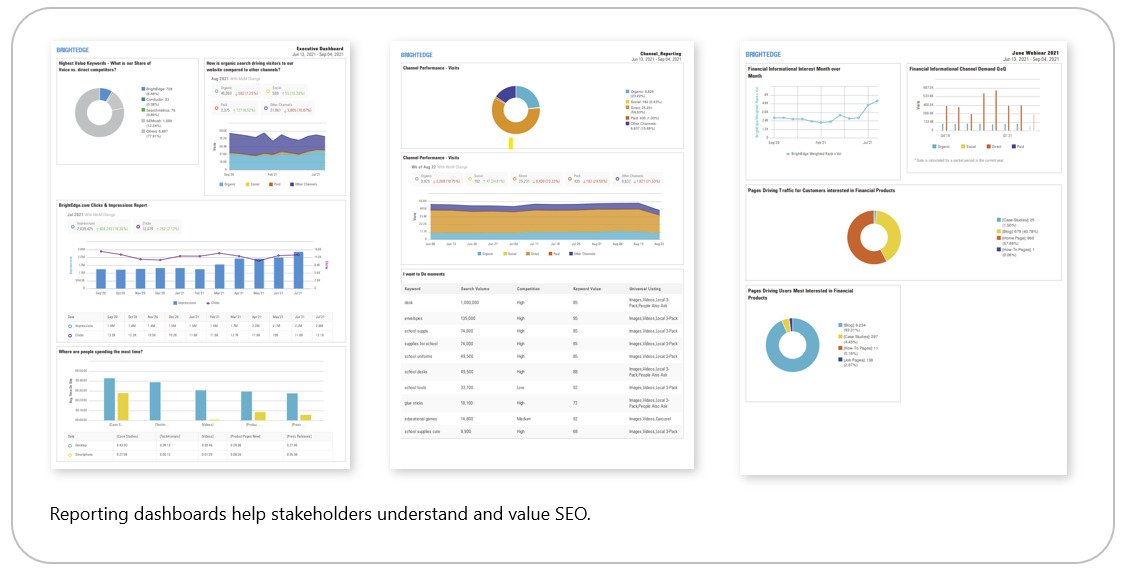
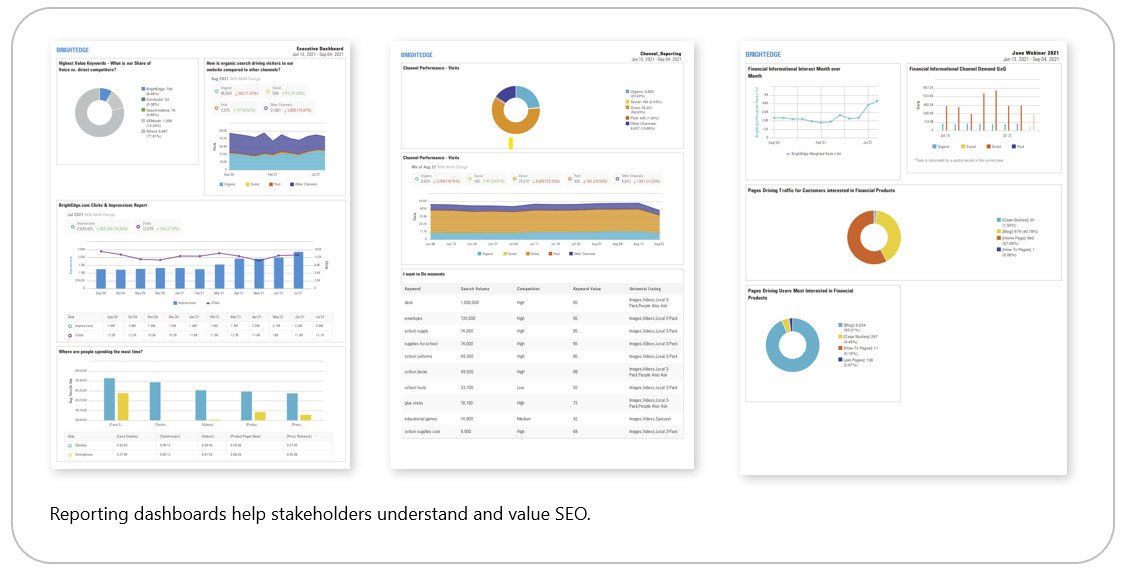
The reporting itself works best when it is straightforward and easy to understand quickly. One of the best ways to achieve this is with reporting dashboards. Proper dashboards offer at-a-glance insights into performance, and personalized, on-demand access for stakeholders that – once you’ve set up the dashboard – frees you up from repetitive and time-consuming report refreshes.

Reporting dashboards help stakeholders understand and value SEO. 

ORIENT YOUR DATA TO WHAT EACH TEAM CARES ABOUT 

As before, it’s important to translate the results in a way that is meaningful for the audience. In this case, frame results in terms of the benefits that were promised at the outset. If improved traffic was forecasted, report on relevant traffic data. If an uptick in revenue was promised, track key sales metrics for the impacted keywords and pages.  

REDUCE FRICTION BETWEEN DATA AND INSIGHTS 

As SEO programs scale, they begin to involve different groups with different perspectives. Technical teams may be looking at an opportunity one way, while content teams may be looking at it from an entirely different perspective. This issue gets compounded if the teams aren’t basing their insights on the same data sets. As a result, it becomes critical that there is a single source of truth in the organization for things like rankings, crawl activity and business performance so the group can make decisions based on a shared reality that still respects each stakeholder’s unique perspective. Consolidating data sets, tailoring reports by stakeholder audience, and automating ongoing report generation help reduce the friction inherent in turning data into actionable insights.    

Change Minds by Changing the Approach 
SEO doesn’t happen in a vacuum. It’s informed by, among many other things, the actions and goals of the larger enterprise. By collaborating with the business at-large, SEO takes on greater purpose in the organization.  

Framing SEO in terms of how it supports the business is essential to acquiring the resources to make an impact. Reporting on the impact of SEO is essential to acquiring the resources and clout to keep making an impact.       

BrightEdge SEO Platform 
If you would like to learn more about how BrightEdge can help you better make the case for SEO, execute winning strategies and facilitate robust and time-saving enterprise-wide reporting, schedule a demo today.   

Google Title Update: Everything You Need To Know

Over the past few weeks, one topic has clearly dominated the SEO community: Google’s recent title update. Since mid-August, Google has been rewriting page titles of search results much more often, which leads to title tags (also called meta titles) being displayed less frequently in SERPs.

After the change has been strongly criticized by some SEOs, Google finally followed up with a second update last Friday, along with a new blog post that contains more information about its new system for generating page titles.

Keep reading to learn how the new system works, in which cases Google is rewriting your title tags, and how you can make sure your website’s SERP snippets still attract as many visitors as possible!

Table of Content

How did Google generate page titles in the past?

To understand the scope of the current changes, we first need to take a look at how Google used to generate page titles for search results in the past.

In most cases, Google just used the title tag of a web page:

title tag of the Seobility home page

Snippet of the Seobility home page

But as this tag might not provide the best possible title for each potential search query, Google started generating alternative titles in 2012 to provide more relevant results for individual searches.

In addition, Google adjusted page titles or replaced them with other content on a page (e.g. headings) if…

  • … the title tag was missing or empty
  • … the title tag contained generic content (e.g. “home page”)
  • … the same title was used for multiple pages
  • … the title was unnecessarily long or hard to read

But besides truncating title tags that are too long, Google rarely changed page titles. In most cases, you could expect your title tag to be displayed in search results as long as it was complete and unique.

What changed in August?

From mid-August, many SEOs, including Brodie Clark, started to notice that Google was changing many more page titles in the search results. And in many cases, it wasn’t clear where the new title came from.

These observations led to a high level of confusion and criticism among SEOs. Hence, Google published an official blog post on August 24 explaining that they updated their system for generating page titles.

According to this post, Google will no longer generate different titles depending on the search query. Instead, the new system improves page titles regardless of the search query if Google deems this necessary. Back then, Google said that the title tag will only be displayed in 80% of cases (although they updated this number to 87% last week – more on that later).

In addition to that, Google uses even more other website content besides the title tag for generating page titles – especially content that is directly visible to website visitors (e.g. (H1-)headings and other elements that are visually highlighted). They might also use other text on a page or link anchors of referring pages.

Google’s main goal with that update is to improve users’ search experience by generating easy-to-read page titles that describe the page content in the best possible way. If Google thinks that the HTML title tag doesn’t serve this goal, they rewrite it. Google shared a few examples of their rationales:

  • HTML title tags that are too long
  • title tags that are stuffed with keywords
  • title tags that are missing or containing generic content

To improve readability and relevance, Google might only show titles that are too long in part, append the website’s name, or replace the title with other page elements.

To summarize:

  • Google is rewriting much more page titles after the update
  • Google is making more use of other page elements such as headings for generating page titles

Let’s take a look at some real-world examples.

Example

Here’s how Google rewrote the title of one of our wiki articles:

The HTML code of that page includes the following title tag:

title tag of our ftp wiki article

But Google displays this title in the search results:

search snippet of our ftp article

Instead of the title tag, Google is using the page’s H1 heading (“FTP (File Transfer Protocol)”) and is appending the site name. We think that Google changed the title because the important term “File Transfer Protocol” was missing in the title. We saw a similar pattern for other rewritten titles as well:


title tag of our cms wiki article

search snippet of our cms article

What strikes us most, however, is that these title tags don’t fit into any of the categories Google described. So there seem to be more reasons for rewriting page titles than the few examples mentioned in Google’s blog post.

What are other reasons for rewriting page titles?

A recent study by Moz found a few more reasons why page titles might be rewritten.

For example, Google seems to be extending page titles that are too short (and in some cases, the additional text could be found nowhere on the page).

short title is extended by Google
Source

Another interesting result: Google seems to be modifying titles that contain superlatives or marketing language, and replaces them with more neutral alternatives.

superlatives are replaced
Source

Besides extreme cases of keyword stuffing, the study found that Google also rewrites less critical titles where multiple words are strung together. Google seems to be pretty aggressive with such titles, even if they’re not spammy or deceiving.

title with multiple words strung together is replaced
Source

In addition, the study could replicate some of the ways titles are rewritten that Google described:

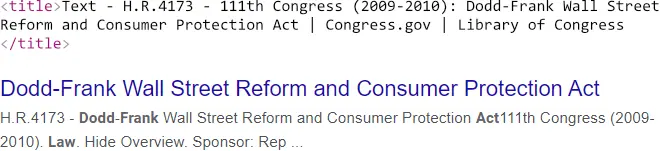
Titles that are too long aren’t simply truncated at the end but shortened in a more advanced way, e.g. by extracting their most relevant parts:
long titles are shortened in a more advanced way
Source

And in many instances, Google is appending the site name or moving its position within the title:

site name is appended
Source

All in all, these changes seem to make sense but there were still many critical reactions to this update.

Reactions of the SEO community

The title update was heavily criticized by some and there were several complaints about Google replacing carefully crafted title tags through titles that performed much worse. For example, the team of Wordstream reported that the CTR for one of their most popular pages dropped by up to 37% depending on the search query after Google rewrote the title.

And there were many other sites that claimed that the changes Google made weren’t always favorable. For example, Google often used separators such as hyphens, slashes, or brackets to separate overly long titles. However, the results didn’t always make sense:
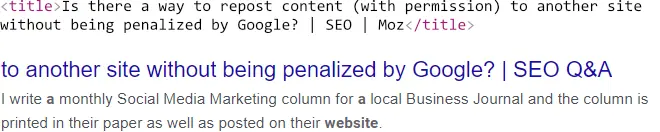
example of a bad rewrite
Source

In the example above, a simple truncation at the end of the title would have been much better than only showing the second part of the question after the brackets.

But fortunately, Google responded to the criticism shortly after.

Another title update on September 17

Last Friday, Google published another blog post where they explained that they further improved the system of generating page titles. Seems like Google actually listened to the feedback from the SEO community and tweaked its algorithms!

Google also stated that the percentage of title tags being displayed in search results had increased from 80% to 87% due to the second update.

In addition, the blog post includes more information about which type of titles are being rewritten:

  • Half-empty title tags that are often caused by templates (e.g. “| Site Name”). Google automatically extends such titles and includes more information found on the page.
  • Titles that weren’t updated while updating the page content
  • Inaccurate titles, e.g. due to dynamic content
  • “Micro-boilerplate” titles, i.e. titles that are repeated for a smaller subset of pages

It can be criticized though that Google only lists unproblematic cases where rewriting the page title obviously leads to an improvement. Other scenarios, such as those uncovered by Moz or those where the new title performed much worse, aren’t addressed in the post.

But the fact that Google is now using the title tag more often than before leaves us hoping that the system is now less aggressive and yields better results than before.

At least some SEOs noticed that the quality of the title rewrites started to improve again at the beginning of last week.

But many are still critical about the change and would like the option to opt-out of title rewrites. However, it’s questionable whether Google will make this possible anytime soon.

So what can you do now to make sure that your search snippets still drive lots of visitors to your site?

What should you do now?

First of all, you should stay calm and check how you are affected by the change.

Google clarified that the update doesn’t have any impact on rankings as it only changes how titles are displayed in SERPs.

That’s why you should mainly keep an eye on your CTR and organic traffic and check whether these metrics have been negatively affected through the update.

You’ll find the average CTR of your pages in the Performance report in Google’s Search Console.
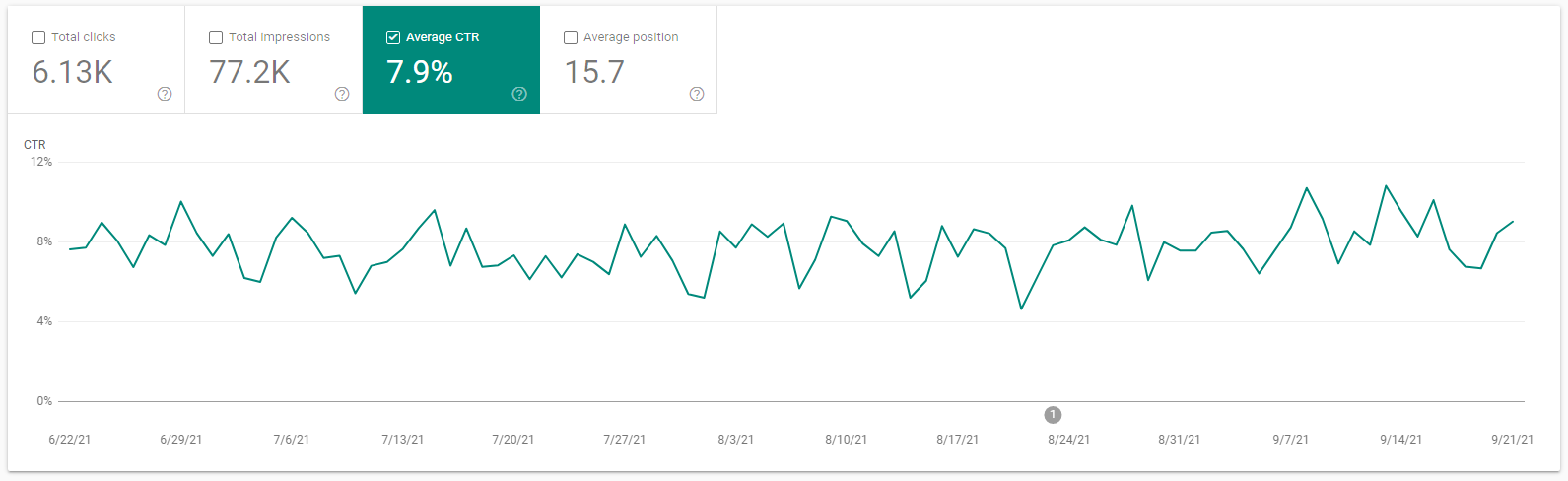
average CTR in Google's performance report

Check if the CTRs of your most important pages decreased significantly during the last weeks. If you see any negative changes, conduct a Google search to see whether this is due to rewritten page titles.

What to do if you’ve been negatively impacted

If you find that Google changed some of your page titles for the worse, you can submit feedback to Google. Google is still improving its system for generating titles and might solve that issue in the future.

If Google is showing a header tag or another element of a page instead of the title tag, you can also edit that element in order to improve your CTR. The team of Wordstream reported that this quick fix turned out really well for them.

You should also check whether the rewritten titles fall into any of the categories described above and fix the underlying problems. For example, if you find that one of your title tags is too long and Google is shortening it in an unfavorable way, you should replace it with a shorter title. Google confirmed that a title tag can be displayed again after the underlying problems have been resolved!

How to prevent Google from rewriting your page titles

At the moment, there’s no way to tell Google not to rewrite your titles but you can still lower the chances that it will happen. By writing great page titles that meet Google’s quality standards, you’re providing them with fewer reasons to rewrite your titles.

Seobility helps you identify page titles that still need improvement. The site audit includes an analysis of the most frequent issues with page titles which are basically the same issues that Google mentioned as reasons for title rewrites:

  • missing or empty title tags
  • page titles that are too short or too long
  • generic page titles (e.g. “home page”)
  • word repetitions (which can indicate keyword stuffing)
  • page titles used on multiple pages

page title analysis in Seobility

By fixing the issues listed here, you’ll be much safer from page title rewrites. If Google still changes your titles, you should evaluate whether this has a negative impact on your traffic and if a more thorough optimization makes sense (as described in the previous section).

If yes, compare the content of your title tag with the title generated by Google and try to understand what could have caused the rewrite. This can provide you with interesting insights that might even be useful when optimizing page titles in general. After all, meta titles are still one of the most important on-page ranking factors!

One last piece of advice: Focus on your most important pages when doing these optimizations. Google is still working on improving the system so it’s possible that some of the current changes might be reversed in the future.

We’ll keep you up to date!

PS: Get blog updates straight to your inbox!
seobility

The Seobility team supports you gladly with any questions regarding Seobility and the search engine optimization of your website!

Categories SEO

The Future SEO: Boardroom edition

  • 30-second summary: SEO’s vibrant nature and Google’s mysterious algorithm specifics keep the market on its toes
  • Is it possible to merely identify the inefficiencies of SEO in its infancy and visualize patterns?
  • With over 20 years of leadership functions, SEO leader Kris Jones taps into his experience to help SEOs derive more tactical worth

Practically anytime we discuss something’s future, we’re doing something called theorizing. By meaning, theorizing includes extending existing data or patterns to assume the very same procedure will continue in the future. It’s a form of the clinical approach that we probably use every day in our own lives, quite reasonably, too: the summertimes will be hot, the downtown traffic will be bad at 9 AM, and the sun will increase tomorrow early morning.

However how can we look into the future of something as complex and ever-changing as SEO? Similar to all cases of hindsight, we are clear on how SEO started and how it has transformed gradually.

We see the inefficiencies of SEO in its infancy and how advancing search engines have actually changed the playing field.


The catch is this: how can we assume about the future of SEO without having access to all the mysterious algorithm specifics that Google itself holds?

The response is easy: we have to extrapolate.

I’ve seen SEO from the boardroom viewpoint for more than 20 years. I’ve seen the old days of keyword stuffing to the semi-modernization of the late 2000s to the absolute beast that Google has become now, in the 2020s.

Considered that, where do I believe SEO is going in the not-too-distant future? Here are some thoughts on that.

User intent will remain vital

One aspect of SEO that is essential today and will become just more crucial as time goes on is user intent in search inquiries.

It’s an old-fashioned view to think that Google still cares much about exact-match keywords. Perhaps 15 to 20 years earlier, getting keywords precisely right in your content was a substantial deal. Google matched queries to matching word strings in material and after that served the very best of that content to a user.

Today, attempting to enhance for exact-match keywords is a futile effort, as Google now comprehends the intent behind every question, and it’s only going to get better at it as time goes by.

If you remember Google’s BERT upgrade from late 2019, you’ll keep in mind that this was the modification that enabled Google to understand the context of each search inquiry, or the significance behind the words themselves. And the latest Multitask Unified Model (MUM) update includes more depth and dimensions to understanding search intent.

No longer does Google look just at the words “family destinations.” It knows that inquiry recommendations kids’s activities, fun activities, and events that are typically lighthearted and innocent.

And all of that came from two words. How did Google do it? Its constant algorithm updates have allowed it to think like a human.

All of this is to state that user intent needs to be part of your keyword and content technique going forward when you’re doing SEO.

Produce more evergreen material

In some cases, over the years, I have heard individuals point out that developing an effective material marketing method is hard since as quickly as a topic’s period of relevance is over, that content will never ever rank again. Utilize your data to analyze content performance and strike the right balance in between content and formats.

If you don’t know anymore about this topic, you may be tempted to believe that. Perhaps, at one time, you got a content piece entitled “Top Furniture Brands of 2019” to rank for the featured bit. That makes sense. The post was most likely a long listicle that explained the best brand names and connected out to the makers’ websites or retail stores that carried those brands.

However maybe, as spring of 2019 transitioned into fall and winter, that post fell way down the rankings and now can’t be found anywhere anymore.

The reason is obvious: you have not made the content evergreen. The very best furniture brands of 2019 might not be the best brands of 2020 or 2021 or 2022. So, what do you do? You put the work in to make the blog post evergreen by upgrading it. Go through and alter out the best brand names, alter the content, alter the post’s title, and then republish the post.

You can also just plain concentrate on subjects that will nearly never require any upgrading at all:

  • “Top 20 Christmas cookies to bake this year”
  • “How to train a dog”
  • “10 Steps for Hanging Heavy Objects on the Wall”

Whether it’s 2021 or 2050 or 2100, there are going to be people who have never hung a thing on a wall before and will need some assistance online.

Whatever your market niche is, do some topic research in Answer the Public, Semrush, or BuzzSumo to discover appropriate subjects for you. You can likewise mine the SERPs to see what kinds of content are ranking currently for your preferred topics. Just keep in mind to mix in a lot of evergreen content with your more prompt material posts. Google will reward you for it.

Mobile will remain first

This last point is about mobile-first indexing, but you likely currently understand about that. It’s definitely clear that Google is going to rank your website’s mobile version when it crawls your pages. About 60 percent of all searches are now carried out on mobile devices, and so Google now prioritizes a site’s mobile web pages over the desktop variations.

As I said, you understood all that.

What some people still may not know is that Google’s brand-new Core Web Vitals need to be a major part of your mobile page optimizations.

The Core Web Vitals are mostly a web-dev job. Overall, the 3 vitals collaborate to give users favorable, seamless experiences when they access a websites.

The vitals are Cumulative Layout Shift (CLS), Largest Contentful Paint (LCP), and First Input Delay (FID).

CLS describes the amount of moving that a web page’s content does before it really loads completely.

If you have a high CLS, that’s bad. It suggests some aspects are appearing before the page loads all the way, which increases the chances of a user clicking something that then moves elsewhere. That, in turn, indicates the user will probably click something unintended.

LCP, on the other hand, is the time it takes for a page’s material to appear. It specifically describes the amount of time between when you click a URL and when most of that URL’s content appears for you to see.

Lastly, FID measures how long it takes users to be able to engage with a web page in any way. These actions might be typing in a field or clicking menu items.

Even if you don’t work in web advancement, you can see how useful these three measures really are. They all take user experience into account, which, coincidentally, is why they become part of Google’s larger 2021 Page Experience upgrade.

The Core Web Vitals are vital in and of themselves, but I think my “boardroom” point of view on them is one we can all safely adopt: that they are just examples of more fantastic things to come from Google.

The search engine giant is always considering new ways to make users have better, more helpful, and more favorable experiences on its platform. As SEOs, we need to be ready to react so we do not get left in the dust.

To understand the future, want to the previous

We understand that projection can be taken just up until now, however that’s why the past is so crucial to understand. It can provide us hints at what lies ahead.

What will Google think about next? It’s going to react to whatever require is out there for enhanced online search experiences.

Consider 2020, when the pandemic remained in its infancy. Individuals required info, and Google responded. Within months, you could inform whether dining establishments were requiring masks indoors, how many infection cases remained in your county, and where you could go for more information or assistance.

What, then, is the future of SEO? It’s going to be whatever the masses require it to become.

Kris Jones is the creator and previous CEO of digital marketing and affiliate network Pepperjam, which he offered to eBay Enterprises in 2009. Most just recently Kris established SEO services and software company LSEO.com and has actually formerly invested in various effective technology business. Kris is a knowledgeable speaker and is the author of one of the very popular SEO books of perpetuity called, ‘Search-Engine Optimization– Your Visual Blueprint to Effective Internet Marketing’, which has sold nearly 100,000 copies.

Sign up for the Search Engine Watch newsletter for insights on SEO, the search landscape, search marketing, digital marketing, management, podcasts, and more.

Sign up with the discussion with us on LinkedIn and Twitter.


Everything you need to learn about the Google MUM upgrade

  • 30-second summary: Google’s Multitask Unified Model (MUM) update landed in June 2021, looking for to provide search engine result that conquer language and format barriers to provide an enhanced search experience
  • The Google MUM upgrade utilizes an innovative option that accesses a wealth of previously hidden information around a core question, supplying more of what we want without having to perform numerous various searches
  • Google MUM can understand and translates 75 different languages, consisting of text and images
  • MUM will see us bid farewell to BERT

They say Mum constantly knows best however can the exact same be said for Google’s MUM update? Giant search engine, Google, introduced their latest update as the answer we have been trying to find to make internet browsing more inclusive and intuitive.

But what does this mean for website owners, SEO specialists, and firms providing marketing services?

What is Google’s MUM update?

The Google Multitask Unified Model (MUM) update, aims to respond to modern-day search demands by using an AI-powered algorithm to improve online search capability. When searching the internet, contradictory to expectations users are faced with numerous searches, geographical, and language barriers due to a lack of instinct on the online search engine.

Google’s MUM will remove the requirement to carry out several searches that users currently do in order to compare and gain deeper insights. It has the capability to comprehend and bring options based not simply on textual material but also an interpretation of images, videos, and podcasts in a way that was never possible before.

It comprehends 75 various languages which indicates that it can pool and serve results to offer users the most holistic and thorough search experience, answering even the most intricate questions.

Google MUM will redefine search relevance changing the method individuals accesses and use information across the web. This nevertheless, needs to be taken with a pinch of salt that not all content can be trusted and would ultimately come down to user discretion.

The MUM update methods searches will serve info that provides handy, associated insights, and will reach further for these sources than any other search engine update before it.

Google thinks that the MUM upgrade is the response.

In its early days the algorithm will continue to see iterations however it certainly looks to be an exciting move that Google is devoted to develop on. How? Google plans to follow these in order to ensure they can make it “the world’s finest MUM” and get rid of any device discovering biases:

  • Human feedback from raters utilizing the Search Quality Rater Guidelines will help comprehend how people discover details
  • Comparable to 2019’s BERT update, MUM too will undergo the same process used to Google search models
  • Using learnings from their latest research study on how to decrease the carbon footprint of large neural network training systems to make sure search continues to operate as effectively as possible

Why MUM matters

MUM analyzes significance in a people-friendly method, breaking down language barriers to provide us with the most detailed online search engine ability ever.

It’s quick, significant, and comprehensive as compared to any previous search engine upgrade. This matters in a world where users want in-depth, pertinent, and accurate responses in seconds– anywhere, anytime.

This will get rid of silos in search dropping all the veils of language barriers and absence of intuition. It will view user questions, concerns and contrast requirements from all angles minimizing the time we invest searching for the ideal responses to elicit what we need.

For a long period of time, keywords and SEO content have actually been a critical part of how info is served and how it needs to match intent. Over recent years whilst this has stayed important to draw attention to specifics, it has changed somewhat to be more phrase friendly, discovering keywords utilized in a more natural context. This definitely benefits the MUM search algorithm. It can provide nuanced responses to questions, utilizing NLP, and in-depth world knowledge to gather additional info supplements by a mix of formats– text, images, or perhaps video and audio in the future.

The benefits of MUM

Its ability to believe beyond the question or statement will take advantage of multiple dimensions of the SERP and SEO as an outcome. Users, services, and content creators are being motivated to bid farewell to the “exact reaction days” and tap into the user intent and journey that is layered, complicated, and often more generalized.

Google MUM’s AI smarts will be another piece in comprehending and mastering user intent and thought procedures.

Picture wishing to take a trip to a nation and the concerns you currently need to ask to find all you require to know. You may wonder how you get there. You might browse for where to remain, what’s in the location, for vaccinations or visas required and possibly a bit about the weather condition and activities available. The list goes on and so does the time taken to sift and browse through outcomes.

We now want more, right away, and Google MUM is the beginning of fulfilling these needs.

Removing language barriers

MUM will find lead to other languages, opening up a treasure chest of regional and more informative info than any previous Google search innovation has ever offered. It aims to become your very own specialist and translator, with the added worth that you can get out of a passionate human– succinctly provided, abundant comprehensive, and readily given in a language you comprehend, just like engaging with a human professional.

Searches are no longer inhibited by the words we pick. People can elicit more specific answers to concerns by consisting of a web, image or video page in our search. This guarantee higher access to international material that previous online search engine would not have actually recognized.

This breaking down of language barriers will enable services, users, and seos to see more localized insights and responses. On the SEO and digital marketing front, this likewise means– more competition! Local individuals create lots of evaluations on areas or centers, yet we presently miss what might be the best answer to our review design questions due to language barriers.

Unless users search sufficiently and extensively using local terms, spellings or language subtleties, they never ever discover pieces of information that would be an integral part of choice making.

Making multi-modal matter

While MUM will understand all of it (hopefully) given that it uses the T5 text-to-text structure and is 1,000 times more effective than BERT. We will still see responses to uncomplicated questions. The ones that are less basic or do not have a straight answer will flourish with this multi-modal method. Envision, what if the answer lies in an image that could be in Japanese?

AI and the search engine

Search engines have driven the way content is created, focusing greatly on keywords, phrases, intent, and other essential elements. So should AI alter how seos, services, and firms consider bring in visitors and engaging them while guaranteeing we use the direct exposure Google MUM can use? This is a far higher smart search algorithm that understands subtleties and will bring more pertinent and diverse material to the fore.

Content that is mistakenly pitched will vanish quicker than ever in the past. This restores how important the user experience, material, general SEO, accessibility, and intent are for success in the age of digital. Content must, therefore, be better than a few positioned keywords to make it anywhere in page rankings and it should make optimal use of multimedia formats that Google MUM looks at. End-users are MUM’s focus and that should be at the front of how content marketers work. This is essential to remember when considering redesigning your site. We see it reinforcing the need for quality SEO and essential expression material if you want to be discovered.

Google MUM has a far higher ability to answer comparison style questions too.

“Will I find the very same weather condition in Turkey as Egypt?” style concerns will bring responses in one go. Formerly we would have to dig around the information for each country and compare information ourselves. Not only will one concern suffice to generate temperatures for each, but it will use included worth details on each nation that it knows people may have gone on to search. It might include relevant comparisons between the two nations, such as vaccinations or visa information, dress codes or valuable information that its AI ability recognizes as suitable.

MUM vs BERT

Like every launch, the latest announces to be the very best. BERT (Bidirectional Encoder Representations from Transformers) was launched in 2019 and comprehended searches better than we have ever had the ability to in the past. Around this time, keywords ended up being key phrases looking for to supply results based upon user intent. To put it simply, material had to address common questions.

Numbers inform us that MUM is 1000 times more effective than BERT, so will MUM constantly know finest? It undoubtedly would seem that this changes the face of search and SEO as we understand it in 2021.

What you require to do

  • Produce material that stays high quality and focused yet opens up the possibilities that digressive connecting can give comparison and associated topics. Material should respond to concerns and provide the best level of added worth, consisting of proper usage of multimedia formats so that MUM will discover you. Written content, including article and articles, is still an essential player in attracting attention. There is increased value on backing this up with podcasts, images, audio, and video material– this would assist when MUM’s brand-new versions enter play.
  • Google MUM will understand it is relevant and add it to search engine result. Your material will now complete amongst the most substantial contributions around the world. While it gets rid of language barriers, it would still be a good idea to have multi-lingual SEO as part of your method. This will considerably affect the regional power of content, so utilize it to your benefit, increase local significance, neighborhood interests, or specifics both verbally and aesthetically.
  • Produce material that develops brand name acknowledgment and commitment utilizing useful, interesting writing, images, and other media. Remember to include structured data to your page to give ideas about the content. Brands and advertisers require to be mindful that this is an AI-centric update and would find out as it goes. We know that whilst Google MUM will expand search responses, there will always be people that understand where to look and who to rely on for trusted content, so the expanded pool of SERP competition will not normally lessen your existing audience as long as you continue to stay trustworthy. Bottom line is– Continue to construct your expertise and authority in the market so you can ‘EAT’ your competitors.

In all sincerity, with fewer tricks to hide behind, what you require to ensure of when developing MUM-friendly material merely equates to quality. If it is intriguing, pertinent, and valuable to your end user, then it will be seen. It will expand the possible audience and bring more significant competition for visibility, which is simply as likely to be a good idea as bad for many.

Conclusion

Are we truly heading to an internet-driven world without barriers? While Google’s MUM looks for to understand more about what we might be searching for than any online search engine has ever in the past, will this open up the search-scape to a genuinely more worldly experience? We can’t address all the questions and there are numerous still to be asked as the rollout gathers pace. Just time will inform us how Google improvise MUM in the future. After all, technology and development never ever stand still for long.

Joe Dawson is Director of tactical growth agency Creative.onl, based in the UK. He can be discovered on Twitter @jdwn.

Sign up for the Search Engine Watch newsletter for insights on SEO, the search landscape, search marketing, digital marketing, leadership, podcasts, and more.

Join the conversation with us on LinkedIn and Twitter.