Are your leads slipping through the fractures in these company gaps?
SEOs have a great perspective in the form of data that actively assists recognize service chances and gaps
SEO pioneer, serial entrepreneur, and best offering author, Kris Jones recognizes 3 critical elements that can be fixed to develop the structure of an effective SEO strategy in 2021
One of the strangest things to try to discuss to someone who isn’t so knowledgeable about digital marketing is how company owner can begin targeting service opportunities that aren’t currently on their radars. — if we think about the issue semi-philosophically– how can we understand what we do not understand? Relying on human reasoning alone would make that task quite tough.
The good news is, as SEOs, we have a lot of tools readily available that can help us identify organization chances and gaps. That means keywords we aren’t targeting, audiences we aren’t going after, backlinks we aren’t getting, and material topics we aren’t covering on our websites. To put it simply, these are the structures of an effective SEO technique in 2021, and you might be missing out on leveraging them on your own. Here are three pointers for utilizing SEO analytics to recognize your organization gaps, in the location of keywords, content, and backlinks.
Find your keyword spaces
Digital marketers know the variation in the significance of keywords considering that the late 1990s. However no matter just how much that has actually changed, you still need to be ranking for the ideal keywords, otherwise you won’t be appearing for anything.
However have you ever done a few look for keywords you wish to rank for and not even had the ability to find your website in the SERPs? Does not it frustrate you to see your rivals on page one?
You can be as great as they are. The method to do it is to run a keyword gap analysis in a tool such as Semrush or Google Search Console (GSC).
Semrush is better and more easy to use for this, but if you do not have access to that, let me cover GSC first.
You initially need to connect your Google Analytics and GSC together. After that, go to Analytics and browse to Acquisition>> Search Console>>
Queries. You’ll see the search terms individuals have actually used to get to you, as well as those inquiries’clicks, impressions, and click-through rates (CTRs). Export that data into an Excel or Google Sheets spreadsheet, and after that compare the number of real website check outs that those keywords got you to the number of impressions you got for those keywords. The portion of difference in between them will provide you a measurable concept of where you need to enhance.
However, I choose Semrush’s Keyword Gap tool for this. You just input your URL and those of a couple of rivals, and it compares your keyword numbers against your competitors. The tool reveals you a keyword overlap diagram along with your leading opportunities for getting brand-new rankings.
Discover your content spaces
You likely know that no serious SEO today writes material for keywords alone. Keywords have their location as subject identifiers for Google, but we require to focus content around real topics. We require our content to deal with questions people are asking.
And maybe your leading competitors are doing that better than you are.
As an outcome, they rank well for this or that question, and you don’t. How do we use SEO information to discover content spaces?
Well, we are going to develop on the previous point and utilize our competitors’ keywords to find this out. I pointed out earlier that we compose material for subjects over keywords, but keywords are still how the general public discovers your content.
In Semrush or your spreadsheet from in the past, you can filter your keyword space analysis to reveal the keywords you’re ranking for in positions 11 through 100 or any number you like. If your rivals are doing well for this or that term, while you are suffering in position 18 or 22, then it’s time to have a look at the material you’ve developed around those terms.
What’s wrong with it from user experience and SEO point of views? Is the information obsoleted? Is the content thin? Does it not resolve a specific concern within the buyer’s journey?
For example, are you composing blog posts about making an appointment with a physician when you have not even covered why you might require to see a medical professional? Not everyone who’s searching a medical center’s website is all set to act.
Evaluating your content by doing this (along with the material of your competitors, by mining the SERPs, for example) tends to be more of a manual method, but the keyword gap analysis you did ought to actually come in convenient.
You can also utilize what you’ve gained from that data to create new ideas for content marketing , if you need to.. Tools such as BuzzSumo, Answer the general public, and Semrush’s Topic Research tool aggregate user analytics to show you the currently trending subjects around certain keywords.
Discover your backlink gaps
When we’re talking about using SEO data to recognize your business spaces, then the icing on the cake is a good, thorough backlink space.
Where keywords get you found and content makes client trust, backlinks flex your website’s authority for Google. A backlink is a vote of self-confidence. It’s the equivalent of somebody standing up in a crowd and saying, “Yes, I think in what you’re doing.”
The method to a strong backlink profile is through your content marketing, reaching out to influencers to see if they wish to link to your helpful and authoritative content.
Then, your competitors are doing the same thing, and potentially to much higher result.
Here again, we can use SEO analytics to find where you’re falling behind.
You can definitely utilize everything already pointed out here to examine your rivals’ content, however in the end, you’ll likely require a paid tool to perform a full-fledged backlink space analysis.
You can use Ahrefs, Semrush, Moz’s Link Explorer, or something else. You can check out how each deal with a free trial, however to stay on top of your backlink spaces, you would require a paid subscription.
From your research, input your site and a few of your competitors’ websites. Whichever tool you utilize, you will require to see the total variety of backlinks and referring domains.
Now, note that it is quite typical to have more backlinks than domains. When, that simply indicates that some domains are linking to you more than. That does not sound so bad, however if you want a big and differed backlink profile, you will want to ramp up the number of domains that link to you.
At this point, though, it’s everything about sifting through the information to see where you’re missing the mark. Take a look at your top competitors ‘backlinks. What kind of material gets the most links? Is it long-form post? White papers? Or is it some other content format that’s winning those links?
Discover what your competitors are succeeding, and after that produce better content!.?.!! If these domains connected to that type of content for somebody else, they can definitely do it for you.
Likewise, if you’ve filtered to see your top pages for backlinks and see you’ve gotten a load to a certain kind of post, then make more of those in the future!
In conclusion
In the end, whether it’s keywords, content, or backlinks, the very best general presentation wins in SEO. You have to be authoritative and beneficial to human users and Google.
As SEOs, we’re used to sorting through information. The everyday entrepreneur may not be, though. In that case, I hope readers have actually found out a lot from this about how analytics information is your friend when you’re seeking to determine spaces in your service’s SEO strategies.
When you start to get this right, you’re going to share in those wins, too.
Kris Jones is the founder and former CEO of digital marketing and affiliate network Pepperjam, which he sold to eBay Enterprises in 2009. Most recently Kris founded SEO services and software application business LSEO.com and has actually formerly bought numerous successful innovation companies. Kris is an experienced public speaker and is the author of one of the best-selling SEO books of all time called, ‘Search-Engine Optimization– Your Visual Blueprint to Effective Internet Marketing’, which has actually sold almost 100,000 copies.
This is the third post in our series where we test the on-page SEO of the world’s most popular CMS systems.
In parts 1 and 2 of the series we tested Wix and Squarespace. The headlines: Wix offers decent control of on-page SEO, Squarespace not so much.
But if Squarespace was hoping for a consolation “wooden spoon” in our on-page SEO series they’re going to be disappointed.
Because this week we’re diving into Godaddy’s Website Builder…
…and the low bar just got a whole lot lower.
So buckle up, and read on to discover:
how well setup for on-page SEO GoDaddy’s Website Builder is out the box,
how you can configure your GoDaddy Website Builder site to rank higher in Google,
the technical SEO issues we found on the platform
Let’s get started with a summary.
Table of Content
In Summary: Is Godaddy’s Website Builder good for SEO?
No.
You were expecting more? Ok then…
We’re sure you know GoDaddy. They’re the world’s largest domain registrar.
But you might not know — unless you spotted the numerous upsells when you registered your domain — that they also have a semi-popular CMS you can use to build your website.
Why do we say semi-popular? Because according to w3techs just 0.3% of sites run on GoDaddy’s Website Builder. Which means that WordPress sites (with a market share of 41.4%) outnumber GoDaddy sites by 138-1.
But those numbers don’t tell the full story.
Because our guess is that when you consider the amount of spam sites choosing WordPress, the percentage of “real” businesses running on GoDaddy’s Website Builder will be much higher than 0.3%.
The bad news?
Those businesses are going to be seriously hampered by the lack of control over their website’s on-page SEO.
Because the bottom line is, there’s just not much you can do to optimize your GoDaddy site.
In fact, what you can do is pretty much summed up in this video:
We’ll save you time watching and summarize. To optimize your GoDaddy site you can use a fancy wizard to:
Generate an SEO title straight outta 1999
Add a meta description
Change your H1 tag
Spam some keywords into your text
Profit?
We made up number 5.
In a nutshell:
You’ve got about as much control over your website’s on-page SEO as Donald Trump has over his hair in a strong wind.
Throw in slow load times and you’ve got a platform that’s definitely going to be holding back your efforts to rank your site higher in Google.
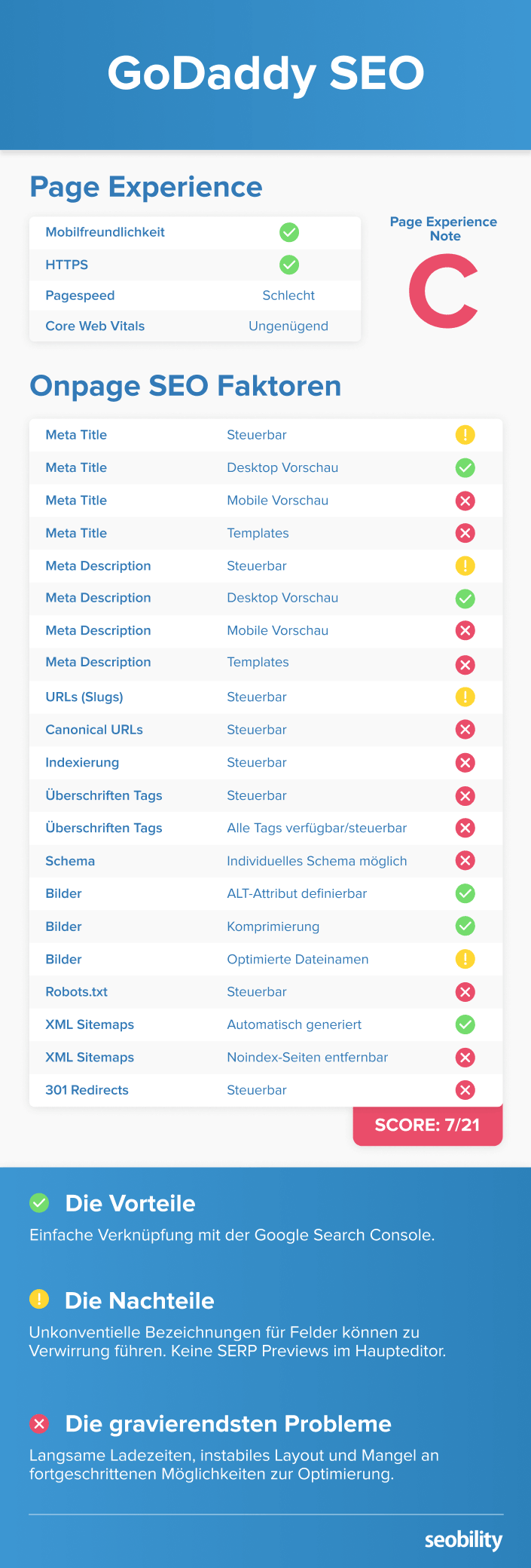
Like pictures? Here’s a summary…
How we tested GoDaddy Website Builder for SEO optimization
We set up a small site on a GoDaddy Website Builder Premium plan.
We chose a popular theme and loaded the site with demo content.
The tests included manual review, running the site through our own SEO audit tool, and testing using third party tools such as Google’s PageSpeed Insights and GTMetrix.
GoDaddy Website Builder SEO: The good, the bad, and the ugly
Before reviewing GoDaddy’s control of on-page SEO factors, let’s run through some of the SEO highlights (and lowlights) of the platform.
We’ll start with the positives.
Good:
Crickets chirp…
Empires rise and fall…
The sun slowly melts away the rocks over millions of years…
Ok, um… it’s easy to integrate your GoDaddy site with Google Search Console.
Moving on.
Bad: Unconventional naming of fields, no search previews outwith wizard
GoDaddy has a wizard you can use to “optimize” each page on your site. We don’t find it particularly useful, but we’ll come onto that later.
Outside the wizard, they’ll let you set a title and meta description for each page on your site in the main editor.
Only they don’t call it a title. For some reason they’ve decided to call it a “headline”.
So why is this a problem?
Well, consider a non technical user who’s just read an article (like our SEO audit guide) telling them to create an optimized title tag. Isn’t calling the field “headline” just causing unnecessary confusion?
Are we nitpicking? Perhaps. But this just seems illogical to us.
You’ll also note from the screenshot above that you won’t get a search preview in the main editor (you will get one in the wizard).
Ugly: Slow load times
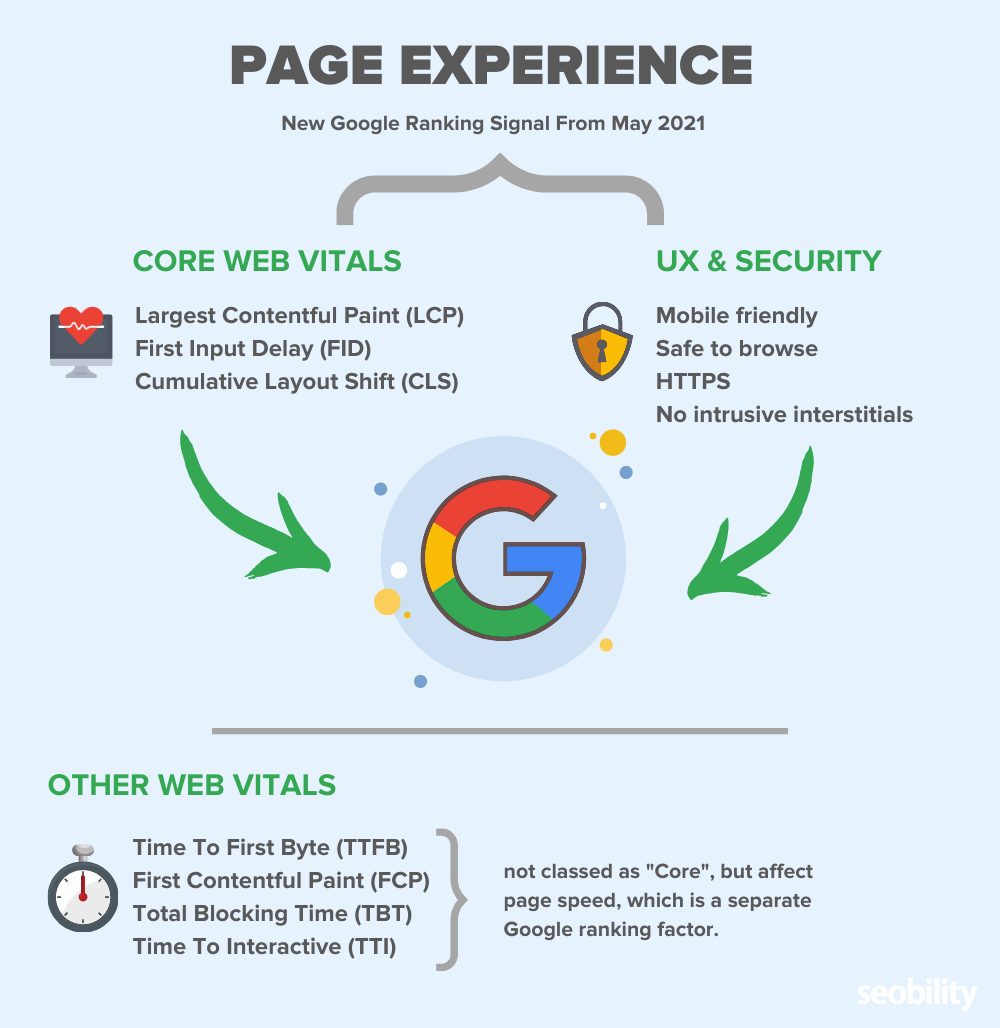
With Google about to start integrating Core Web Vitals into their main algorithm, speed and layout stability is becoming increasingly important to SEO.
Our test GoDaddy site had serious issues with both.
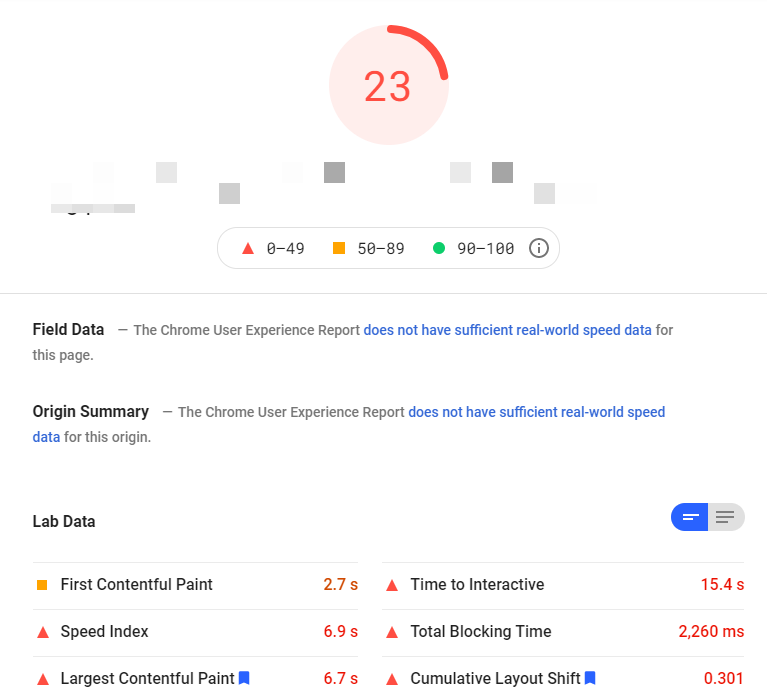
For example, this super basic blog post…
…had a Google PageSpeed Insights score of just 23, and a time to interactive of 15.4 seconds.
It also had strange issues with layout stability (loading then hiding layers), which you can see in the timeline below.
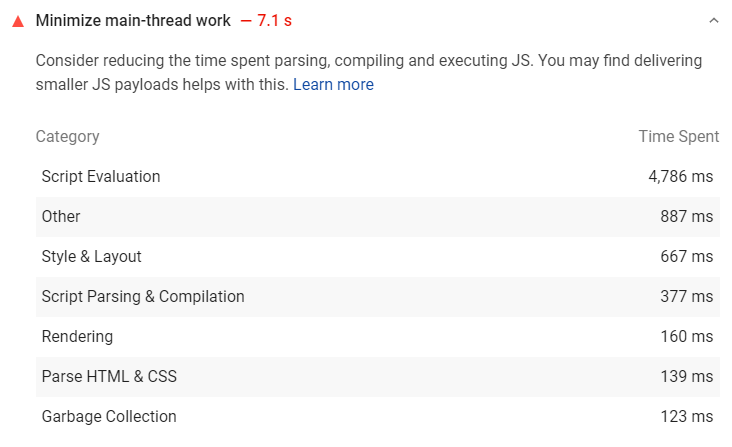
The slow load times were primarily caused by heavy script usage.
Ugly: There’s just not much you can do to optimize your site
Want to edit a page’s title and meta description? No problem… unless you want to do it for a blog page.
Want to get more advanced?
Time to switch to another CMS.
On-Page SEO Fundamentals: How does GoDaddy’s Website Builder measure up?
Now let’s turn our attention to control of some of the fundamental on-page SEO factors.
Does GoDaddy’s Website Builder cover them all?
Not even close.
Here’s our summary again.
Note: having control of an SEO ranking factor is not equal to its optimization. SEO audit tools like Seobility offer advice on how to properly optimize each element, and find errors in optimization which may be holding back your site. See our SEO audit guide for more information on how to fully optimize your website.
SEO Titles and Meta Descriptions
Control in GoDaddy: partial
A page’s title continues to be one of the most important on-page ranking factors. And a well written meta description can help you get more click-throughs (although Google won’t always use it).
On a GoDaddy site you can set a custom title and meta description for each “page”, but for a blog post you’re out of luck.
There are two ways you can set the title and description for a page.
The first is in the main editor, which we already covered above.
The second way is through the SEO wizard.
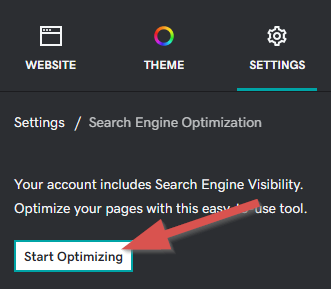
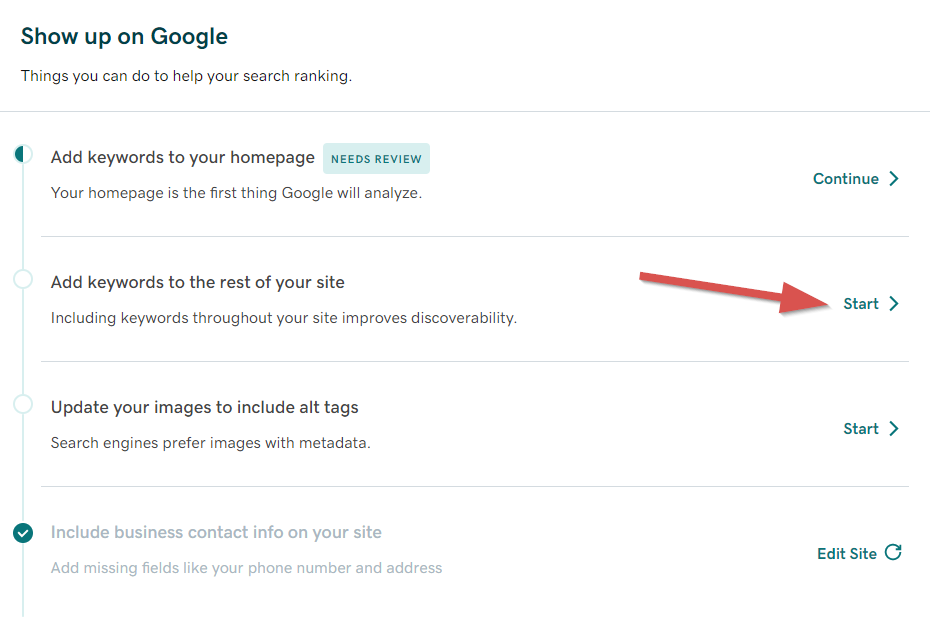
To access the wizard, click on “Start Optimizing” under “Settings > Search Engine Optimization” on any page (shown below), or choose “SEO” from the “Marketing” dropdown.
From there, you can choose to “optimize” your homepage, or any other page on your site.
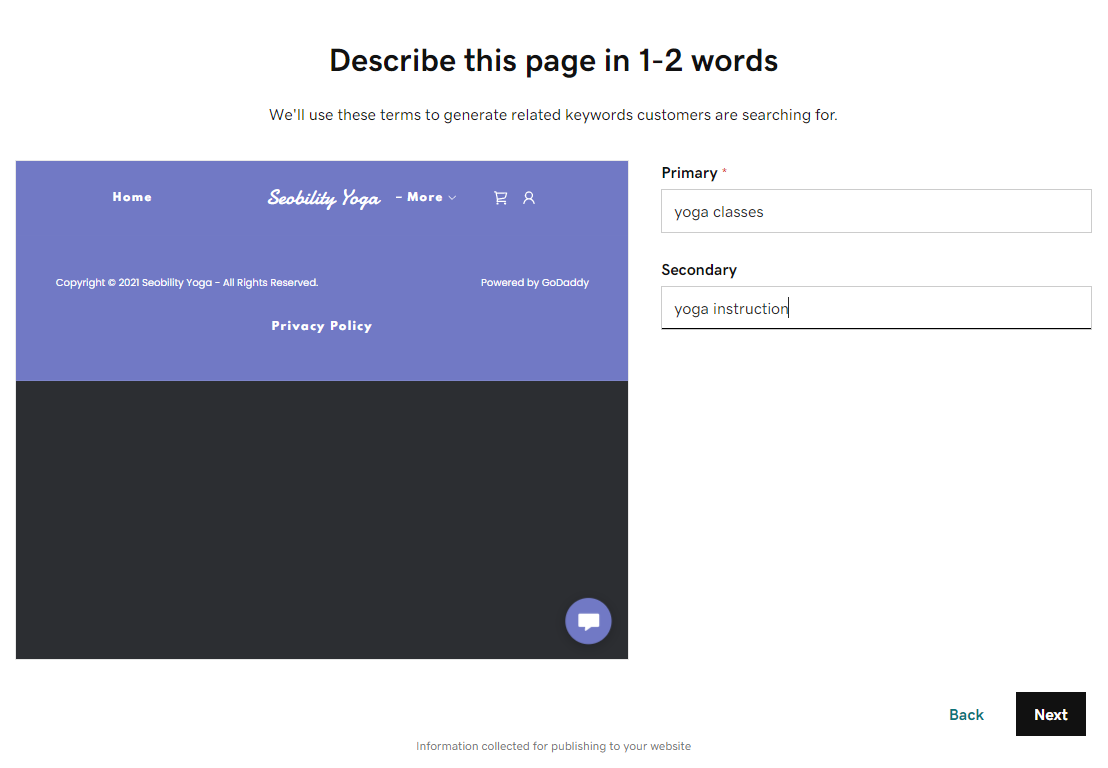
Once you’ve selected a page to optimize, GoDaddy will ask you to describe it in one or two words….
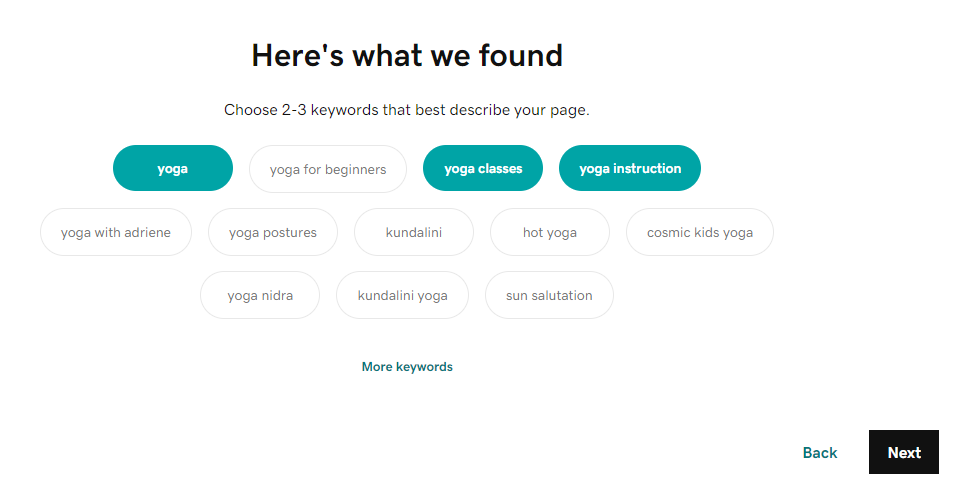
…which they’ll use to generate a list of related keywords. You can select two or three of the most relevant phrases for your page.
After a prompt to insert those keywords into your content (which you can do if you wish, but we’ve skipped) you’ll be asked to select a title for your page.
Yikes!
Let’s take a look at that first title (which we suspect many small business owners may pick):
Looks good right? Because stuffing keywords into your title and repeating the word yoga 5 times is a great way to boost your search engine rankings.
*checks calendar
Wait, it’s 2021 not 1999.
Obvious sarcasm is obvious hopefully. But just In case… let’s be crystal clear. This is not a good way to write your page titles for SEO in 2021.
In fact, we don’t really like any of GoDaddy’s suggested titles. But as we’re forced to select one before proceeding we’ll choose the simplest:
Yoga Classes – Seobility Yoga
It’s not good. But at least it’s not spammy.
On the next screen, we can add our page’s meta description.
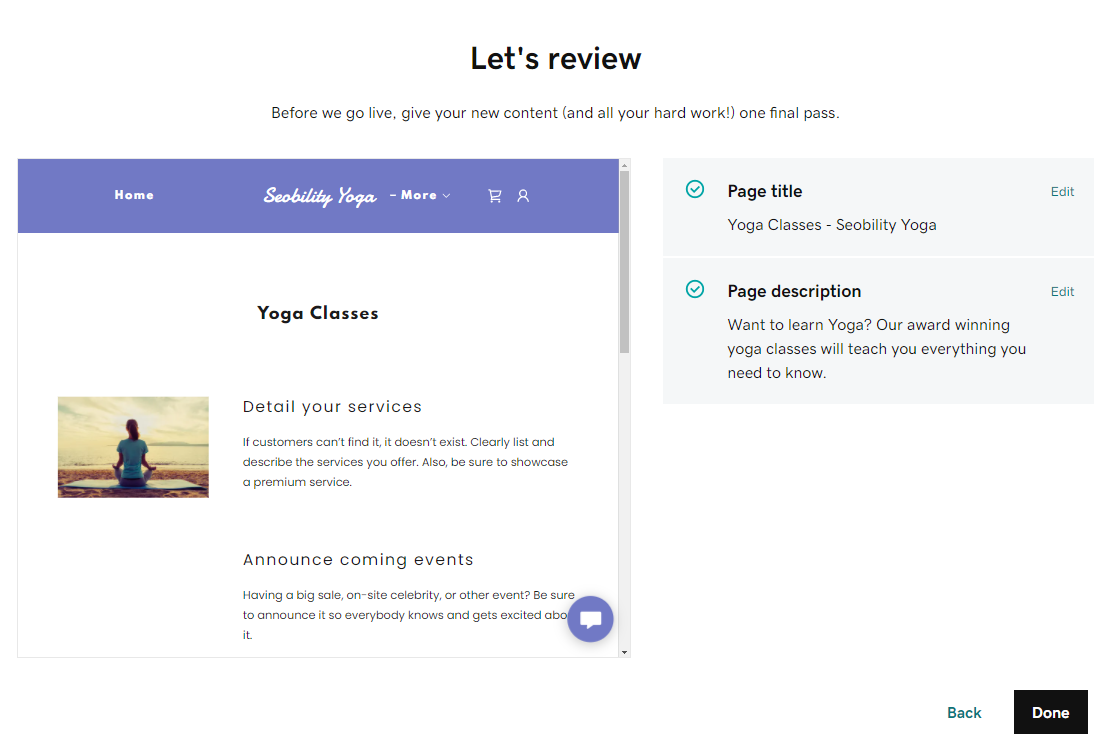
And then after another couple of screens where we can choose to add our keywords to our page’s content and heading, we’ll get to a final review page…
…and we’re done.
As we alluded to earlier, we don’t find this SEO wizard particularly helpful. Notwithstanding the fact that the page title suggestions are poor, it’s an incredibly slow way of updating some of the most basic SEO ranking factors.
Ultimately though, that’s just our opinion. And non technical users may prefer to update their site this way.
So we can’t exactly call this a negative.
But what we can say is a negative is that GoDaddy doesn’t give you any way to set a custom SEO title and description for your blog posts. The title will always be the same as your headline, and there’s nowhere to add a meta description.
We’ve no idea why this is the case, but it’s not good.
Learn more about SEO Titles and Meta Descriptions
Page slug / URL
Control in GoDaddy: partial
We recommend creating short, descriptive, 2-3 word slugs, including the primary keyword (or phrase) for each page. Use hyphens to separate words.
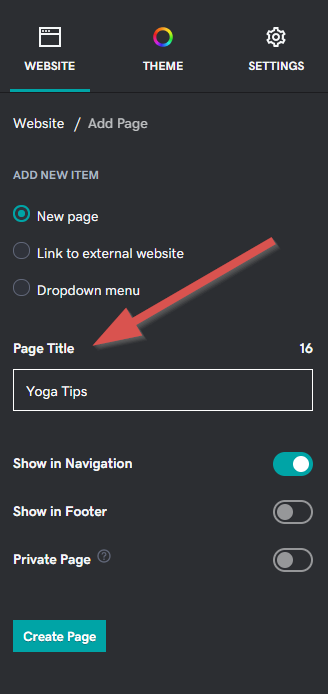
You can do it on a GoDaddy site, but again, it’s pretty unintuitive. There’s no field for editing your slug, but GoDaddy will base it on your page’s title.
And to layer on the confusion, we don’t mean SEO title (remember, GoDaddy calls that “headline”), we mean the “title” you choose when you create a new page:
So in the example above, we’d get a slug that looks like:
yourdomain/yoga-tips
If you update this title, the URL will also update.
Which is kind of fine we guess. But a field for slug/URL might have made it a little simpler to grasp?
As for the blog, you’ll be stuck with a slug based on the title of the blog post itself. So if we have a blog post titled:
Yoga Tips For Beginners: Here’s How To Get Better At Yoga FAST
And there’s nothing we can do to change it. Not ideal.
Note: something we did discover is that if you change a published blog post’s title, GoDaddy will keep the old URL. So we suppose you could initially create the blog post with a short, 2-3 word keyword targeted title, then change it to a longer title afterwards if you wanted a workaround.
Learn more about URL slugs/permalinks
Canonical URLs
Control in GoDaddy: no
On smaller sites you probably won’t need to worry about this.
But if you have a series of similar pages on your site — i.e. targeting the same keywords, or with very small variations in content — there may be times when you’ll want to set a canonical (master) URL.
This helps to avoid duplicate content issues.
There’s certainly no obvious way to set canonical URLs in GoDaddy’s Website Builder. So potential fiddly workarounds excepted, we’re going to say that this is not something you can control on a GoDaddy site.
Learn more about canonical URLs
Index control (robots meta tag)
Control in GoDaddy: no
The robots meta tag instructs Google to either index (1), or not to index (2) a page:
<meta name=”robots” content=”index, follow”> – index this page please Google
<meta name=”robots” content=”noindex, follow”> – ignore this page please Google (but follow the links on it)
You don’t actually need the first one as (assuming your page meets their quality standards) indexing is Google’s default action. But it doesn’t do any harm to have it in place.
We couldn’t see any simple way to noindex an individual page on a GoDaddy site.
Learn more about index control
Heading Tags (h1, h2, h3 etc)
Control in GoDaddy: no
Heading tags (h1, h2, h3 etc) help Google understand the structure, and topic(s) of your page.
They should be properly nested.
For example, an h1 tag would generally be the main topic (level 1), an h2 could be a subtopic (level 2), and an h3 could be a sub-sub topic (level 3) etc:
<h1>Pets</h1> (topic of the page)
<h2>Goldfish</h2> (subtopic)
<h3>Caring for your goldfish</h3> (subtopic of goldfish)
<h4>Clean your fish’s tank regularly</h4> (subtopic of caring for your goldfish)
<h2>Cats</h2> (subtopic)
<h3>Caring for your cat</h3> (subtopic of cats)
GoDaddy’s Website Builder fails miserably here. You’ve got pretty much zero control over headings.
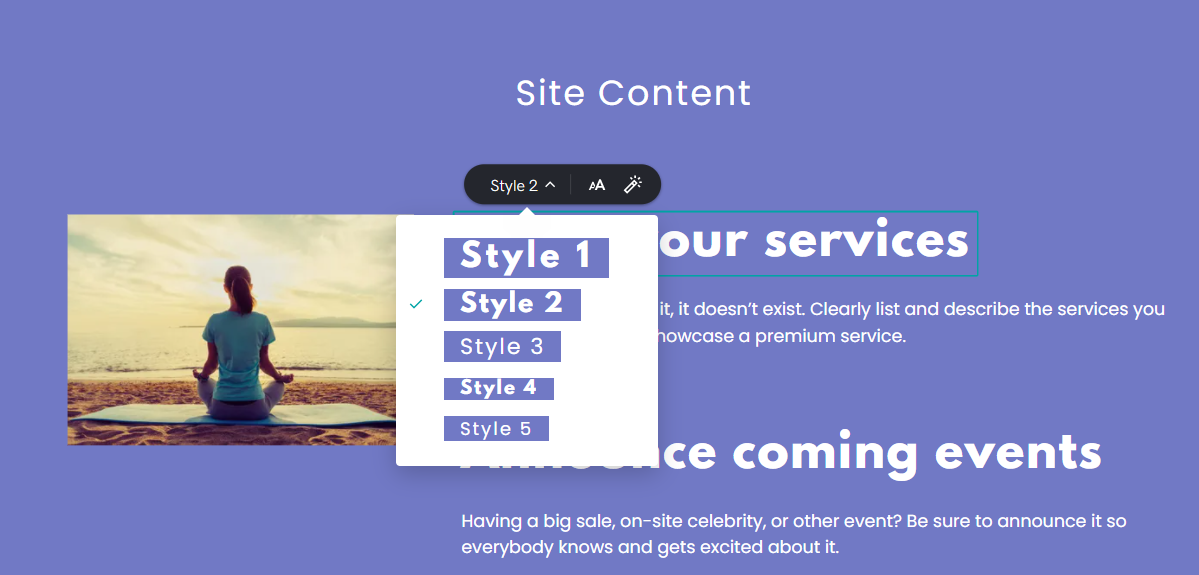
At first glance, we thought perhaps they were doing their funky naming convention trick again and calling heading tags “Styles”. But we were wrong.
Turns out the dropdown in the image above is literally for controlling the style of the heading. There’s no way to change the actual heading tag itself.
So you’re stuck with whatever GoDaddy feels is the best fit for a particular heading tag. Which wouldn’t be quite so much of an issue if they were choosing the right ones…
…but (at least in our tests) they’re not.
In the example above, we’ve skipped straight from H2 to H4.
How about on a blog page?
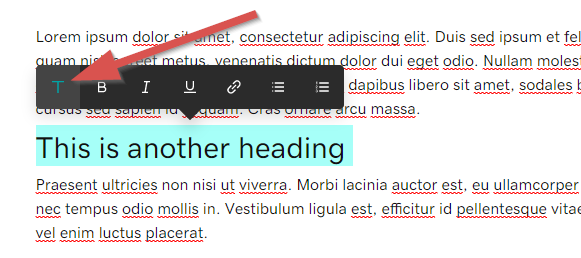
Well, all you can do is select “T” in the text tool bar.
Which turns the highlighted text into an H4. Want a subheading? Tough, you’re getting another H4.
(H4 wasn’t even the right tag here, it should have been an H2)
So there’s just no way to create a properly structured page.
Poor.
Learn more about heading tags
Structured data (aka schema)
Control in GoDaddy: no
Structured data (also known as schema) can help Google understand:
the type of content on a page (i.e. recipe, review, product, article),
the entity behind the website (i.e. organization),
and can also be used to show additional search features (rich snippets)
If you’re not familiar with structured data and its impact on SEO, we recommend reading our rich snippets guide.
There’s no simple way to add schema markup to a page on GoDaddy.
Learn more about structured data and rich snippets
Image SEO
Control in GoDaddy: yes
The three most important elements of image SEO are:
Alt text (description of the image for screen readers and search engines)
File size (smaller = faster = better)
File name (we recommend using descriptive file names)
GoDaddy’s Website Builder performs reasonably well here.
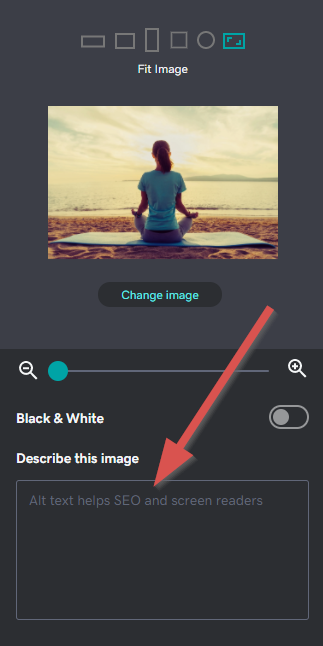
It’s easy to add alt text…
And when you upload an image GoDaddy will create (and serve) a WebP version — a lightweight image format that’s recommended by Google.
They will change the filename of the webp (we’d rather they kept it the same), but overall we’re pretty happy with how GoDaddy handles image SEO.
Learn more about image SEO
HTTPS
Do GoDaddy sites run over HTTPS? yes
HTTPS has been a confirmed Google ranking signal since 2014.
And in 2021 there’s really no excuse for any site to still be running over HTTP. Notwithstanding any SEO benefits, it’s unsecure.
So we’re pleased to say that every GoDaddy site (whether on a custom domain or not) runs on HTTPS.
Learn more about HTTPS
Robots.txt file
Control in GoDaddy: no
A robots.txt file allows you to stop search engine bots from accessing certain areas of your site.
For example, you might have a section with user generated content that you don’t want crawled or indexed by Google.
Unfortunately while GoDaddy will create a default robots.txt file for your site, there’s currently no way to edit it. They explain why here.
Unfortunately, no, you will not be able to edit the robots.txt directly on GoCentral. It is a proprietary GoDaddy product and all server side access is controlled by GoDaddy. The customer has no direct access.
Learn more about Robots.txt
XML Sitemaps
Generated by GoDaddy: yes
An XML sitemap helps Google find (and index) all the pages on your site.
GoDaddy automatically sets up and maintains an XML sitemap for your site (pages, blog posts etc), however, there is no way to edit it.
Learn more about XML Sitemaps
Are GoDaddy sites mobile friendly?
One word answer: yes
When designing your site on GoDaddy, there’s a good chance you’ll be focusing on how it looks on desktop.
But mobile traffic overtook desktop traffic in 2017. And Google now prioritizes the mobile version of your site for crawling and indexing.
The good news is that GoDaddy sites are fully responsive, and (speed issues notwithstanding) work well on mobile.
Just make sure to preview how your site looks on both desktop and mobile. And remember it’s the mobile version of your site that Google will index and rank. So if you have a feature that displays on desktop but not mobile, then Google won’t take it into account for rankings.
GoDaddy will give you a preview of how your site looks on mobile.
But we’d still recommend testing on your own device after going live.
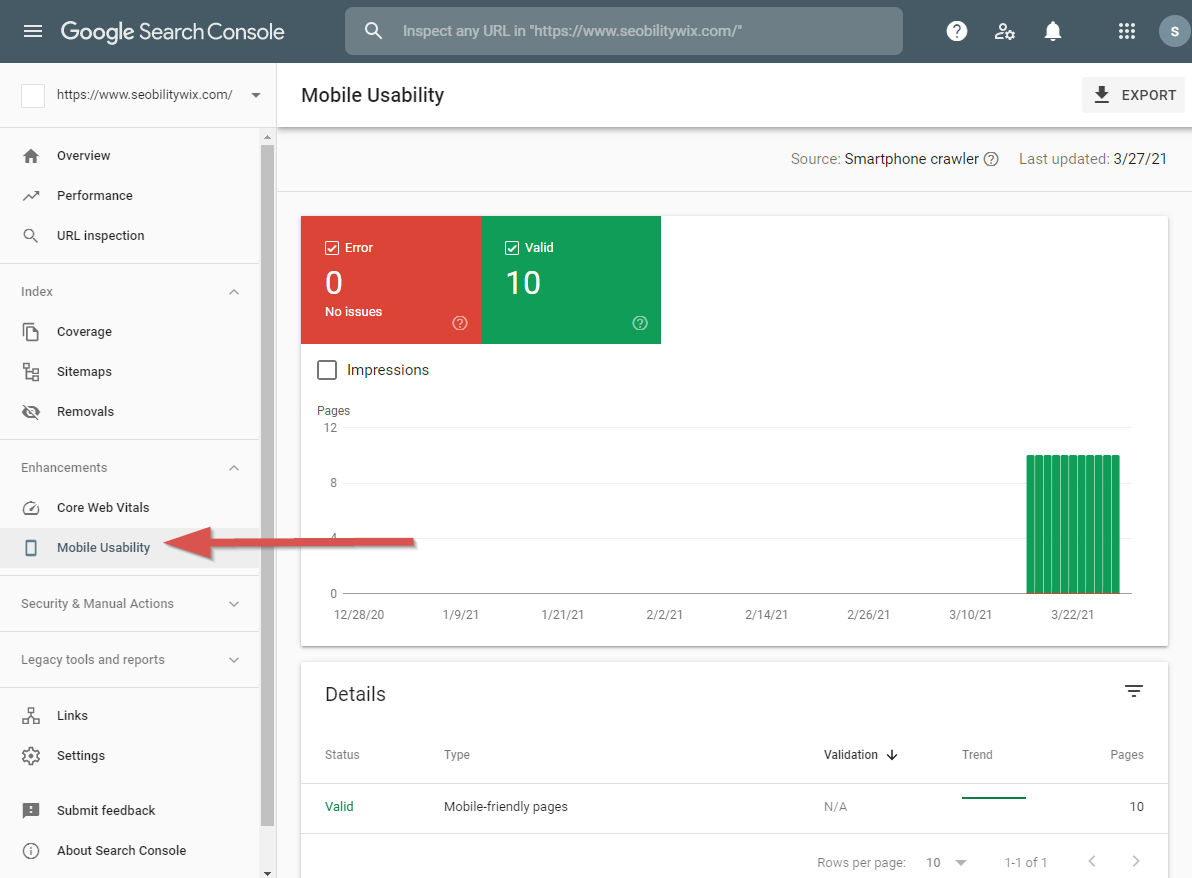
If Google does find any issues with the mobile version of your website, they’ll let you know in Search Console.
So keep an eye out.
In conclusion: GoDaddy Website Builder’s SEO is seriously lacking
Our mother told us that if we don’t have anything positive to say, then don’t say anything.
But if we stuck by that rule… well, you’d be looking at a blank page here.
Because it’s pretty hard to conclude anything other than GoDaddy’s Website Builder is poor for SEO.
If you’re on the platform, you’re going to be hampered by the lack of options for optimizing your site/content. And the slow page load times are going to see you lagging your competitors both literally and metaphorically.
But with that being said:
If you currently have a GoDaddy site and don’t want to switch to a more advanced CMS — an action we actually found GoDaddy support engineers recommending in many of their own help threads! — our advice would be to:
run a full SEO audit (you can follow this guide),
allocate time to fixing issues and optimizing your site (where possible),
focus in on creating high quality content that helps your users and fully answers their search queries,
build your site’s authority by earning high quality backlinks (check out our recommended link building tactics here)
Over the coming weeks we’ll be reviewing the on-page SEO of two more popular CMS systems. We’ll then be comparing the SEO pros and cons of each CMS in a roundup post, where we’ll also reveal the best CMS for SEO in 2021. Sign up for our email list below to follow this series, and for loads more fresh SEO tips, tutorials, and guides straight to your inbox.
The needs of an SEO firm are vibrant and modification as business grows
From data precision to smooth functionality, the spectrum of SEO tools and their functions is large, however how do you decide?
5 dead giveaways that it may be time to begin prospecting for new SEO software application to finish your innovation stack
The SEO market is continuously changing and developing. Your SEO agency’s requirements likewise alter as your business grows. The tools you utilize will form how you direct your development. So it’s essential to remain updated on what’s new in the area to decide whether adopting a new SEO tool would benefit your organization.
Yet, it’s always a concern of prioritizing what’s vital for your business requirements.
There are lots of aspects at play here:
Some SEO platforms solve issues that you maybe didn’t even know existed– to recognize these, you need to stay abreast of new improvements in the industry
Some solve a particular problem, which you’re already knowledgeable about– in these cases, it’s just about determining which tool is the best suitable for your firm’s requirements
Some use a smooth experience that assists you enhance your SEO workflows
Some offer competitive advantages in terms of features or rates
In our interviews with leading SEO firms from around the world, we’ve gathered various insights into the elements that the majority of influence the decision to test, and even change, to a new core SEO tool.
Here are some of the dead giveaways that it may be time to start prospecting for new SEO software application in your tool stack.
Content developed in partnership with SEOmonitor.
1. Your current tool isn’t offering you the best information or performances
Accuracy and performance are the biggest discomfort points SEO experts have with their tools.
Does your present option give you enough information? Does it offer the best data? If not, you may not have the ability to provide on your SEO objectives.
Have you ever discover either of these issues?
Unreliable or insufficient information
Some SEO platforms merely supply more information features than others, while others charge additional to see particular metrics, like:
Google’s “(not provided)” data
Brand/non-brand organic traffic division
Mobile vs. desktop traffic
Having this data is indispensable for SEO experts. Having to pay for it granularly can be a hugely restricting factor, particularly for smaller agencies.
For instance, mapping the traffic information from Google Analytics and matching it with the keyword data from Google Search Console to get what’s “(not provided)” means you can reveal customers the direct effect which SEO has on other business goals– like how increasing ranking for a keyword affects conversions.
SEO platforms that offer this type of data as standard can provide you an advantage when it pertains to obtaining and maintaining customers by highlighting the connection between SEO and service results. Or it can be an issue of undependable metrics– opaque or misleading computations, problems that relate to technical changes and not your SEO performance, and so on. Think about the visibility metric. If it’s determined as approximately positions for a set of keywords, then changes based on adding or deleting keywords on that list will be deceptive, leaving you to determine why ball game changes.
Paul Wood, Director of Indulge Media, explains that development in how an SEO tool computes a key metric is a deciding aspect. Much more so if it’s something the agency utilized to do with spreadsheets and many hours invested before finding out about such an effective metric.
“The more interesting situation is when you all of a sudden become mindful of a tool that’s out there that does something your team didn’t even consider,” Wood stated. “When you see it in a tool, that’s a minute when you change the method you’re considering things, about how you structure your work. And then you start to work differently.”
This is how the ideal SEO tools need to work– resolving company pain points, even the ones you might not have thought were possible to solve. Performance concerns Speed is a huge factor in the SEO market.
Search experts need access to precise, up-to-date data in the minute to carry out campaigns and track efficiency.
Since when your software malfunctions, you require to get the issue fixed quickly.
This is why it’s essential to consider the quality of support offered when choosing an SEO tool.
Ideally, you need to get access to a dedicated account supervisor who you can approach for quick resolution of concerns on an as-needed basis, along with regular support calls to evaluate your company’s requirements.
When Paul Friend, Head of SEO, and Ben Foster, Managing Director, from SEO Works decided it’s time to pick a different core SEO tool, they scored ad-hoc and ongoing support as one of the “numerous different relevant aspects when choosing the right tool.”
As part of their decisional matrix, this was one point that needed to match essential functionalities like keyword functions including universal rankings, general market visibility ratings, material insights, forecasting and reporting abilities, link structure capabilities, competition insights, and a lot more.
When you’re considering or evaluating upgrading your existing tech stack, you require to see how well an option performs based on your firm’s particular needs.
2. You want to be seen as a leader in development
Digital is constantly moving, and SEO specialists need to be updated with new developments to remain competitive. Agencies require to be at the forefront of development, so they continuously lookout for brand-new technologies that will set them apart.
Paul Wood states that they “make an effort a minimum of a couple of times a year to have a correct evaluation of what’s out there in terms of tools.” They focus mostly on availability and UX when evaluating brand-new tools on the market, like:
How easily they allow you to export information
How they facilitate partnership between internal teams and clients
How many performances can be integrated into a single platform
The team at SEO Works likewise highlights the importance of constantly watching, with members keeping each other informed. They have an extensive training program in place, too– so everyone is onboarded not only with the tools but the particular approaches the agency utilizes for superior SEO strategies.
Going even further, firms like SEO Works develop exclusive tools, showing how their innovative method can be a competitive advantage for clients in their portfolio.
3. You’re growing or scaling your SEO firm
Digital adoption has sped up globally by at least three to four years in simply a few months, according to a recent McKinsey Global Survey of C-level magnate.
This drive toward a digital-first approach is just expected to continue, which indicates that scaling needs for SEO companies are likely to be high right now, in addition to for the foreseeable future.
Meeting this growing demand for SEO services requires companies to scale operations effectively while likewise staying competitive themselves. If you’re growing your company, it’s a good time to test your tools and see if they have the right set of performances to promote and support this development.
Fast-growing agencies require more abilities, like:
Access to more users: As you add brand-new customers and workers, you want tools that enable you to have limitless users (preferably, at no extra cost) and assist in cooperation across teams
Limitless API access: Your SEO tools require to work seamlessly with your other company tools as you grow your general technology toolkit. For instance, we’ve made it as basic as possible to export big quantities of data through the SEOmonitor API, letting you pull the campaign and keyword-level data into your preferred internal systems (like Klipfolio) and tailor customer reports
More efficient workflows: Operational dashboards, integrated systems, and organizing capabilities for your customer portfolio, all make a difference in helping you get the status quo at a glimpse
In the words of numerous SEO professionals we’ve talked with, the greatest value an SEO platform can bring is to assist you not waste time. The right tools will help you do this, however inefficient ones can leave your group spending too much time on technical processes, which will seriously hamper your ability to scale. 4. Your tool isn’t collaborative enough or adjustable SEO professionals need to have stable processes and methods across all groups. The best software application is constructed with this
in mind. When choosing SEO tools, partnership and customization are the most essential things that companies prioritize. And great deals of features facilitate this, like:
Multiple user access: Unlimited gain access to for team members and clients, with customizable client view permissions.
Collective features: Real-time annotations, remarks, and sharing abilities for both customers and teams.
Tracking metrics: A central company dashboard that lets groups keep an eye on efficiency and jobs, as well as align on goals.
Personalization functions: From filtering campaigns by account managers, to an editing mode that enhances your time for keyword management, to saving tailored reporting templates throughout the agency, there are numerous capabilities you should think about.
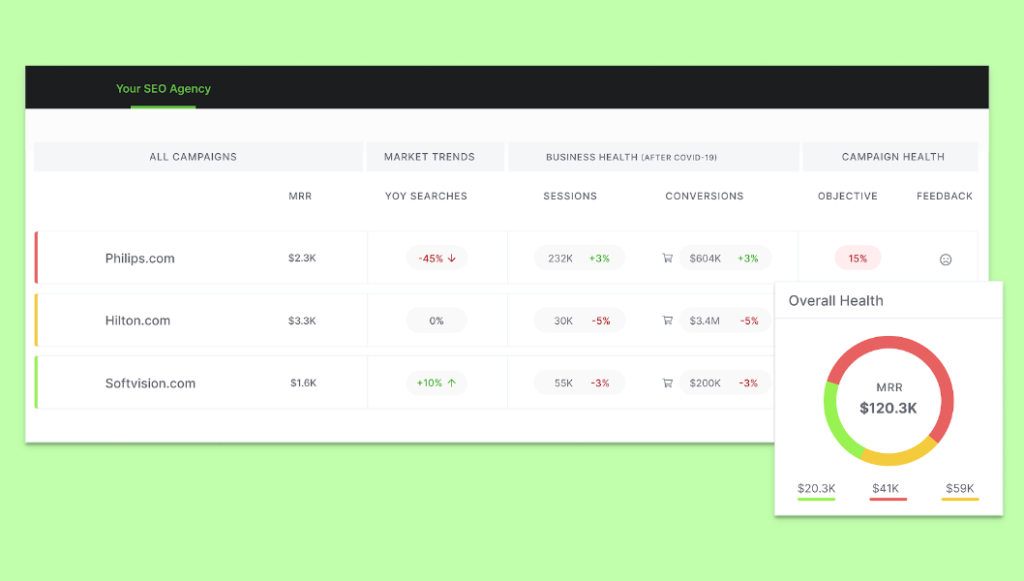
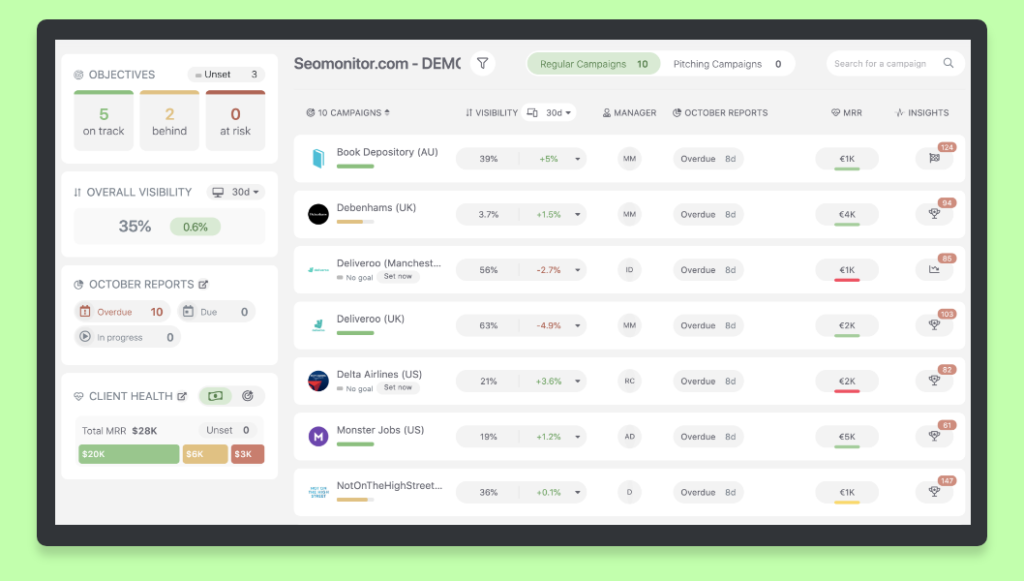
< img loading =”lazy”class=”aligncenter size-large wp-image-143321″src=”https://www.searchenginewatch.com/wp-content/uploads/2021/05/4-1024×581.png”alt width =”640 “height= “363 “srcset =”https://www.searchenginewatch.com/wp-content/uploads/2021/05/4-1024×581.png 1024w, https://www.searchenginewatch.com/wp-content/uploads/2021/05/4-300×170.png 300w, https://www.searchenginewatch.com/wp-content/uploads/2021/05/4-768×436.png 768w, https://www.searchenginewatch.com/wp-content/uploads/2021/05/4.png 728w “sizes=” (max-width: 640px)100vw, 640px” > A robust SEO solution, which integrates several performances like these in a single platform, assists enhance internal workflows and get a holistic view into firm operations. 5. Your tool isn’t economical Various sized firms
have different budgets. Optimizing costs is important, particularly for scaling companies. You need to work with more individuals and utilize more resources in your tools to deal with a larger volume of clients, and you don’t want to scale your costs at the same rate.
Some concerns to ask when assessing the cost-efficiency of a particular tool are:
Does it offer versatile prices and use of resources?
Most SEO software application solutions have a repaired subscription expense, that includes a set number of domains and keywords. But if your usage of the tool’s resources changes from month to month, your rates stays the same.
Other platforms provide companies the ability to update or downgrade monthly, so you only spend for what you utilize. Having no predefined strategy supports companies much better examine their expenses based upon campaign volume on a particular timeframe.
Are there any extra concealed expenses?
Some tools have an appealing base price but featured covert costs and extras that can quickly build up, specifically when you’re onboarding great deals of brand-new customers and handling bigger campaigns. These include:
Per-user costs: Will you have the ability to add unrestricted users (including customers) at no additional cost to permit external and internal partnership?
Migration charges: Is there a per hour or set rate for migrating from your existing system to a new tool?
Integration costs: Are there multiple combinations to crucial tools of the trade (Data Studio, Google Sheets, API gain access to, and more) included in the price?
If your current software isn’t making the most monetary sense for your business, it might be time to test a new one.
When is the right time to start prospecting for a new SEO tool?
The answer is, you need to never ever stop your vital analysis.
Innovation is an ongoing procedure, specifically in this rapidly-changing market. Your core SEO tool of choice requires to keep up the speed and constantly upgrade its abilities.
When you come across these indications with your existing solutions, they may not be serving you as well as they need to be, like:
When you don’t get access to the ideal information or performances.
When you wish to be a leader in development, which suggests you need ingenious approaches.
When you’re growing or scaling your agency, and you need more capabilities in location.
Or when you wish to be more cost-effective.
We comprehend that an SEO agency’s core tools are crucial in winning more clients and handling them more efficiently.
That’s why our team at SEOmonitor is committed to developing specific options that help you get, manage, and retain appropriate consumers.
Join us and our SEO firms community in the journey to bring more transparency and measurability to the SEO market.
Alice Teodorescu is Content Marketing Manager at SEOmonitor. More about:
We analyzed 208,085 webpages to learn more about Core Web Vitals.
First, we established benchmarks for Cumulative Layout Shift, First Input Delay, and Largest Contentful Paint.
Then, we looked into the correlation between Core Web Vitals and user experience metrics (like bounce rate).
Thanks to data provided by WebCEO, we were able to uncover some interesting findings.
Let’s dive right into the data.
Here is a Summary of Our Key Findings:
1. 53.77% of sites had a good Largest Contentful Paint (LCP) score. 46.23% of sites had “poor” or “needs improvement” LCP ratings.
2. 53.85% of websites in our data set had optimal First Input Delay (FID) ratings. Only 8.57% of sites had a “poor” FID score.
3. 65.13% of analyzed sites boasted good optimal Cumulative Layout Shift (CLS) scores.
4. The average LCP of the sites we analyzed clocked in at 2,386 milliseconds.
5. Average FID was 137.74 milliseconds.
6. The mean CLS score was 0.14. This is slightly higher than the optimal score.
7. The most common issues impacting LCP were high request counts and large transfer sizes.
8. Large layout shifts were the #1 cause of poor CLS scores.
9. The most common issue affecting FID was an inefficient cache policy.
10. There was a weak correlation between Core Web Vital scores and UX metrics.
11. We did find that FID did tend to slightly correlate with page views.
53.77% of Websites Had an Optimal Largest Contentful Paint Score
Our first goal was to see how each site performed based on the three factors that make up Google’s Core Web Vitals: Largest Contentful Paint, Cumulative Layout Shift, and First Input Delay.
Specifically, we wanted to determine the percentage of pages that were classified as “good”, “needs improvement” and “poor” inside of each site’s Search Console.
To do this, we analyzed anonymized Google Search Console data from 208k pages (approximately 20k total sites).
Our first task: analyze LCP (Large Contentful Paint). In simple terms, LCP measures how long it takes a page to load its visible content.
Here’s how the sites that we analyzed fared:
Good: 53.77%
Needs Improvement: 28.76%
Poor: 17.47%
As you can see, the majority of sites that we looked at had a “good” LCP rating. This was higher than expected, especially when taking into account other benchmarking efforts (like this one by iProspect).
It may be that the websites in our dataset are especially diligent about page performance. Or it may be partly due to a sample size difference (the iProspect analysis continuously monitors 1,500 sites. We analyzed 20,000+).
Either way, it’s encouraging to see that only about half of all websites need to work on their LCP.
53.85% of Websites We Analyzed Had Good First Input Delay Ratings
Next, we looked at Search Console reported First Input Delay (FID) ratings. As the name suggests, FIP measures the delay between the first request and a user being able to input something (like typing in a username).
Here’s a breakdown of FID scores from our dataset:
Good: 53.85%
Needs Improvement: 37.58%
Poor: 8.57%
Again, just over half of the sites we looked at had “good” FID ratings.
Interestingly, very few (8.57%) had “poor” scores. This shows that a relatively small number of sites are likely to be negatively affected once Google incorporates FID into their algorithm.
65.13% of Sites Had an Optimal Cumulative Layout Shift Score
Finally, we looked at the Cumulative Layout Shift (CLS) ratings from Search Console.
CLS is a measurement of how elements on a page move while loading. Pages that are relatively stable through the loading process have high (good) CLS scores.
Here were the CLS ratings among the sites that we analyzed:
Good: 65.13%
Needs Improvement: 17.03%
Poor: 17.84%
Among the three Core Web Vitals scores, CLS tended to be the least problematic. In fact, only around 35% of the sites that we analyzed need to work on their CLS.
Average LCP Is 2,836 Milliseconds
Next, we wanted to establish benchmarks for each Core Web Vital metric. As mentioned above, Google has created their own set of guidelines for each Core Web Vital.
(For example, a “good” LCP is considered to be under 2.5 seconds.)
However, we hadn’t seen a large-scale analysis that attempted to benchmark each Core Web Vital metric “in the wild”.
First, we benchmarked LCP scores for the sites in our database.
Among the sites that we analyzed, the average LCP turned out to be 2,836 Milliseconds (2.8 seconds).
Here were the most common issues that negatively impacted LCP performance:
High request counts and large transfer sizes (100% of pages)
High network round-trip time (100% of pages)
Critical request chains (98.9% of pages)
High initial server response time (57.4% of pages)
Images not served in next-gen format (44.6% of pages)
Overall, 100% of pages had high LCP scores at least partly due to “High request counts and large transfer sizes”. In other words, pages that are heavy with excess code, large file sizes, or both.
This finding is in line with another analysis that we did which found that large pages tended to be the culprit behind most slow-loading pages.
Average FID Is 137.4 Milliseconds
We then looked at FID scores among the pages in our dataset.
Overall, the mean First Input Delay was 137.4 milliseconds:
Here are the most prevalent FID-related issues that we discovered:
Inefficient cache policy (87.4% of pages)
Long main-thread tasks (78.4% of pages)
Unused JavaScript (54.1% of pages)
Unused CSS (38.7% of pages)
Excessive Document Object Model size (22.3% of pages)
It was interesting to see that caching issues tended to negatively affect FID more than any other problem. And, not surprisingly, poorly-optimized code (in the form of unused JS and CSS) was behind many high FID scores.
Average CLS Is .14
We discovered that the average CLS score is .14.
This metric specifically looks at how the content on a page “shifts”.Anything below .1 is rated as “good” in Search Console.
The most common issues affecting the projects’ CLS included:
Large layout shifts (94.5% of pages)
Render-blocking resources (86.3% of pages)
Text hidden during web font load (82.6% of pages)
Not preloaded key requests (26.7% of pages)
Improperly sized images (24.7% of pages)
How LCP Correlates With User Behavior
Now that benchmarks were set, we then set to find out how accurately Core Web Vitals represent real-life user experience.
In fact, this relationship is something that Google themselves highlight in their “Core Web Vitals report” documentation:
To analyze Core Web Vitals and their impact on UX, we decided to look at three UX metrics designed to represent user behavior on webpages:
Bounce rate (% of users leaving a website’s page upon visiting it)
Page depth per session (how many pages users see before leaving the website)
Time on website (how much time users spend on a website in a single session)
Our hypothesis was as follows: if you improve a website’s Core Web Vitals, it will positively affect UX metrics.
In other words, a site with “good” Core Web Vitals will have a lower bounce rate, longer sessions, and higher page views. Fortunately, in addition to Search Console data, this data set also contained UX metrics from Google Analytics.
Then, we simply had to compare each website’s Core Web Vitals against each UX metric. You can find our results for LCP below:
LCP and Bounce Rate
LCP and Pages per Session
LCP and Time on Site
On the three graphs, it was clear that all three different segments (Good, Poor and Needs Improvement) are somewhat evenly distributed on the graph.
In other words, there wasn’t any direct relationship between LCP and UX metrics.
FID Has a Slight Relationship With Page Views
Next, we looked at the potential relationship between First Input Delay and user behavior.
Like with LCP, it’s logical that a poor FID would negatively impact UX metrics (especially bounce rate).
A user that needs to wait to choose from a menu or type in their password is likely to become frustrated and bounce. And if that experience carries across several pages, it may lead to them reducing their total page views.
With that, here’s how FID correlated with their behavioral metrics.
FID and Bounce Rate
FID and Pages per Session
Note: We found that a high FID tends to correlate with a low number of pages per session. The opposite was also true.
FID and Time on Site
Overall, the only instance where we see hints of correlation is when we compare FID to the number of pages viewed per session. When it comes to bounce rate and time on site, a website’s FID appears to have no influence on user behavior.
How CLS Impacts User Behavior
Next, we wanted to investigate a potential link between CLS and user activity.
It seems logical that a poor CLS would frustrate users. And could therefore increase bounce rate and reduce session time.
However, we weren’t able to find any case studies or large-scale analysis that demonstrated that high CLS scores influence user behavior. So we decided to run an analysis that looked for potential relationships between CLS, bounce rate, “dwell time” and pages viewed. Here’s what we found:
CLS and Bounce Rate
CLS and Pages per Session
CLS and Time on Site
Overall, we didn’t see any significant correlation between CLS, bounce rate, time on site, or page views.
Summary
I hope you found this analysis interesting and useful (especially with Google’s Page Experience update on the way).
Here’s a link to the raw data set that we used. Along with our methods.
I want to thank SEO software WebCEO for providing the data that made this industry study possible.
Overall, it was interesting to see that most of the sites that we analyzed performed relatively well. And are largely ready for the Google update. And it was interesting to find that, while Core Web Vitals represent metrics for a positive UX on a website, we didn’t see any correlation with behavioral metrics.
Now I’d like to hear from you:
What’s your main takeaway from today’s study? Or maybe you have a question about something from the analysis. Either way, leave a comment below right now.
We analyzed 208,085 webpages to learn more about Core Web Vitals.
First, we established benchmarks for Cumulative Layout Shift, First Input Delay, and Largest Contentful Paint.
Then, we looked into the correlation between Core Web Vitals and user experience metrics (like bounce rate).
Thanks to data provided by WebCEO, we were able to uncover some interesting findings.
Let’s dive right into the data.
Here is a Summary of Our Key Findings:
1. 53.77% of sites had a good Largest Contentful Paint (LCP) score. 46.23% of sites had “poor” or “needs improvement” LCP ratings.
2. 53.85% of websites in our data set had optimal First Input Delay (FID) ratings. Only 8.57% of sites had a “poor” FID score.
3. 65.13% of analyzed sites boasted good optimal Cumulative Layout Shift (CLS) scores.
4. The average LCP of the sites we analyzed clocked in at 2,386 milliseconds.
5. Average FID was 137.74 milliseconds.
6. The mean CLS score was 0.14. This is slightly higher than the optimal score.
7. The most common issues impacting LCP were high request counts and large transfer sizes.
8. Large layout shifts were the #1 cause of poor CLS scores.
9. The most common issue affecting FID was an inefficient cache policy.
10. There was a weak correlation between Core Web Vital scores and UX metrics.
11. We did find that FID did tend to slightly correlate with page views.
53.77% of Websites Had an Optimal Largest Contentful Paint Score
Our first goal was to see how each site performed based on the three factors that make up Google’s Core Web Vitals: Largest Contentful Paint, Cumulative Layout Shift, and First Input Delay.
Specifically, we wanted to determine the percentage of pages that were classified as “good”, “needs improvement” and “poor” inside of each site’s Search Console.
To do this, we analyzed anonymized Google Search Console data from 208k pages (approximately 20k total sites).
Our first task: analyze LCP (Large Contentful Paint). In simple terms, LCP measures how long it takes a page to load its visible content.
Here’s how the sites that we analyzed fared:
Good: 53.77%
Needs Improvement: 28.76%
Poor: 17.47%
As you can see, the majority of sites that we looked at had a “good” LCP rating. This was higher than expected, especially when taking into account other benchmarking efforts (like this one by iProspect).
It may be that the websites in our dataset are especially diligent about page performance. Or it may be partly due to a sample size difference (the iProspect analysis continuously monitors 1,500 sites. We analyzed 20,000+).
Either way, it’s encouraging to see that only about half of all websites need to work on their LCP.
53.85% of Websites We Analyzed Had Good First Input Delay Ratings
Next, we looked at Search Console reported First Input Delay (FID) ratings. As the name suggests, FIP measures the delay between the first request and a user being able to input something (like typing in a username).
Here’s a breakdown of FID scores from our dataset:
Good: 53.85%
Needs Improvement: 37.58%
Poor: 8.57%
Again, just over half of the sites we looked at had “good” FID ratings.
Interestingly, very few (8.57%) had “poor” scores. This shows that a relatively small number of sites are likely to be negatively affected once Google incorporates FID into their algorithm.
65.13% of Sites Had an Optimal Cumulative Layout Shift Score
Finally, we looked at the Cumulative Layout Shift (CLS) ratings from Search Console.
CLS is a measurement of how elements on a page move while loading. Pages that are relatively stable through the loading process have high (good) CLS scores.
Here were the CLS ratings among the sites that we analyzed:
Good: 65.13%
Needs Improvement: 17.03%
Poor: 17.84%
Among the three Core Web Vitals scores, CLS tended to be the least problematic. In fact, only around 35% of the sites that we analyzed need to work on their CLS.
Average LCP Is 2,836 Milliseconds
Next, we wanted to establish benchmarks for each Core Web Vital metric. As mentioned above, Google has created their own set of guidelines for each Core Web Vital.
(For example, a “good” LCP is considered to be under 2.5 seconds.)
However, we hadn’t seen a large-scale analysis that attempted to benchmark each Core Web Vital metric “in the wild”.
First, we benchmarked LCP scores for the sites in our database.
Among the sites that we analyzed, the average LCP turned out to be 2,836 Milliseconds (2.8 seconds).
Here were the most common issues that negatively impacted LCP performance:
High request counts and large transfer sizes (100% of pages)
High network round-trip time (100% of pages)
Critical request chains (98.9% of pages)
High initial server response time (57.4% of pages)
Images not served in next-gen format (44.6% of pages)
Overall, 100% of pages had high LCP scores at least partly due to “High request counts and large transfer sizes”. In other words, pages that are heavy with excess code, large file sizes, or both.
This finding is in line with another analysis that we did which found that large pages tended to be the culprit behind most slow-loading pages.
Average FID Is 137.4 Milliseconds
We then looked at FID scores among the pages in our dataset.
Overall, the mean First Input Delay was 137.4 milliseconds:
Here are the most prevalent FID-related issues that we discovered:
Inefficient cache policy (87.4% of pages)
Long main-thread tasks (78.4% of pages)
Unused JavaScript (54.1% of pages)
Unused CSS (38.7% of pages)
Excessive Document Object Model size (22.3% of pages)
It was interesting to see that caching issues tended to negatively affect FID more than any other problem. And, not surprisingly, poorly-optimized code (in the form of unused JS and CSS) was behind many high FID scores.
Average CLS Is .14
We discovered that the average CLS score is .14.
This metric specifically looks at how the content on a page “shifts”.Anything below .1 is rated as “good” in Search Console.
The most common issues affecting the projects’ CLS included:
Large layout shifts (94.5% of pages)
Render-blocking resources (86.3% of pages)
Text hidden during web font load (82.6% of pages)
Not preloaded key requests (26.7% of pages)
Improperly sized images (24.7% of pages)
How LCP Correlates With User Behavior
Now that benchmarks were set, we then set to find out how accurately Core Web Vitals represent real-life user experience.
In fact, this relationship is something that Google themselves highlight in their “Core Web Vitals report” documentation:
To analyze Core Web Vitals and their impact on UX, we decided to look at three UX metrics designed to represent user behavior on webpages:
Bounce rate (% of users leaving a website’s page upon visiting it)
Page depth per session (how many pages users see before leaving the website)
Time on website (how much time users spend on a website in a single session)
Our hypothesis was as follows: if you improve a website’s Core Web Vitals, it will positively affect UX metrics.
In other words, a site with “good” Core Web Vitals will have a lower bounce rate, longer sessions, and higher page views. Fortunately, in addition to Search Console data, this data set also contained UX metrics from Google Analytics.
Then, we simply had to compare each website’s Core Web Vitals against each UX metric. You can find our results for LCP below:
LCP and Bounce Rate
LCP and Pages per Session
LCP and Time on Site
On the three graphs, it was clear that all three different segments (Good, Poor and Needs Improvement) are somewhat evenly distributed on the graph.
In other words, there wasn’t any direct relationship between LCP and UX metrics.
FID Has a Slight Relationship With Page Views
Next, we looked at the potential relationship between First Input Delay and user behavior.
Like with LCP, it’s logical that a poor FID would negatively impact UX metrics (especially bounce rate).
A user that needs to wait to choose from a menu or type in their password is likely to become frustrated and bounce. And if that experience carries across several pages, it may lead to them reducing their total page views.
With that, here’s how FID correlated with their behavioral metrics.
FID and Bounce Rate
FID and Pages per Session
Note: We found that a high FID tends to correlate with a low number of pages per session. The opposite was also true.
FID and Time on Site
Overall, the only instance where we see hints of correlation is when we compare FID to the number of pages viewed per session. When it comes to bounce rate and time on site, a website’s FID appears to have no influence on user behavior.
How CLS Impacts User Behavior
Next, we wanted to investigate a potential link between CLS and user activity.
It seems logical that a poor CLS would frustrate users. And could therefore increase bounce rate and reduce session time.
However, we weren’t able to find any case studies or large-scale analysis that demonstrated that high CLS scores influence user behavior. So we decided to run an analysis that looked for potential relationships between CLS, bounce rate, “dwell time” and pages viewed. Here’s what we found:
CLS and Bounce Rate
CLS and Pages per Session
CLS and Time on Site
Overall, we didn’t see any significant correlation between CLS, bounce rate, time on site, or page views.
Summary
I hope you found this analysis interesting and useful (especially with Google’s Page Experience update on the way).
Here’s a link to the raw data set that we used. Along with our methods.
I want to thank SEO software WebCEO for providing the data that made this industry study possible.
Overall, it was interesting to see that most of the sites that we analyzed performed relatively well. And are largely ready for the Google update. And it was interesting to find that, while Core Web Vitals represent metrics for a positive UX on a website, we didn’t see any correlation with behavioral metrics.
Now I’d like to hear from you:
What’s your main takeaway from today’s study? Or maybe you have a question about something from the analysis. Either way, leave a comment below right now.
We analyzed 208,085 webpages to learn more about Core Web Vitals.
First, we established benchmarks for Cumulative Layout Shift, First Input Delay, and Largest Contentful Paint.
Then, we looked into the correlation between Core Web Vitals and user experience metrics (like bounce rate).
Thanks to data provided by WebCEO, we were able to uncover some interesting findings.
Let’s dive right into the data.
Here is a Summary of Our Key Findings:
1. 53.77% of sites had a good Largest Contentful Paint (LCP) score. 46.23% of sites had “poor” or “needs improvement” LCP ratings.
2. 53.85% of websites in our data set had optimal First Input Delay (FID) ratings. Only 8.57% of sites had a “poor” FID score.
3. 65.13% of analyzed sites boasted good optimal Cumulative Layout Shift (CLS) scores.
4. The average LCP of the sites we analyzed clocked in at 2,386 milliseconds.
5. Average FID was 137.74 milliseconds.
6. The mean CLS score was 0.14. This is slightly higher than the optimal score.
7. The most common issues impacting LCP were high request counts and large transfer sizes.
8. Large layout shifts were the #1 cause of poor CLS scores.
9. The most common issue affecting FID was an inefficient cache policy.
10. There was a weak correlation between Core Web Vital scores and UX metrics.
11. We did find that FID did tend to slightly correlate with page views.
53.77% of Websites Had an Optimal Largest Contentful Paint Score
Our first goal was to see how each site performed based on the three factors that make up Google’s Core Web Vitals: Largest Contentful Paint, Cumulative Layout Shift, and First Input Delay.
Specifically, we wanted to determine the percentage of pages that were classified as “good”, “needs improvement” and “poor” inside of each site’s Search Console.
To do this, we analyzed anonymized Google Search Console data from 208k pages (approximately 20k total sites).
Our first task: analyze LCP (Large Contentful Paint). In simple terms, LCP measures how long it takes a page to load its visible content.
Here’s how the sites that we analyzed fared:
Good: 53.77%
Needs Improvement: 28.76%
Poor: 17.47%
As you can see, the majority of sites that we looked at had a “good” LCP rating. This was higher than expected, especially when taking into account other benchmarking efforts (like this one by iProspect).
It may be that the websites in our dataset are especially diligent about page performance. Or it may be partly due to a sample size difference (the iProspect analysis continuously monitors 1,500 sites. We analyzed 20,000+).
Either way, it’s encouraging to see that only about half of all websites need to work on their LCP.
53.85% of Websites We Analyzed Had Good First Input Delay Ratings
Next, we looked at Search Console reported First Input Delay (FID) ratings. As the name suggests, FIP measures the delay between the first request and a user being able to input something (like typing in a username).
Here’s a breakdown of FID scores from our dataset:
Good: 53.85%
Needs Improvement: 37.58%
Poor: 8.57%
Again, just over half of the sites we looked at had “good” FID ratings.
Interestingly, very few (8.57%) had “poor” scores. This shows that a relatively small number of sites are likely to be negatively affected once Google incorporates FID into their algorithm.
65.13% of Sites Had an Optimal Cumulative Layout Shift Score
Finally, we looked at the Cumulative Layout Shift (CLS) ratings from Search Console.
CLS is a measurement of how elements on a page move while loading. Pages that are relatively stable through the loading process have high (good) CLS scores.
Here were the CLS ratings among the sites that we analyzed:
Good: 65.13%
Needs Improvement: 17.03%
Poor: 17.84%
Among the three Core Web Vitals scores, CLS tended to be the least problematic. In fact, only around 35% of the sites that we analyzed need to work on their CLS.
Average LCP Is 2,836 Milliseconds
Next, we wanted to establish benchmarks for each Core Web Vital metric. As mentioned above, Google has created their own set of guidelines for each Core Web Vital.
(For example, a “good” LCP is considered to be under 2.5 seconds.)
However, we hadn’t seen a large-scale analysis that attempted to benchmark each Core Web Vital metric “in the wild”.
First, we benchmarked LCP scores for the sites in our database.
Among the sites that we analyzed, the average LCP turned out to be 2,836 Milliseconds (2.8 seconds).
Here were the most common issues that negatively impacted LCP performance:
High request counts and large transfer sizes (100% of pages)
High network round-trip time (100% of pages)
Critical request chains (98.9% of pages)
High initial server response time (57.4% of pages)
Images not served in next-gen format (44.6% of pages)
Overall, 100% of pages had high LCP scores at least partly due to “High request counts and large transfer sizes”. In other words, pages that are heavy with excess code, large file sizes, or both.
This finding is in line with another analysis that we did which found that large pages tended to be the culprit behind most slow-loading pages.
Average FID Is 137.4 Milliseconds
We then looked at FID scores among the pages in our dataset.
Overall, the mean First Input Delay was 137.4 milliseconds:
Here are the most prevalent FID-related issues that we discovered:
Inefficient cache policy (87.4% of pages)
Long main-thread tasks (78.4% of pages)
Unused JavaScript (54.1% of pages)
Unused CSS (38.7% of pages)
Excessive Document Object Model size (22.3% of pages)
It was interesting to see that caching issues tended to negatively affect FID more than any other problem. And, not surprisingly, poorly-optimized code (in the form of unused JS and CSS) was behind many high FID scores.
Average CLS Is .14
We discovered that the average CLS score is .14.
This metric specifically looks at how the content on a page “shifts”.Anything below .1 is rated as “good” in Search Console.
The most common issues affecting the projects’ CLS included:
Large layout shifts (94.5% of pages)
Render-blocking resources (86.3% of pages)
Text hidden during web font load (82.6% of pages)
Not preloaded key requests (26.7% of pages)
Improperly sized images (24.7% of pages)
How LCP Correlates With User Behavior
Now that benchmarks were set, we then set to find out how accurately Core Web Vitals represent real-life user experience.
In fact, this relationship is something that Google themselves highlight in their “Core Web Vitals report” documentation:
To analyze Core Web Vitals and their impact on UX, we decided to look at three UX metrics designed to represent user behavior on webpages:
Bounce rate (% of users leaving a website’s page upon visiting it)
Page depth per session (how many pages users see before leaving the website)
Time on website (how much time users spend on a website in a single session)
Our hypothesis was as follows: if you improve a website’s Core Web Vitals, it will positively affect UX metrics.
In other words, a site with “good” Core Web Vitals will have a lower bounce rate, longer sessions, and higher page views. Fortunately, in addition to Search Console data, this data set also contained UX metrics from Google Analytics.
Then, we simply had to compare each website’s Core Web Vitals against each UX metric. You can find our results for LCP below:
LCP and Bounce Rate
LCP and Pages per Session
LCP and Time on Site
On the three graphs, it was clear that all three different segments (Good, Poor and Needs Improvement) are somewhat evenly distributed on the graph.
In other words, there wasn’t any direct relationship between LCP and UX metrics.
FID Has a Slight Relationship With Page Views
Next, we looked at the potential relationship between First Input Delay and user behavior.
Like with LCP, it’s logical that a poor FID would negatively impact UX metrics (especially bounce rate).
A user that needs to wait to choose from a menu or type in their password is likely to become frustrated and bounce. And if that experience carries across several pages, it may lead to them reducing their total page views.
With that, here’s how FID correlated with their behavioral metrics.
FID and Bounce Rate
FID and Pages per Session
Note: We found that a high FID tends to correlate with a low number of pages per session. The opposite was also true.
FID and Time on Site
Overall, the only instance where we see hints of correlation is when we compare FID to the number of pages viewed per session. When it comes to bounce rate and time on site, a website’s FID appears to have no influence on user behavior.
How CLS Impacts User Behavior
Next, we wanted to investigate a potential link between CLS and user activity.
It seems logical that a poor CLS would frustrate users. And could therefore increase bounce rate and reduce session time.
However, we weren’t able to find any case studies or large-scale analysis that demonstrated that high CLS scores influence user behavior. So we decided to run an analysis that looked for potential relationships between CLS, bounce rate, “dwell time” and pages viewed. Here’s what we found:
CLS and Bounce Rate
CLS and Pages per Session
CLS and Time on Site
Overall, we didn’t see any significant correlation between CLS, bounce rate, time on site, or page views.
Summary
I hope you found this analysis interesting and useful (especially with Google’s Page Experience update on the way).
Here’s a link to the raw data set that we used. Along with our methods.
I want to thank SEO software WebCEO for providing the data that made this industry study possible.
Overall, it was interesting to see that most of the sites that we analyzed performed relatively well. And are largely ready for the Google update. And it was interesting to find that, while Core Web Vitals represent metrics for a positive UX on a website, we didn’t see any correlation with behavioral metrics.
Now I’d like to hear from you:
What’s your main takeaway from today’s study? Or maybe you have a question about something from the analysis. Either way, leave a comment below right now.
We analyzed 208,085 webpages to learn more about Core Web Vitals.
First, we established benchmarks for Cumulative Layout Shift, First Input Delay, and Largest Contentful Paint.
Then, we looked into the correlation between Core Web Vitals and user experience metrics (like bounce rate).
Thanks to data provided by WebCEO, we were able to uncover some interesting findings.
Let’s dive right into the data.
Here is a Summary of Our Key Findings:
1. 53.77% of sites had a good Largest Contentful Paint (LCP) score. 46.23% of sites had “poor” or “needs improvement” LCP ratings.
2. 53.85% of websites in our data set had optimal First Input Delay (FID) ratings. Only 8.57% of sites had a “poor” FID score.
3. 65.13% of analyzed sites boasted good optimal Cumulative Layout Shift (CLS) scores.
4. The average LCP of the sites we analyzed clocked in at 2,386 milliseconds.
5. Average FID was 137.74 milliseconds.
6. The mean CLS score was 0.14. This is slightly higher than the optimal score.
7. The most common issues impacting LCP were high request counts and large transfer sizes.
8. Large layout shifts were the #1 cause of poor CLS scores.
9. The most common issue affecting FID was an inefficient cache policy.
10. There was a weak correlation between Core Web Vital scores and UX metrics.
11. We did find that FID did tend to slightly correlate with page views.
53.77% of Websites Had an Optimal Largest Contentful Paint Score
Our first goal was to see how each site performed based on the three factors that make up Google’s Core Web Vitals: Largest Contentful Paint, Cumulative Layout Shift, and First Input Delay.
Specifically, we wanted to determine the percentage of pages that were classified as “good”, “needs improvement” and “poor” inside of each site’s Search Console.
To do this, we analyzed anonymized Google Search Console data from 208k pages (approximately 20k total sites).
Our first task: analyze LCP (Large Contentful Paint). In simple terms, LCP measures how long it takes a page to load its visible content.
Here’s how the sites that we analyzed fared:
Good: 53.77%
Needs Improvement: 28.76%
Poor: 17.47%
As you can see, the majority of sites that we looked at had a “good” LCP rating. This was higher than expected, especially when taking into account other benchmarking efforts (like this one by iProspect).
It may be that the websites in our dataset are especially diligent about page performance. Or it may be partly due to a sample size difference (the iProspect analysis continuously monitors 1,500 sites. We analyzed 20,000+).
Either way, it’s encouraging to see that only about half of all websites need to work on their LCP.
53.85% of Websites We Analyzed Had Good First Input Delay Ratings
Next, we looked at Search Console reported First Input Delay (FID) ratings. As the name suggests, FIP measures the delay between the first request and a user being able to input something (like typing in a username).
Here’s a breakdown of FID scores from our dataset:
Good: 53.85%
Needs Improvement: 37.58%
Poor: 8.57%
Again, just over half of the sites we looked at had “good” FID ratings.
Interestingly, very few (8.57%) had “poor” scores. This shows that a relatively small number of sites are likely to be negatively affected once Google incorporates FID into their algorithm.
65.13% of Sites Had an Optimal Cumulative Layout Shift Score
Finally, we looked at the Cumulative Layout Shift (CLS) ratings from Search Console.
CLS is a measurement of how elements on a page move while loading. Pages that are relatively stable through the loading process have high (good) CLS scores.
Here were the CLS ratings among the sites that we analyzed:
Good: 65.13%
Needs Improvement: 17.03%
Poor: 17.84%
Among the three Core Web Vitals scores, CLS tended to be the least problematic. In fact, only around 35% of the sites that we analyzed need to work on their CLS.
Average LCP Is 2,836 Milliseconds
Next, we wanted to establish benchmarks for each Core Web Vital metric. As mentioned above, Google has created their own set of guidelines for each Core Web Vital.
(For example, a “good” LCP is considered to be under 2.5 seconds.)
However, we hadn’t seen a large-scale analysis that attempted to benchmark each Core Web Vital metric “in the wild”.
First, we benchmarked LCP scores for the sites in our database.
Among the sites that we analyzed, the average LCP turned out to be 2,836 Milliseconds (2.8 seconds).
Here were the most common issues that negatively impacted LCP performance:
High request counts and large transfer sizes (100% of pages)
High network round-trip time (100% of pages)
Critical request chains (98.9% of pages)
High initial server response time (57.4% of pages)
Images not served in next-gen format (44.6% of pages)
Overall, 100% of pages had high LCP scores at least partly due to “High request counts and large transfer sizes”. In other words, pages that are heavy with excess code, large file sizes, or both.
This finding is in line with another analysis that we did which found that large pages tended to be the culprit behind most slow-loading pages.
Average FID Is 137.4 Milliseconds
We then looked at FID scores among the pages in our dataset.
Overall, the mean First Input Delay was 137.4 milliseconds:
Here are the most prevalent FID-related issues that we discovered:
Inefficient cache policy (87.4% of pages)
Long main-thread tasks (78.4% of pages)
Unused JavaScript (54.1% of pages)
Unused CSS (38.7% of pages)
Excessive Document Object Model size (22.3% of pages)
It was interesting to see that caching issues tended to negatively affect FID more than any other problem. And, not surprisingly, poorly-optimized code (in the form of unused JS and CSS) was behind many high FID scores.
Average CLS Is .14
We discovered that the average CLS score is .14.
This metric specifically looks at how the content on a page “shifts”.Anything below .1 is rated as “good” in Search Console.
The most common issues affecting the projects’ CLS included:
Large layout shifts (94.5% of pages)
Render-blocking resources (86.3% of pages)
Text hidden during web font load (82.6% of pages)
Not preloaded key requests (26.7% of pages)
Improperly sized images (24.7% of pages)
How LCP Correlates With User Behavior
Now that benchmarks were set, we then set to find out how accurately Core Web Vitals represent real-life user experience.
In fact, this relationship is something that Google themselves highlight in their “Core Web Vitals report” documentation:
To analyze Core Web Vitals and their impact on UX, we decided to look at three UX metrics designed to represent user behavior on webpages:
Bounce rate (% of users leaving a website’s page upon visiting it)
Page depth per session (how many pages users see before leaving the website)
Time on website (how much time users spend on a website in a single session)
Our hypothesis was as follows: if you improve a website’s Core Web Vitals, it will positively affect UX metrics.
In other words, a site with “good” Core Web Vitals will have a lower bounce rate, longer sessions, and higher page views. Fortunately, in addition to Search Console data, this data set also contained UX metrics from Google Analytics.
Then, we simply had to compare each website’s Core Web Vitals against each UX metric. You can find our results for LCP below:
LCP and Bounce Rate
LCP and Pages per Session
LCP and Time on Site
On the three graphs, it was clear that all three different segments (Good, Poor and Needs Improvement) are somewhat evenly distributed on the graph.
In other words, there wasn’t any direct relationship between LCP and UX metrics.
FID Has a Slight Relationship With Page Views
Next, we looked at the potential relationship between First Input Delay and user behavior.
Like with LCP, it’s logical that a poor FID would negatively impact UX metrics (especially bounce rate).
A user that needs to wait to choose from a menu or type in their password is likely to become frustrated and bounce. And if that experience carries across several pages, it may lead to them reducing their total page views.
With that, here’s how FID correlated with their behavioral metrics.
FID and Bounce Rate
FID and Pages per Session
Note: We found that a high FID tends to correlate with a low number of pages per session. The opposite was also true.
FID and Time on Site
Overall, the only instance where we see hints of correlation is when we compare FID to the number of pages viewed per session. When it comes to bounce rate and time on site, a website’s FID appears to have no influence on user behavior.
How CLS Impacts User Behavior
Next, we wanted to investigate a potential link between CLS and user activity.
It seems logical that a poor CLS would frustrate users. And could therefore increase bounce rate and reduce session time.
However, we weren’t able to find any case studies or large-scale analysis that demonstrated that high CLS scores influence user behavior. So we decided to run an analysis that looked for potential relationships between CLS, bounce rate, “dwell time” and pages viewed. Here’s what we found:
CLS and Bounce Rate
CLS and Pages per Session
CLS and Time on Site
Overall, we didn’t see any significant correlation between CLS, bounce rate, time on site, or page views.
Summary
I hope you found this analysis interesting and useful (especially with Google’s Page Experience update on the way).
Here’s a link to the raw data set that we used. Along with our methods.
I want to thank SEO software WebCEO for providing the data that made this industry study possible.
Overall, it was interesting to see that most of the sites that we analyzed performed relatively well. And are largely ready for the Google update. And it was interesting to find that, while Core Web Vitals represent metrics for a positive UX on a website, we didn’t see any correlation with behavioral metrics.
Now I’d like to hear from you:
What’s your main takeaway from today’s study? Or maybe you have a question about something from the analysis. Either way, leave a comment below right now.
We analyzed 208,085 webpages to learn more about Core Web Vitals.
First, we established benchmarks for Cumulative Layout Shift, First Input Delay, and Largest Contentful Paint.
Then, we looked into the correlation between Core Web Vitals and user experience metrics (like bounce rate).
Thanks to data provided by WebCEO, we were able to uncover some interesting findings.
Let’s dive right into the data.
Here is a Summary of Our Key Findings:
1. 53.77% of sites had a good Largest Contentful Paint (LCP) score. 46.23% of sites had “poor” or “needs improvement” LCP ratings.
2. 53.85% of websites in our data set had optimal First Input Delay (FID) ratings. Only 8.57% of sites had a “poor” FID score.
3. 65.13% of analyzed sites boasted good optimal Cumulative Layout Shift (CLS) scores.
4. The average LCP of the sites we analyzed clocked in at 2,386 milliseconds.
5. Average FID was 137.74 milliseconds.
6. The mean CLS score was 0.14. This is slightly higher than the optimal score.
7. The most common issues impacting LCP were high request counts and large transfer sizes.
8. Large layout shifts were the #1 cause of poor CLS scores.
9. The most common issue affecting FID was an inefficient cache policy.
10. There was a weak correlation between Core Web Vital scores and UX metrics.
11. We did find that FID did tend to slightly correlate with page views.
53.77% of Websites Had an Optimal Largest Contentful Paint Score
Our first goal was to see how each site performed based on the three factors that make up Google’s Core Web Vitals: Largest Contentful Paint, Cumulative Layout Shift, and First Input Delay.
Specifically, we wanted to determine the percentage of pages that were classified as “good”, “needs improvement” and “poor” inside of each site’s Search Console.
To do this, we analyzed anonymized Google Search Console data from 208k pages (approximately 20k total sites).
Our first task: analyze LCP (Large Contentful Paint). In simple terms, LCP measures how long it takes a page to load its visible content.
Here’s how the sites that we analyzed fared:
Good: 53.77%
Needs Improvement: 28.76%
Poor: 17.47%
As you can see, the majority of sites that we looked at had a “good” LCP rating. This was higher than expected, especially when taking into account other benchmarking efforts (like this one by iProspect).
It may be that the websites in our dataset are especially diligent about page performance. Or it may be partly due to a sample size difference (the iProspect analysis continuously monitors 1,500 sites. We analyzed 20,000+).
Either way, it’s encouraging to see that only about half of all websites need to work on their LCP.
53.85% of Websites We Analyzed Had Good First Input Delay Ratings
Next, we looked at Search Console reported First Input Delay (FID) ratings. As the name suggests, FIP measures the delay between the first request and a user being able to input something (like typing in a username).
Here’s a breakdown of FID scores from our dataset:
Good: 53.85%
Needs Improvement: 37.58%
Poor: 8.57%
Again, just over half of the sites we looked at had “good” FID ratings.
Interestingly, very few (8.57%) had “poor” scores. This shows that a relatively small number of sites are likely to be negatively affected once Google incorporates FID into their algorithm.
65.13% of Sites Had an Optimal Cumulative Layout Shift Score
Finally, we looked at the Cumulative Layout Shift (CLS) ratings from Search Console.
CLS is a measurement of how elements on a page move while loading. Pages that are relatively stable through the loading process have high (good) CLS scores.
Here were the CLS ratings among the sites that we analyzed:
Good: 65.13%
Needs Improvement: 17.03%
Poor: 17.84%
Among the three Core Web Vitals scores, CLS tended to be the least problematic. In fact, only around 35% of the sites that we analyzed need to work on their CLS.
Average LCP Is 2,836 Milliseconds
Next, we wanted to establish benchmarks for each Core Web Vital metric. As mentioned above, Google has created their own set of guidelines for each Core Web Vital.
(For example, a “good” LCP is considered to be under 2.5 seconds.)
However, we hadn’t seen a large-scale analysis that attempted to benchmark each Core Web Vital metric “in the wild”.
First, we benchmarked LCP scores for the sites in our database.
Among the sites that we analyzed, the average LCP turned out to be 2,836 Milliseconds (2.8 seconds).
Here were the most common issues that negatively impacted LCP performance:
High request counts and large transfer sizes (100% of pages)
High network round-trip time (100% of pages)
Critical request chains (98.9% of pages)
High initial server response time (57.4% of pages)
Images not served in next-gen format (44.6% of pages)
Overall, 100% of pages had high LCP scores at least partly due to “High request counts and large transfer sizes”. In other words, pages that are heavy with excess code, large file sizes, or both.
This finding is in line with another analysis that we did which found that large pages tended to be the culprit behind most slow-loading pages.
Average FID Is 137.4 Milliseconds
We then looked at FID scores among the pages in our dataset.
Overall, the mean First Input Delay was 137.4 milliseconds:
Here are the most prevalent FID-related issues that we discovered:
Inefficient cache policy (87.4% of pages)
Long main-thread tasks (78.4% of pages)
Unused JavaScript (54.1% of pages)
Unused CSS (38.7% of pages)
Excessive Document Object Model size (22.3% of pages)
It was interesting to see that caching issues tended to negatively affect FID more than any other problem. And, not surprisingly, poorly-optimized code (in the form of unused JS and CSS) was behind many high FID scores.
Average CLS Is .14
We discovered that the average CLS score is .14.
This metric specifically looks at how the content on a page “shifts”.Anything below .1 is rated as “good” in Search Console.
The most common issues affecting the projects’ CLS included:
Large layout shifts (94.5% of pages)
Render-blocking resources (86.3% of pages)
Text hidden during web font load (82.6% of pages)
Not preloaded key requests (26.7% of pages)
Improperly sized images (24.7% of pages)
How LCP Correlates With User Behavior
Now that benchmarks were set, we then set to find out how accurately Core Web Vitals represent real-life user experience.
In fact, this relationship is something that Google themselves highlight in their “Core Web Vitals report” documentation:
To analyze Core Web Vitals and their impact on UX, we decided to look at three UX metrics designed to represent user behavior on webpages:
Bounce rate (% of users leaving a website’s page upon visiting it)
Page depth per session (how many pages users see before leaving the website)
Time on website (how much time users spend on a website in a single session)
Our hypothesis was as follows: if you improve a website’s Core Web Vitals, it will positively affect UX metrics.
In other words, a site with “good” Core Web Vitals will have a lower bounce rate, longer sessions, and higher page views. Fortunately, in addition to Search Console data, this data set also contained UX metrics from Google Analytics.
Then, we simply had to compare each website’s Core Web Vitals against each UX metric. You can find our results for LCP below:
LCP and Bounce Rate
LCP and Pages per Session
LCP and Time on Site
On the three graphs, it was clear that all three different segments (Good, Poor and Needs Improvement) are somewhat evenly distributed on the graph.
In other words, there wasn’t any direct relationship between LCP and UX metrics.
FID Has a Slight Relationship With Page Views
Next, we looked at the potential relationship between First Input Delay and user behavior.
Like with LCP, it’s logical that a poor FID would negatively impact UX metrics (especially bounce rate).
A user that needs to wait to choose from a menu or type in their password is likely to become frustrated and bounce. And if that experience carries across several pages, it may lead to them reducing their total page views.
With that, here’s how FID correlated with their behavioral metrics.
FID and Bounce Rate
FID and Pages per Session
Note: We found that a high FID tends to correlate with a low number of pages per session. The opposite was also true.
FID and Time on Site
Overall, the only instance where we see hints of correlation is when we compare FID to the number of pages viewed per session. When it comes to bounce rate and time on site, a website’s FID appears to have no influence on user behavior.
How CLS Impacts User Behavior
Next, we wanted to investigate a potential link between CLS and user activity.
It seems logical that a poor CLS would frustrate users. And could therefore increase bounce rate and reduce session time.
However, we weren’t able to find any case studies or large-scale analysis that demonstrated that high CLS scores influence user behavior. So we decided to run an analysis that looked for potential relationships between CLS, bounce rate, “dwell time” and pages viewed. Here’s what we found:
CLS and Bounce Rate
CLS and Pages per Session
CLS and Time on Site
Overall, we didn’t see any significant correlation between CLS, bounce rate, time on site, or page views.
Summary
I hope you found this analysis interesting and useful (especially with Google’s Page Experience update on the way).
Here’s a link to the raw data set that we used. Along with our methods.
I want to thank SEO software WebCEO for providing the data that made this industry study possible.
Overall, it was interesting to see that most of the sites that we analyzed performed relatively well. And are largely ready for the Google update. And it was interesting to find that, while Core Web Vitals represent metrics for a positive UX on a website, we didn’t see any correlation with behavioral metrics.
Now I’d like to hear from you:
What’s your main takeaway from today’s study? Or maybe you have a question about something from the analysis. Either way, leave a comment below right now.
We analyzed 208,085 webpages to learn more about Core Web Vitals.
First, we established benchmarks for Cumulative Layout Shift, First Input Delay, and Largest Contentful Paint.
Then, we looked into the correlation between Core Web Vitals and user experience metrics (like bounce rate).
Thanks to data provided by WebCEO, we were able to uncover some interesting findings.
Let’s dive right into the data.
Here is a Summary of Our Key Findings:
1. 53.77% of sites had a good Largest Contentful Paint (LCP) score. 46.23% of sites had “poor” or “needs improvement” LCP ratings.
2. 53.85% of websites in our data set had optimal First Input Delay (FID) ratings. Only 8.57% of sites had a “poor” FID score.
3. 65.13% of analyzed sites boasted good optimal Cumulative Layout Shift (CLS) scores.
4. The average LCP of the sites we analyzed clocked in at 2,386 milliseconds.
5. Average FID was 137.74 milliseconds.
6. The mean CLS score was 0.14. This is slightly higher than the optimal score.
7. The most common issues impacting LCP were high request counts and large transfer sizes.
8. Large layout shifts were the #1 cause of poor CLS scores.
9. The most common issue affecting FID was an inefficient cache policy.
10. There was a weak correlation between Core Web Vital scores and UX metrics.
11. We did find that FID did tend to slightly correlate with page views.
53.77% of Websites Had an Optimal Largest Contentful Paint Score
Our first goal was to see how each site performed based on the three factors that make up Google’s Core Web Vitals: Largest Contentful Paint, Cumulative Layout Shift, and First Input Delay.
Specifically, we wanted to determine the percentage of pages that were classified as “good”, “needs improvement” and “poor” inside of each site’s Search Console.
To do this, we analyzed anonymized Google Search Console data from 208k pages (approximately 20k total sites).
Our first task: analyze LCP (Large Contentful Paint). In simple terms, LCP measures how long it takes a page to load its visible content.
Here’s how the sites that we analyzed fared:
Good: 53.77%
Needs Improvement: 28.76%
Poor: 17.47%
As you can see, the majority of sites that we looked at had a “good” LCP rating. This was higher than expected, especially when taking into account other benchmarking efforts (like this one by iProspect).
It may be that the websites in our dataset are especially diligent about page performance. Or it may be partly due to a sample size difference (the iProspect analysis continuously monitors 1,500 sites. We analyzed 20,000+).
Either way, it’s encouraging to see that only about half of all websites need to work on their LCP.
53.85% of Websites We Analyzed Had Good First Input Delay Ratings
Next, we looked at Search Console reported First Input Delay (FID) ratings. As the name suggests, FIP measures the delay between the first request and a user being able to input something (like typing in a username).
Here’s a breakdown of FID scores from our dataset:
Good: 53.85%
Needs Improvement: 37.58%
Poor: 8.57%
Again, just over half of the sites we looked at had “good” FID ratings.
Interestingly, very few (8.57%) had “poor” scores. This shows that a relatively small number of sites are likely to be negatively affected once Google incorporates FID into their algorithm.
65.13% of Sites Had an Optimal Cumulative Layout Shift Score
Finally, we looked at the Cumulative Layout Shift (CLS) ratings from Search Console.
CLS is a measurement of how elements on a page move while loading. Pages that are relatively stable through the loading process have high (good) CLS scores.
Here were the CLS ratings among the sites that we analyzed:
Good: 65.13%
Needs Improvement: 17.03%
Poor: 17.84%
Among the three Core Web Vitals scores, CLS tended to be the least problematic. In fact, only around 35% of the sites that we analyzed need to work on their CLS.
Average LCP Is 2,836 Milliseconds
Next, we wanted to establish benchmarks for each Core Web Vital metric. As mentioned above, Google has created their own set of guidelines for each Core Web Vital.
(For example, a “good” LCP is considered to be under 2.5 seconds.)
However, we hadn’t seen a large-scale analysis that attempted to benchmark each Core Web Vital metric “in the wild”.
First, we benchmarked LCP scores for the sites in our database.
Among the sites that we analyzed, the average LCP turned out to be 2,836 Milliseconds (2.8 seconds).
Here were the most common issues that negatively impacted LCP performance:
High request counts and large transfer sizes (100% of pages)
High network round-trip time (100% of pages)
Critical request chains (98.9% of pages)
High initial server response time (57.4% of pages)
Images not served in next-gen format (44.6% of pages)
Overall, 100% of pages had high LCP scores at least partly due to “High request counts and large transfer sizes”. In other words, pages that are heavy with excess code, large file sizes, or both.
This finding is in line with another analysis that we did which found that large pages tended to be the culprit behind most slow-loading pages.
Average FID Is 137.4 Milliseconds
We then looked at FID scores among the pages in our dataset.
Overall, the mean First Input Delay was 137.4 milliseconds:
Here are the most prevalent FID-related issues that we discovered:
Inefficient cache policy (87.4% of pages)
Long main-thread tasks (78.4% of pages)
Unused JavaScript (54.1% of pages)
Unused CSS (38.7% of pages)
Excessive Document Object Model size (22.3% of pages)
It was interesting to see that caching issues tended to negatively affect FID more than any other problem. And, not surprisingly, poorly-optimized code (in the form of unused JS and CSS) was behind many high FID scores.
Average CLS Is .14
We discovered that the average CLS score is .14.
This metric specifically looks at how the content on a page “shifts”.Anything below .1 is rated as “good” in Search Console.
The most common issues affecting the projects’ CLS included:
Large layout shifts (94.5% of pages)
Render-blocking resources (86.3% of pages)
Text hidden during web font load (82.6% of pages)
Not preloaded key requests (26.7% of pages)
Improperly sized images (24.7% of pages)
How LCP Correlates With User Behavior
Now that benchmarks were set, we then set to find out how accurately Core Web Vitals represent real-life user experience.
In fact, this relationship is something that Google themselves highlight in their “Core Web Vitals report” documentation:
To analyze Core Web Vitals and their impact on UX, we decided to look at three UX metrics designed to represent user behavior on webpages:
Bounce rate (% of users leaving a website’s page upon visiting it)
Page depth per session (how many pages users see before leaving the website)
Time on website (how much time users spend on a website in a single session)
Our hypothesis was as follows: if you improve a website’s Core Web Vitals, it will positively affect UX metrics.
In other words, a site with “good” Core Web Vitals will have a lower bounce rate, longer sessions, and higher page views. Fortunately, in addition to Search Console data, this data set also contained UX metrics from Google Analytics.
Then, we simply had to compare each website’s Core Web Vitals against each UX metric. You can find our results for LCP below:
LCP and Bounce Rate
LCP and Pages per Session
LCP and Time on Site
On the three graphs, it was clear that all three different segments (Good, Poor and Needs Improvement) are somewhat evenly distributed on the graph.
In other words, there wasn’t any direct relationship between LCP and UX metrics.
FID Has a Slight Relationship With Page Views
Next, we looked at the potential relationship between First Input Delay and user behavior.
Like with LCP, it’s logical that a poor FID would negatively impact UX metrics (especially bounce rate).
A user that needs to wait to choose from a menu or type in their password is likely to become frustrated and bounce. And if that experience carries across several pages, it may lead to them reducing their total page views.
With that, here’s how FID correlated with their behavioral metrics.
FID and Bounce Rate
FID and Pages per Session
Note: We found that a high FID tends to correlate with a low number of pages per session. The opposite was also true.
FID and Time on Site
Overall, the only instance where we see hints of correlation is when we compare FID to the number of pages viewed per session. When it comes to bounce rate and time on site, a website’s FID appears to have no influence on user behavior.
How CLS Impacts User Behavior
Next, we wanted to investigate a potential link between CLS and user activity.
It seems logical that a poor CLS would frustrate users. And could therefore increase bounce rate and reduce session time.
However, we weren’t able to find any case studies or large-scale analysis that demonstrated that high CLS scores influence user behavior. So we decided to run an analysis that looked for potential relationships between CLS, bounce rate, “dwell time” and pages viewed. Here’s what we found:
CLS and Bounce Rate
CLS and Pages per Session
CLS and Time on Site
Overall, we didn’t see any significant correlation between CLS, bounce rate, time on site, or page views.
Summary
I hope you found this analysis interesting and useful (especially with Google’s Page Experience update on the way).
Here’s a link to the raw data set that we used. Along with our methods.
I want to thank SEO software WebCEO for providing the data that made this industry study possible.
Overall, it was interesting to see that most of the sites that we analyzed performed relatively well. And are largely ready for the Google update. And it was interesting to find that, while Core Web Vitals represent metrics for a positive UX on a website, we didn’t see any correlation with behavioral metrics.
Now I’d like to hear from you:
What’s your main takeaway from today’s study? Or maybe you have a question about something from the analysis. Either way, leave a comment below right now.
We analyzed 208,085 webpages to learn more about Core Web Vitals.
First, we established benchmarks for Cumulative Layout Shift, First Input Delay, and Largest Contentful Paint.
Then, we looked into the correlation between Core Web Vitals and user experience metrics (like bounce rate).
Thanks to data provided by WebCEO, we were able to uncover some interesting findings.
Let’s dive right into the data.
Here is a Summary of Our Key Findings:
1. 53.77% of sites had a good Largest Contentful Paint (LCP) score. 46.23% of sites had “poor” or “needs improvement” LCP ratings.
2. 53.85% of websites in our data set had optimal First Input Delay (FID) ratings. Only 8.57% of sites had a “poor” FID score.
3. 65.13% of analyzed sites boasted good optimal Cumulative Layout Shift (CLS) scores.
4. The average LCP of the sites we analyzed clocked in at 2,386 milliseconds.
5. Average FID was 137.74 milliseconds.
6. The mean CLS score was 0.14. This is slightly higher than the optimal score.
7. The most common issues impacting LCP were high request counts and large transfer sizes.
8. Large layout shifts were the #1 cause of poor CLS scores.
9. The most common issue affecting FID was an inefficient cache policy.
10. There was a weak correlation between Core Web Vital scores and UX metrics.
11. We did find that FID did tend to slightly correlate with page views.
53.77% of Websites Had an Optimal Largest Contentful Paint Score
Our first goal was to see how each site performed based on the three factors that make up Google’s Core Web Vitals: Largest Contentful Paint, Cumulative Layout Shift, and First Input Delay.
Specifically, we wanted to determine the percentage of pages that were classified as “good”, “needs improvement” and “poor” inside of each site’s Search Console.
To do this, we analyzed anonymized Google Search Console data from 208k pages (approximately 20k total sites).
Our first task: analyze LCP (Large Contentful Paint). In simple terms, LCP measures how long it takes a page to load its visible content.
Here’s how the sites that we analyzed fared:
Good: 53.77%
Needs Improvement: 28.76%
Poor: 17.47%
As you can see, the majority of sites that we looked at had a “good” LCP rating. This was higher than expected, especially when taking into account other benchmarking efforts (like this one by iProspect).
It may be that the websites in our dataset are especially diligent about page performance. Or it may be partly due to a sample size difference (the iProspect analysis continuously monitors 1,500 sites. We analyzed 20,000+).
Either way, it’s encouraging to see that only about half of all websites need to work on their LCP.
53.85% of Websites We Analyzed Had Good First Input Delay Ratings
Next, we looked at Search Console reported First Input Delay (FID) ratings. As the name suggests, FIP measures the delay between the first request and a user being able to input something (like typing in a username).
Here’s a breakdown of FID scores from our dataset:
Good: 53.85%
Needs Improvement: 37.58%
Poor: 8.57%
Again, just over half of the sites we looked at had “good” FID ratings.
Interestingly, very few (8.57%) had “poor” scores. This shows that a relatively small number of sites are likely to be negatively affected once Google incorporates FID into their algorithm.
65.13% of Sites Had an Optimal Cumulative Layout Shift Score
Finally, we looked at the Cumulative Layout Shift (CLS) ratings from Search Console.
CLS is a measurement of how elements on a page move while loading. Pages that are relatively stable through the loading process have high (good) CLS scores.
Here were the CLS ratings among the sites that we analyzed:
Good: 65.13%
Needs Improvement: 17.03%
Poor: 17.84%
Among the three Core Web Vitals scores, CLS tended to be the least problematic. In fact, only around 35% of the sites that we analyzed need to work on their CLS.
Average LCP Is 2,836 Milliseconds
Next, we wanted to establish benchmarks for each Core Web Vital metric. As mentioned above, Google has created their own set of guidelines for each Core Web Vital.
(For example, a “good” LCP is considered to be under 2.5 seconds.)
However, we hadn’t seen a large-scale analysis that attempted to benchmark each Core Web Vital metric “in the wild”.
First, we benchmarked LCP scores for the sites in our database.
Among the sites that we analyzed, the average LCP turned out to be 2,836 Milliseconds (2.8 seconds).
Here were the most common issues that negatively impacted LCP performance:
High request counts and large transfer sizes (100% of pages)
High network round-trip time (100% of pages)
Critical request chains (98.9% of pages)
High initial server response time (57.4% of pages)
Images not served in next-gen format (44.6% of pages)
Overall, 100% of pages had high LCP scores at least partly due to “High request counts and large transfer sizes”. In other words, pages that are heavy with excess code, large file sizes, or both.
This finding is in line with another analysis that we did which found that large pages tended to be the culprit behind most slow-loading pages.
Average FID Is 137.4 Milliseconds
We then looked at FID scores among the pages in our dataset.
Overall, the mean First Input Delay was 137.4 milliseconds:
Here are the most prevalent FID-related issues that we discovered:
Inefficient cache policy (87.4% of pages)
Long main-thread tasks (78.4% of pages)
Unused JavaScript (54.1% of pages)
Unused CSS (38.7% of pages)
Excessive Document Object Model size (22.3% of pages)
It was interesting to see that caching issues tended to negatively affect FID more than any other problem. And, not surprisingly, poorly-optimized code (in the form of unused JS and CSS) was behind many high FID scores.
Average CLS Is .14
We discovered that the average CLS score is .14.
This metric specifically looks at how the content on a page “shifts”.Anything below .1 is rated as “good” in Search Console.
The most common issues affecting the projects’ CLS included:
Large layout shifts (94.5% of pages)
Render-blocking resources (86.3% of pages)
Text hidden during web font load (82.6% of pages)
Not preloaded key requests (26.7% of pages)
Improperly sized images (24.7% of pages)
How LCP Correlates With User Behavior
Now that benchmarks were set, we then set to find out how accurately Core Web Vitals represent real-life user experience.
In fact, this relationship is something that Google themselves highlight in their “Core Web Vitals report” documentation:
To analyze Core Web Vitals and their impact on UX, we decided to look at three UX metrics designed to represent user behavior on webpages:
Bounce rate (% of users leaving a website’s page upon visiting it)
Page depth per session (how many pages users see before leaving the website)
Time on website (how much time users spend on a website in a single session)
Our hypothesis was as follows: if you improve a website’s Core Web Vitals, it will positively affect UX metrics.
In other words, a site with “good” Core Web Vitals will have a lower bounce rate, longer sessions, and higher page views. Fortunately, in addition to Search Console data, this data set also contained UX metrics from Google Analytics.
Then, we simply had to compare each website’s Core Web Vitals against each UX metric. You can find our results for LCP below:
LCP and Bounce Rate
LCP and Pages per Session
LCP and Time on Site
On the three graphs, it was clear that all three different segments (Good, Poor and Needs Improvement) are somewhat evenly distributed on the graph.
In other words, there wasn’t any direct relationship between LCP and UX metrics.
FID Has a Slight Relationship With Page Views
Next, we looked at the potential relationship between First Input Delay and user behavior.
Like with LCP, it’s logical that a poor FID would negatively impact UX metrics (especially bounce rate).
A user that needs to wait to choose from a menu or type in their password is likely to become frustrated and bounce. And if that experience carries across several pages, it may lead to them reducing their total page views.
With that, here’s how FID correlated with their behavioral metrics.
FID and Bounce Rate
FID and Pages per Session
Note: We found that a high FID tends to correlate with a low number of pages per session. The opposite was also true.
FID and Time on Site
Overall, the only instance where we see hints of correlation is when we compare FID to the number of pages viewed per session. When it comes to bounce rate and time on site, a website’s FID appears to have no influence on user behavior.
How CLS Impacts User Behavior
Next, we wanted to investigate a potential link between CLS and user activity.
It seems logical that a poor CLS would frustrate users. And could therefore increase bounce rate and reduce session time.
However, we weren’t able to find any case studies or large-scale analysis that demonstrated that high CLS scores influence user behavior. So we decided to run an analysis that looked for potential relationships between CLS, bounce rate, “dwell time” and pages viewed. Here’s what we found:
CLS and Bounce Rate
CLS and Pages per Session
CLS and Time on Site
Overall, we didn’t see any significant correlation between CLS, bounce rate, time on site, or page views.
Summary
I hope you found this analysis interesting and useful (especially with Google’s Page Experience update on the way).
Here’s a link to the raw data set that we used. Along with our methods.
I want to thank SEO software WebCEO for providing the data that made this industry study possible.
Overall, it was interesting to see that most of the sites that we analyzed performed relatively well. And are largely ready for the Google update. And it was interesting to find that, while Core Web Vitals represent metrics for a positive UX on a website, we didn’t see any correlation with behavioral metrics.
Now I’d like to hear from you:
What’s your main takeaway from today’s study? Or maybe you have a question about something from the analysis. Either way, leave a comment below right now.