What Can Search Results Tell Us About Black Friday and Cyber Monday?

For digital marketers who work in e-commerce or retail, Black Friday and Cyber Monday are two of the most important days of the year. These two days represent the kickoff of the holiday shopping season, and many brands offer special deals and incentives for their customers, leading to higher sales volumes, site traffic and activity. And with 2021 predicted to be the highest retail holiday season on record, we wanted to look at the early data to see what happened.

At BrightEdge, we were curious to see if there are discernable changes in how Google is treating searches on Black Friday and Cyber Monday and how they are treated in the weeks prior to and after the events. This insight could reveal whether there are experiences that are best served on transactional days. We have been tracking 500 e-commerce related keywords (including informational, navigational and transactional intents) over the course of the last month to get a sense of how results fluctuated to accommodate the shoppers on these days. While we did not see any dramatic swings with share of voice, we do see some interesting fluctuations this year.

Here are some insights we gathered:

  • Amazon’s dominance is less apparent in the heat of Black Friday and Cyber Monday

For the 500 keywords we measured, we saw Amazon’s share of voice in organic results decline while during the two days, we saw brands like Apple, Nintendo and Healthline see an increase in their organic presence.

  • Regular web results get more diverse as the holiday season kicks into gear

As we move into the holiday season, we are seeing more players gain market share in organic, with the “other” category up almost 5% from where it was during Black Friday and Cyber Monday.

  • Informational content still matters

As shopping continues, contrary to what we may have expected, we saw Wikipedia’s visibility in organic results increase. This could be due to a rise in shopping feeds and paid results requiring organic to fulfill more informational needs during these times. Interestingly, Wikipedia’s increase in visibility is almost the mirror of what we are seeing with Amazon.

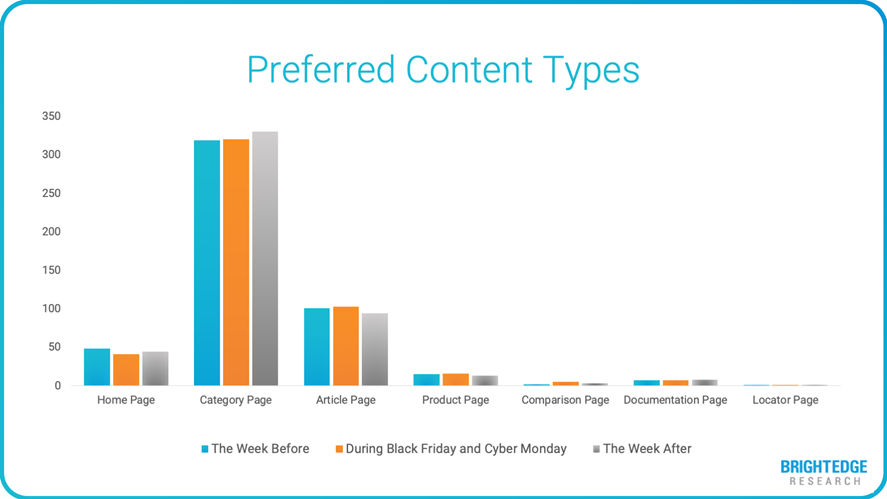
When we looked at the types of pages that were preferred, we did not see dramatic fluctuations, but there are a few movements that align to what we saw with share of voice.

  • Category pages continue to dominate e-commerce

If you joined our webinar, Critical Shifts in E-Commerce: Preparing for the 2021 Holiday Season, you heard us discuss the importance of category pages. Based on the data, we see category pages are only gaining prominence as holiday shopping is in full swing.

  • The homepage continues to lose ground

During Black Friday and Cyber Monday, we saw homepages give ground to article and product pages in search engine results pages. While this was not a dramatic shift, it was enough to suggest that richer and deeper experiences do incrementally better during peak shopping periods. If you are launching new products or running promotions, a big splash on your homepage is great, but you need to make sure those deals are prominent on your category and product pages as well, because those may be the pages your customer sees on a search result in lieu of your homepage.

  • Article and product pages are losing steam following Cyber Monday

While slight and incremental, it is interesting to note that coming out of the peak days, the page types we see being less prominent are product and article pages. This is interesting to note because we see the category level pages rise in nearly the same proportion. This anecdotally suggests that in the height of shopping seasons, the more of a rewarding category level experience you can provide, the more likely you will be rewarded in organic results. This makes sense in conjunction with what we see with share of voice as well, where brands like Nintendo and Apple are offering popular products this season and win with category-level pages related to those products.

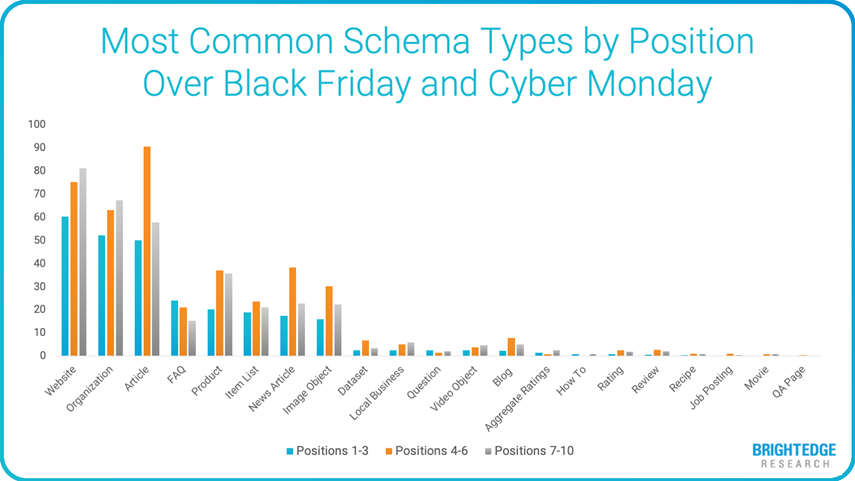
It was also interesting to see the before, during and after aspects across site types. We were curious what schema was the most prominent for pages during Black Friday and Cyber Monday. Schema is a markup language that helps search engines understand the context of the content it is crawling (so instead of a series of numbers, schema can be used to tell a crawler that this is a time or date). The results suggested a lot of page structure information, but also some revealing insights as to what is and is not being conveyed by the winners this year.

  • Site architecture schema doesn’t translate to higher rankings

At the very least we’re seeing winners in e-commerce are giving context of who they are, but it isn’t a direct correlation to better rankings. Fewer winners in the top 3 positions are declaring the site type and organization schema than those occupying the lower third of the results.

  • FAQ schema is more present with higher ranking pages

Unlike architectural content, we do see FAQ schema more likely to be present in the top 3 rankings than in the lower third for the keywords we evaluated. This supports a key observation we’ve made: searchers favor a richer shopping experience as evidenced by the predominance of category pages, fewer homepages, and more brands winning on the peak shopping days. In that vein of richer shopping experiences, it would also follow that easy access to answers about the products creates a positive experience. If you have FAQ content, even if it links out to a separate page, ensure that it is easily identifiable by the search engines on these pages.

  • Product schema is still important

Per what we observed with the slight increase in Wikipedia’s share of voice during Black Friday and Cyber Monday, we suspect that could impact how much product schema was present in the top 3 results. We do note that outside of structural schema, it is the most prominent type we encountered in rankings 4 through 10. Ensure product schema is incorporated in both your category pages and product pages to help engines understand the context of the content.

Ultimately there are hundreds, if not thousands of factors that will determine how and why a page ranks in a certain position for a particular keyword for a given user. But looking at the macro conditions, we do see some slight variations in how results are treated before, during and after peak shopping times. For e-commerce, it appears critical that you focus on the shopping experience your category page offers by providing useful answers to customer questions while making it easy to get into products they may be shopping for.We hope you had a successful kickoff to the holiday shopping season and wish you a great return in Q4!

Four tips for SEM teams to adjust to a privacy-focused future

30-second summary:

  • Within the digital marketing space, the conversation around privacy and cookie changes has focused heavily on programmatic and paid social
  • But how will third-party cookie deprecation and new privacy regulations impact paid search?
  • Here is what search marketers can expect and how to prepare

In the digital marketing world, targeting, measurement, and optimization have foundationally relied on the ability to accurately track user behaviors and performance across the web. However, as we all know, platforms like Google and Apple have introduced privacy-focused initiatives over the past few years that complicate targeting and measurement for advertisers.

When discussing the impacts of these changes, much of the conversation has focused on programmatic and paid social, which are undoubtedly the digital channels feeling the greatest impact. What has not been discussed in great detail is the impact on search marketing. How should advertisers adapt their paid search strategies to adjust to these new realities?

Before digging into action items, let’s recap the newest updates and how they’ll impact paid search campaigns.


Chrome’s privacy updates will have a greater impact than iOS

There are two key privacy changes top-of-mind for search marketers in 2021. App Tracking Transparency (ATT), introduced through Apple’s iOS 14.5 update, requires a user to opt-in before a company can track their data across other apps or websites. Fortunately, the impact of this update on search programs for most advertisers is limited. Advertisers may see fluctuations in universal app campaign (UAC) volume, and search properties with a larger app-based audience (for example, YouTube) will experience some degradation in measurement and targeting. By and large, though, the ATT update is more of an issue for programmatic advertisers than search marketers.

Google Chrome’s third-party cookie deprecation, coming in 2023, will have a larger impact on paid search. From a targeting perspective, remarketing lists for search ads (RLSA) will become less effective without data on users’ behaviors across non-Google properties. As of Q3 2020, RLSA accounted for 20 percent of Google search ad clicks for Merkle advertisers – so this is a significant segment of traffic. There will also be new measurement challenges, especially for companies relying on proprietary reporting tech.

While iOS 14.5 is already a reality for advertisers, there is more than a year left to prepare for Google’s third-party cookie deprecation. There are several steps search marketers can take now to optimize performance within a more privacy-focused environment.

1. Lean into first-party data audience solutions to target

Effective audience segmentation and targeting will continue to be critical in search moving forward. Google offers several in-platform audience options, such as in-market and affinity audiences, that don’t rely on third-party data and can be leveraged by advertisers indefinitely.

However, there’s a greater opportunity for organizations to differentiate themselves by crafting a strong audience strategy using their own first-party data with Customer Match. Many advertisers already use Customer Match to some degree, but the data may not be refreshed regularly, or it may not be segmented in detail. The transition away from third-party cookies is the perfect impetus for fine-tuning a first-party data strategy.

First, advertisers should assess the quality of their first-party data. How comprehensive is the data that’s collected? Are there a lot of duplicate records, or is there a reliable unique record for each customer? All of the slicing and dicing in the world won’t be helpful if the data you’re working with is fundamentally flawed.

Next, marketers should assess opportunities to segment their customer lists in meaningful ways – a single “email subscribers list” isn’t going to cut it anymore. Smart segmentation is always important, but it will become even more critical because it will empower Google to build more tailored similar audiences.

After establishing segments, there must be a plan to refresh those audiences frequently. Determine an appropriate cadence for updating customer match lists and determine who’s responsible for doing it. Currently, this can be done through the Google Ads API or within the Google Ads interface.

Once a foundation is in place for your audience strategy, revisit your approach quarterly to ensure that segments continue to align with attributes important to your customers and your business. This also creates a natural check-in point to confirm that lists are being updated as expected and that they’re all receiving traffic. If needed, audience bid modifiers should be adjusted to reflect current performance.

On the topic of bidding…

2. Test or transition to Smart Bidding to take advantage of Google’s proprietary signals

While we, as advertisers, will have lesser user data available to us without third-party cookies, Google will continue to have a wealth of information about its users and their behavior on Google-owned properties. Google Ads’ Smart Bidding allows advertisers to take advantage of those audience signals to reach the right person at the right bid with machine learning. That’s not to say that segmentation isn’t important with Smart Bidding – it still is. One of the many signals the bidder looks at is all of the audiences a given user belongs to, including customer match audiences.

Advertisers can and should take advantage of custom audience segmentations through Google Analytics, Looker, or Google Cloud Platform (Big Query). And they should automate the pushing of defined customer audiences to Google marketing activation to maximize business data with Google’s Smart Bidding.

Whatever your advertising goals may be, there is likely a Google Ads Smart Bidding strategy to suit your business needs. For search marketers not yet using Smart Bidding, it’d be smart to start testing in early 2022 to iron out any kinks and have a full-blown Smart Bidding approach before 2023.

3. Get comfortable with new reporting methods

We’ve talked a lot about adapting to the changes to come with targeting, but privacy updates also create challenges for reporting. There will be a measurement gap that advertisers need to solve. Fortunately, Google Ads has solutions in place to help fill holes with enhanced and modeled conversions.

Enhanced conversions improve reporting accuracy by using an advertiser’s hashed first-party data to tie a conversion event to an ad interaction. Enhanced conversions are powerful in that they make a one-to-one connection between an impression or click and a purchase. Modeled conversions, on the other hand, find their power in scalability; Google has been using them to report on cross-device conversions for several years. When used in combination, advertisers get the benefit of precision where a one-to-one connection exists, while smartly estimating conversions in areas where it does not.

As privacy regulations increasingly muddy the reporting waters, the stakes are higher to work with Google to fill the gaps. If you’re relying primarily on proprietary technology for reporting, consider using Google’s measurement system to get a more complete picture of performance. Understanding the full impact of search is critical for being able to optimize and allocate budgets effectively. Note that Google’s global site tag or tag manager is required to appropriately track conversions.

4. Monitor universal app campaigns for performance changes

Advertisers using UAC to drive app downloads via paid search should closely monitor performance for those campaigns. So far, Merkle has observed a slow downward trend in tracked installs as a result of Apple’s ATT update. To avoid the effects of ATT, some advertisers are increasing their investment in Android or shifting spend there entirely. UAC can continue to be an effective channel for marketers, but reduced visibility on iOS may require bid or budget shifts in order to hit performance goals.

Conclusion

Privacy updates are changing the way marketers approach targeting and measurement. Don’t panic – but do put a plan in place. With the right adjustments, search advertisers can effectively pivot along with the industry. More than ever, advertisers must value first-party audiences driven by search to further customer engagement, experiences, and marketing ROI. Using that first-party data, in conjunction with machine-learning-based bid strategies and modeled and enhanced reporting, will create a foundation to help future proof search campaigns for privacy updates in the years to come.


Matt Mierzejewski is SVP of Performance Marketing Lab and Search at Merkle Inc.

Subscribe to the Search Engine Watch newsletter for insights on SEO, the search landscape, search marketing, digital marketing, leadership, podcasts, and more.

Join the conversation with us on LinkedIn and Twitter.


Zero click search: the new consumer comfort zone

30-second summary:

  • Zero click search presents advertisers with the opportunity to pro-long budgets during periods when the paid search landscape is hypercompetitive
  • Brands can cash in on zero click searches for the organic element of their overall search strategy to gain visibility and drive conversions
  • Barilla Group’s global digital & search marketing manager, Nitin Manhar Dhamelia advises on zero click search optimization and measurement

Historic context

Back in 1998 when Google was founded, it served 10,000 searches per day and by 2012 it was 3,500,000,000 searches per day.​ And in 2021, search volumes continue to explode with Google serving around 5,600,000,000 searches globally per day.​

Google Search volume stats 2021

Its success in becoming a transitive verb was borne when Google tasked itself with bringing order to the chaos of the world’s knowledge. It knew that to achieve this magnitude of top-of-mind awareness, the key would be to create a window to the web that was inclusive, accessible, and easy to understand for the general population; it knew that inclusivity would accelerate adoption. Even today, the search giant is always working on improving the consumers’ search experience and 2021 saw several key algorithm updates roll out – passage ranking, page experience, page titles, MUM, mobile-first indexing, and more.


Not too far ahead in the future, Google is going to make it even easier for consumers to access information about brands.​ But why?

Micro funnels

Because people visit Google in key decision-making moments along the buyer journey – essentially, each Search session can be deemed a micro funnel. In fact, after the pandemic, there is no undoing the great reset. Nearly, 15 percent of Google search queries Google attended were first of their kind. And 81 percent of consumers discovered new brands online during the pandemic.

“There isn’t a world where people revert back to their 2019 behaviours, and part of that is now a part of their comfort zones.” – Corie Barry, CEO, Best Buy

Google’s own recent retail report identified four key consumer insights:

  1. Dynamic demand: People’s buying patterns will continue to change in response to unpredictable times
  2. Digital inspiration: People will use the internet to be inspired
  3. Convenience: People will prioritize convenience while shopping
  4. Supportive spending: People will be more mindful of how and where they spend their dollars with “values” playing a major influencer

Even though less favored by advertisers, zero click searches are pockets of opportunity for brands to focus on as part of their branded search strategy.

With great power comes great responsibility

With its always-on innovation focus, Google is constantly expected to eclipse itself (for the better) and the way it aims to achieve that is by presenting information in ever more easy-to-digest consumer-friendly formats.​

Its solution? Bringing convenience and comfort to their searcher’s online journey with zero click search. This means redesigning the search experience to align with a lucid consumer journey, which in some cases implies that – the journey both starts and ends in Google, and without a single click in the search results:

Squid Game Google zero click search

In terms of how this translates into volumes of searches, take a look at the data from an industry study below:

Zero click search data

What does this mean for brands?

In my own research the split of traffic between the core search marketing channels for a keyword that has a “need” intent, calculates to:

  • Paid: 6.5 percent
  • Organic (above the fold): 31.5 percent
  • Organic (below the fold): two percent
  • Zero Click Searches: 60 percent

Extraordinarily, the last number isn’t too far off an original 2020 study that was made of a sample size that is far greater than most brand marketers might have immediate access to.

However, when smaller, localized in-house studies surface very similar results it drives the conversation forward into where we need to focus a proportion of our overall search budgets: creating data-driven content that contributes to adding value and top-of-mind awareness (TOMA) to consumers.

Tips for brands to optimize and measure zero click search

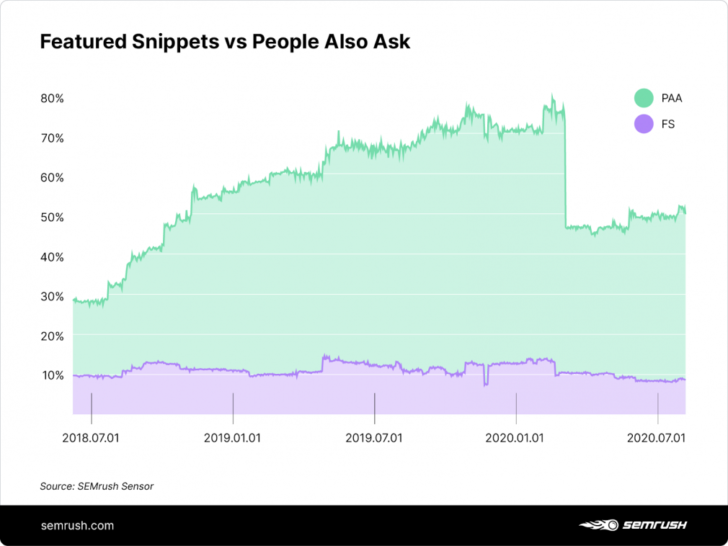
The people also ask (PAA) feature in Google (essentially website content derived FAQs in Search results) are around six times more likely to appear in a search results page versus featured snippets.  And therefore, PAA should not be underestimated as a branding tool. So the first tip is to create editorial content that resides on your website and optimize for PAA – using long-tail search data.

And the second tip is to optimize your content for featured snippets across brand and partner websites – your keyword traffic or search traffic insights could help prioritize this activity internally.

Another interesting insight that stood out was – regardless of the industry, most “big” brands will trigger a PAA.

PAA box visibility stats

Measuring zero-click performance

Gauging the impact of zero click search remains a frequently asked question itself and a continued enigma that has hampered brands from focusing on this highly important search facet. These are some valuable avenues for search marketers to track the zero click search features’ performance:

1. Understand relativity

Understand the relationship between impression volume and average ranking for a target keyword(s) in the Google search console to create insights into where branded content can trigger a zero click search result.

2. Track soft metrics

This is where the soft metric shines – so by focusing on zero click SERP features for brand vs competitor domains, it’s possible to create an index to track the outcomes and evolution of a soft metric such as ‘share of intent’. This will help you grow product or service awareness/consideration via the zero click search element of your Search Strategy.

Piecing all this information and tailoring it to your brand will positively add a new dimension to your search marketing strategy.


Nitin Manhar Dhamelia is the global digital & search marketing manager at Barilla Group. Nitin has a 15-year track record of global B2B/B2C team management, governance, commercial experience, across Americas, EMEA, APAC.

Subscribe to the Search Engine Watch newsletter for insights on SEO, the search landscape, search marketing, digital marketing, leadership, podcasts, and more.

Join the conversation with us on LinkedIn and Twitter.


Categories SEO

5 Critical SEO Considerations for SEO in 2022

Despite the ever-changing nature of search engine algorithms, organic traffic remains one of the most stable and valuable sources of leads and customers for businesses. Research published by Milestone showed that search engines, through a mixture of generic and local results, accounted for 69% of all digital traffic from January 2020 to June 2021. 

As you look towards 2022, it’s essential to recognize the need for a structured, research-based approach to SEO that accounts for a broad set of ranking factors. In this post, you’ll learn about five considerations that will be of central importance in the coming year.  

Google’s market share sat at 87% in September 2021. As such, this article will focus on the acknowledged giant of the industry. That said, a well-rounded strategy will also impact rankings in secondary search engines like Bing, Yahoo, DuckDuckGo, Ecosia, etc.  

Let’s dig in.  

1. Expertise, Authority, and Trust (EAT) 

The acronym “EAT” refers to a bundle of three ranking factors used to determine the quality of content on a site: expertise, authority, and trust. Included in Google’s Search Quality Rater Guidelines, EAT is also cited among the most significant ranking variables in the widely-respected SEO Periodic Table published by Search Engine Land. 

Various experts have echoed this position. Google’s Public Search Liaison Danny Sullivan tweeted, “We…use a variety of signals as a proxy to tell if content seems to match E-A-T as humans would assess it.” 

Here’s a brief overview of each factor: 

  • Expertise – Expertise refers to the accuracy, timeliness, and depth of content. Hiring established experts, regularly auditing your site, and including author bios are all examples of ways to boost expertise.  
  • Authority – Generally speaking, authority refers to the quality and quantity of citations to content, typically in the form of links and social media shares. The centrality of authority highlights the relevance of content promotion in 2022.  
  • Trust – Trust typically refers to the overall perception of your brand and website. Brand authority, past adherence to quality standards, and references from high-tier domains all likely come into play.  

Google’s BERT (2019) and MUM (2021) updates reflect Google’s commitment to providing users with highly relevant content based on limited keyword information. Companies that focus on maximizing EAT factors will find themselves best placed to meet Google’s content quality criteria.  

2. Desktop Page Experience (UX-Driven SEO) and Core Web Vitals 

Google’s “page experience update” is one of the biggest algorithm changes of 2021 and is expected to have lasting ramifications well into and after 2022. Google announced that it would finish adding page experience ranking signals to desktop sites by February 2022. 

Google describes the update in the following way: “Page experience is a set of signals that measure how users perceive the experience of interacting with a web page beyond its pure information value.” 

In addition to several other factors, the update targets three aspects of user experience, collectively called “Core Web Vitals”: largest contentful paint, first input delay, and cumulative layout shift. Ensuring that these on-site elements are accounted for will mean that user experience is optimized beyond EAT-based ranking criteria.  

3. Link Building and Citations 

Link building is still a key ranking factor and one of Google’s oldest and most foundational ways of establishing a site’s reputation. The counterparts of links for local businesses are citations.  

Link building is an essential part of any SEO strategy, and there are no signs that this will change going into 2022. Three factors are relevant when taking an active approach to link-building (which will typically take the form of outreach): 

  • Quality – Links from high-quality, trusted sites carry much greater weight than low-quality alternatives.  
  • Quantity – Generally speaking, the more links you can acquire, the better.  
  • Anchor text – You should aim to build a diverse and relevant anchor text profile.  

For citations in business directories, which are a key ranking factor for local businesses, the same principles apply.  

4. Spam, Cloaking, Stuffing, Low-Quality Links and Other “Toxins” 

Google has renewed its efforts to discount sites that rely on “spammy” optimization strategies. November 2021 saw a spam-related update. And this has been preceded by several algorithm rollouts targeting low-quality content, like the June and July core updates.  

Deceptive SEO tactics are referred to as “toxins” and constitute questionable practices that violate Google’s Webmaster Guidelines.  

There are five strategies that you should take particular care to avoid: 

  • Cloaking – Showing content to search engines that is different from what users see.  
  • Keyword stuffing – Overloading your content with keywords.  
  • Link schemes – Link schemes involve paying for links on third-party sites. Invariably, these sites are of a low quality.  
  • Duplicate content – Don’t repost content that you do not have rights to. If you are using duplicate content, add the proper canonical tags.  
  • Ad-heavy site design – User experience is primary. Don’t overload your website with ads and promotional materials.  

Given the expected significance of EAT factors in 2022, poor quality content should also be considered as something to avoid as a priority.  

5. Voice Search 

Google’s emphasis on voice search comes on the heels of increased user activity in regards to IoT (Internet of Things) devices. And while voice search hasn’t dominated in the way that many predicted several years ago, data from Adobe Analytics clearly shows that the use of voice-based interfaces is growing.  

In September 2021, Google announced the release of its “latest research breakthrough,” which took the form of advanced voice technology LaMDA (Language Model for Dialogue Applications). LaMDA is notable because it signifies Google’s efforts to further streamline search results based on changing user habits.  

Structuring content to include featured snippets, targeting long-tail keywords (especially local terms), and optimizing for mobile are all ways of catering to the increasing number of voice searches.  

Conclusion 

It’s easy to fall into the trap of thinking that nothing about SEO is constant. The reality, however, is that ranking factors change much more gradually than many businesses assume.  

The fundamental criteria of user-focused site design, high-quality content, and citation-based trust have remained largely unaltered since the earliest days of Google’s presence on the web.   

As you build your SEO strategy, it is important to keep this in mind. While specific technical priorities may change, properly laid groundwork that prioritizes customer experience above all else will ensure success over the long term – in 2022 and well beyond.  


2021 Google updates round up: everything businesses need to win at search

30-second summary:

  • There have been three core updates in 2021, released in June, July, and November, while another was rumored but unconfirmed in October
  • Featured snippets that fell under the YMYL algorithm were unexpectedly removed in February, then restored in March
  • Product reviews came under the microscope in April, with marketing and sales-centric language penalized in favor of expertise on review-centric websites
  • Multiple spam updates unfolded throughout the year, though these updates should not impact any website that follows Google’s guidelines

Successful SEO strategy is akin to dancing the tango with Google updates. Unfortunately for copywriters, the Big G can be an unpredictable partner at times. In addition to daily algorithm tweaks that go unnoticed, we all brace ourselves for core updates that have a sizeable impact on page ranking and performance. Throughout 2021, Google has confirmed a handful of updates.

Further updates have also been speculated by experienced web-based professionals, reporting these to aid others in remaining on the right side of an adjustment. Throughout this guide, we’ll discuss the updates rolled out by Google in 2021 to date.

Complete list of 2021 Google updates

As promised, let’s review all the algorithm updates issued by Google during 2021, major and minor alike. Some of these are official, confirmed by Alphabet themselves. The core updates are an obvious example of this. Others were noticed by webmasters of influential brands and discussed online. These unconfirmed updates are marked in red below.


1. Passage indexing (February)

The passage indexing update, announced in October 2020, is probably better described as passage ranking. The purpose behind the update is simple and noble. It will pick out one particular sentence or paragraph from a long-form article, aiding a niche web query and avoiding irrelevance.

Essentially, this update seeks out keywords and terminology in an entire article rather than focusing primarily on titles and subheadings. At the time of writing, Google projects that this will impact around 7 percent of search queries. At this point, the passage indexing update also only applies to copy written in US English, though this will eventually become global and translingual policy.

Now, you may be wondering how this differs from a featured snippet. The short answer is that a snippet is chosen based on the whole web page, seeking relevance to the subject at hand in all aspects of the query. The passage indexing update can pick up on a small element of a broader discussion that would otherwise be banished to the mid-page and beyond. Speaking of featured snippets, however…

2. Featured snippet drop/featured snippet recovery (February and March)

In mid-February, MozCast noticed that featured snippets vanished from countless SERPs on Google. This involved a decline of some 40 percent, the largest in over six years. Snippets that revolved around medical or financial advice were particularly impacted. Some of the keywords and terms that experienced this plummet included:

  • Acne
  • Autism
  • Diabetes
  • Fibromyalgia
  • Investment
  • IRA
  • Lupus
  • Mutual funds
  • Pension
  • Risk management

As you’ll see, the YMYL broad algorithm appeared to be a particular bone of contention. We’ll never know for sure, as this update – if indeed there was an update – has never been confirmed or denied by Google. What’s more, around a month later, these snippets returned as though they had never been away.

Without any explanation behind the mystery, it’s impossible to offer advice to webmasters on how to avoid a future unwarned absence of featured snippets. The fact that YMYL was hit so hard suggests that it was a deliberate action, though. Whenever working within this niche, proceed with caution – especially if relying on SERPs for ecommerce opportunities.

3. Product review update (April)

April’s product review update was also critical to ecommerce sites and those that collate product insights. Google is adamant that this has not been a core update. However, the approach that content marketers must now take mirrors the core updates that arose later in the year.

Following the review update, it’s more important than ever that product reviews remain strictly factual. That means discussing a product’s qualities (or lack thereof) without clear and obvious attempts to push for a sale from an affiliate. Sites that used their copy to talk up the qualities of a product using popular keywords and directing consumers toward Amazon were typically penalized.

Thin copy, as always, captured Google’s attention too, and not in a positive manner. Meaningless, fluffy words designed to pad out a page, along with repetition, will see a page slide down the rankings. A product review site that hopes to remain in good stead with Google must remember the fundamental rules of E-A-T. You can still attempt to make a sale, but not at the expense of demonstrating expertise, authority, and trustworthiness.

4. Multitask Unified Model aka MUM (June)

June was a busy month for Google, starting with the Multitask Unified Model update, better known as MUM. This update could be considered a logical extension of the previously discussed passage indexing update. MUM also used AI to improve the search experience for users, replacing BERT (Bidirectional Encoder Representations from Transformers).

It’s claimed that MUM is at least 1,000 times more powerful than its predecessor. In addition to providing greater, much more insightful data for users, MUM works to eradicate language barriers, including misspellings, leaning upon nuance to meet the expectations of a search.

Perhaps more importantly, MUM means that irrelevant content, picked up through a questionable use of keywords to game the SEO system, will soon disappear from the top of the page in favor of more appropriate content. The core update that came later in the month garnered most of the headlines, but don’t sleep on the impact of MUM.

5. Spam updates (June)

Next in June came a spam update, which took place over two weeks. In theory, this update should not have impacted any website operating under white hat SEO rules. It was designed purely to keep content relevant and appropriate, battling against sinister tactics.

As always, though, there was room for error with this update. It’s always advisable to keep on top of the latest webmaster guidelines laid out by Google. This way, a site is considerably less likely to fall foul to a misunderstanding and accusations of black hat traffic-hoarding.

Updates to Google’s Predator algorithm could also be considered a crucial part of this update. Google has been taking lengths to protect people from harassment online, and a big part of this is downgrading sites that seemingly exist purely to denigrate a reputation.

6. Page experience update (June)

Page experience update sounds like a grand event, comparable even to a core update. In reality, this was a pretty low-key affair. It was also a slow procession, kicking off in June and rumbling on until August. All the same, there will be a degree of ebb and flow as a result. Discuss the update with your UX designer and ensure it remains at the forefront of your thinking.

One of the biggest takeaways from this update is that AMP is no longer essential to rank as a top new story. That could make a sizeable difference to any reporting site. The usual caveats still apply, though – sticking to the established policies of Google News is non-negotiable. Although AMP is no longer critical, ensure your news articles remain mobile-friendly, hosted on a fast and secure server, and unfold devoid of interruptions such as intrusive advertising.

7. Core update (June and July)

Here’s the big kahuna that has every web admin across the globe on tenterhooks – Google’s major summer core update. In 2021, Google announced two updates over June and July, both of which would be connected.

As always, there were winners and losers from this update. In a recurring theme, YMYL sites appeared to lose a great deal of traffic throughout the update – especially in June, when the changes were most volatile. Thin content in any niche also seemed to be a particular focus of this update, with such sites pruned cautiously.

However, some sites that were previously heavily penalized may have experienced a little bounce back. It has been claimed that the biggest priorities of the June and July updates, other than thin copy, have been domain age and the use of backlinks.

Review the traffic of any old sites that you wrote off after the game-changing updates of 2019. These sites may have experienced a revival in page ranking and could be worth reinvestment. Just be mindful that Google may consider this an oversight and reverse the decision at any moment.

8. Link spam update (July)

Another spam-detecting algorithm rolled out in July, this time focusing on backlinks. What’s interesting here is that Google referred to this update as ‘nullifying’ spam links, not penalizing them.

Essentially, Google will just stop counting inappropriate links toward a page ranking and quality score. Naturally, though, it would feel like a punishment if a site relied upon these links previously – this is an important Google update for link-building professionals to pay attention to.

Keep an eye on the links on your site if you have seen a drop in traffic, ensuring that they meet Google’s link scheme standards. It could be all too easy to fall foul to this update based on outdated copy that has not been updated in some time and now links to an altered and irrelevant online location.

9. Page title rewrites (August)

Here’s an interesting update from August. Google started to adjust carefully selected page titles, leading to different ‘headlines’ in search results. This may have SEO consultants across the world wailing and gnashing their teeth, seeing meticulously curated messaging adjusted according to Google’s whims.

Rest assured, the page titles are not undertaking complete rewrites. We are talking about adjustments, not wholesale changes, to title tags. All the same, it could be enough to leave a webmaster frustrated with the outcome. Nobody wants to be accused of click-baiting, especially when the news industry has a questionable reputation with a cynical population segment.

There is little anybody can do to prevent this. To retain some measure of control, though, keep your H1 headings short and readable, and be mindful of your H2 headings. These may be used, in part or whole, to adjust the title of a search result.

10. Speculated core update (October)

We previously discussed how, back in February, MozCast acknowledged some strange patterns pertaining to featured snippets that Google never acknowledged. Something similar unfolded in October when various significant webmasters noted sizeable changes in traffic and performance. This led to claims that Google had engaged in another core update.

Much like February, these changes remain unconfirmed. However, as we’ll discuss in a moment, there was a reasonably seismic core update in November. Given that the previous update unfolded over two months, it is not beyond the realms of possibility that Google adopted the same practice this time around.

11. Spam update (November)

Another spam update occurred in November 2021, once again targeting infractions that break Google’s general content guidelines. A website that does not contravene basic regulations or cut SEO corners should remain unaffected. Do keep an eye on your traffic and performance, though. If you notice any fluctuations, it could be time for a refresh of your content.

12. Confirmed core update (November)

Finally, we had another core algorithm update in November. At the time of writing, this was still a very recent development. As a result, the impact of the update will become more apparent over time. Some early responses and acknowledgments have been noted, though.

The most significant adjustment appears to be mobile searches, which were declared 23 percent more volatile than the previous update. Again, much like earlier in the year, featured snippets and ‘quick answers’ in the YMYL niche seem the most heavily impacted. Health and real estate, in particular, have seen a big change in performance.

Now, it’s worth noting here that Google felt compelled to address the timing of this update. Danny Sullivan took to Twitter and accepted that an update just before Black Friday and the Christmas shopping season is not ideal for ecommerce sites – especially those that already adjusted their copy based on previous updates.
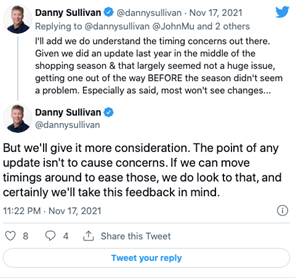
Danny Sullivan's Tweet on Google update

Source: Twitter

It will be interesting to see if this will change how Google approaches algorithm updates in 2022 and beyond.

This concludes our trip through the Google algorithm updates of 2021. Just remember, more tweaks and changes are made each day. Most of these adjustments have little to no impact on the performance of your website. If you have spotted a change in fortunes, though, review when this occurred. You may find the answer lies above.


Joe Dawson is Director of strategic growth agency Creative.onl, based in the UK. He can be found on Twitter @jdwn.

Subscribe to the Search Engine Watch newsletter for insights on SEO, the search landscape, search marketing, digital marketing, leadership, podcasts, and more.

Join the conversation with us on LinkedIn and Twitter.



2021 State of SEO Webinar: Your Questions Answered

Thank you for everyone who joined our State of SEO webinar in mid-November; we welcome you to access the on-demand recording at your convenience. We wanted to use this webinar as an opportunity to engage and see how the community was feeling about various aspects of SEO as we all plan for 2022. We appreciate everyone who participated in the interactive webinar – full results of the polls can be found in this 2021 State of SEO blog post.

We received a lot of questions throughout the webinar and unfortunately due to the volume of content being presented, we weren’t able to have a proper Q&A. We want to address some of the questions that seemed to have common themes here. If we weren’t able to address any questions or concerns you have going into next year, we encourage you to reach out to your BrightEdge Customer Success Manager so we can help you and your organization have the best 2022 possible!

There were three themes that we identified in the questions, so let’s look at those now!

1. What specifically were the 3 spam updates in 2021 targeting?

Google doesn’t typically get into specifics about what each spam update addresses each year. Based on what we have been able to uncover and what the community has flagged as pertinent to the updates, there does appear to be some areas that these updates were designed to help with. As you may have expected, they are right in line with many of the other initiatives Google has undertaken in 2021!

With the Summer update, the details Google gave implied that this was a global update that would impact web and image results. In its communication to webmasters during the rollout, Google shared its general webmaster guidelines and when we look at those in conjunction with spam updates in the prior year, we believe this spam update was primarily focused around eliminated automated and scraped content.

We did not see significant shifts one way or another (while this spam update rolled out, Google also had Core updates over the Summer which may have impacted your results, rather than a spam update). We did not see significant changes in sites being targeted looking at Black Hat resources which leads us to believe the targeting nature of that update was no different than the trajectory Google is on. If you are scraping or automating content you may see those pages suffer from that update.

The November update is early to say for sure, and we aren’t registering significant movements in rankings this month, but we are seeing chatter that webmasters are being impacted. There were not any specific updates to Google’s Webmaster Guidelines on what is considered spam, which suggests no new types of spam are being targeting. Based on those conversations, it appears this update has impacted sites that are using cloaking in order to inject links into their sites. We have no hard data on this, but as always, we believe the best policy is to ensure your tactics and strategies fall within Google’s guidelines.

2. Since the quality of content is king, is it still necessary to have long articles if shorter content is more relevant?

One of the things we discussed about 2021 advancements was that it suggested Google is interested in finding ways to make content useful without its format being a barrier to the user. This means that updates like Passage Based Indexing and bigger initiatives like MUM could sort of democratize content, so regardless of how you did a search, Google can distill a useful answer for you by drawing on content from multiple formats, languages and origins. Pretty cool stuff!

We actually believe these advancements should allow you to focus even more on what’s most relevant for your direct customer. For example, if you are creating a page that’s all about caring for your lawn mower, you probably will need to cover a lot of ground – from cleaning it, to replacing parts, to general upkeep etc. This update should allow Google to decipher and surface the specific parts of that content that is relevant without you having to factor that into how you design that content (the UX, readability, and how you break the content out should be based on building a good experience for the audience).

On the flip side, and more to the spirit of the question, if you are creating a spec sheet for a set of speakers, and you’ve leveraged schema to provide context for what the page is about, that is probably more relevant to your customer than long form content that would require them to read passages about all things speakers before they can see what wattage the speakers are!

These updates should allow you to think in those terms rather than whether the format will be rank-able in SERPs. That said, it’s still critical to pay attention to what Google is treating as quality content and what intentions it believes users have when they are doing searches!

3. Is there any particular preparation you suggest we should take for SEO markup on pages behind a paywall?

Paywall content has long been a challenge for SEOs. There are ways of surfacing this content to engines which could be construed as a form of cloaking if you are not communicating to Google what the site is. Fortunately, this is pretty easy to do. There’s a schema for that!

Google’s official recommendation for paywall content is to either meter the content (I.e., allow a certain amount of free content until you ask for a registration), or use a lead-in, which essentially lets the user see the first couple paragraphs to get a sense of what the article is about, and then require them to subscribe to read the full article. In both cases, you can allow Google to crawl the full depth of the articles.

Regardless of which approach you take, you need to signal to Google that this is paywall content, so it isn’t perceived as cloaking or misleading the engine. You can do this with schema. Per Google’s guidelines, this will help ensure Google can differentiate between content targeting subscribers and cloaking to deceive engines on the pages’ intent.

It remains to be seen how this could change or evolve with the advent of Passage Based Indexing and the launch of MUM, but based on prior advancements, we expect the guidelines and transparency in communicating to Google what the pages’ intention is to remain intact.

There is a lot to think about for next year. We look forward to partnering with you and helping you see more value out of organic search in 2022 than ever before!

What is Keyword Search Intent?

When it comes to leveraging keywords in SEO, there’s more to it than simply selecting words and plugging them into a webpage. Search engines are now more intuitive when it comes to understanding and ranking content on the web. Where previously the authority of a topic could be determined by how many times a keyword was used on a webpage, search engines now consider the context of a keyword (i.e., how the keyword is being used and for which purposes).

When we consider the context of a keyword, we are considering the keyword’s search intent, or user intent. Understanding keyword search intent is highly valuable when creating content for the website; by doing so, you can ensure you are creating content that is useful and relevant to your target audience’s needs.

What is Search Intent?

Search intent is the user or audience’s purpose of a specific online search. Keywords can carry different meanings (i.e., “race” as in “marathon race” vs. “ethnicity”), so search engines use search intent to understand and deliver results they think the audience is looking for. Again, search engines understand search intent because they address the context of a keyword, not just the definition itself.

This context includes factors such as on-page headings (H1s, H2s), internal and external links, anchor text of links, images, and image alt text. These factors inform search engines on how a keyword is being used and defined.

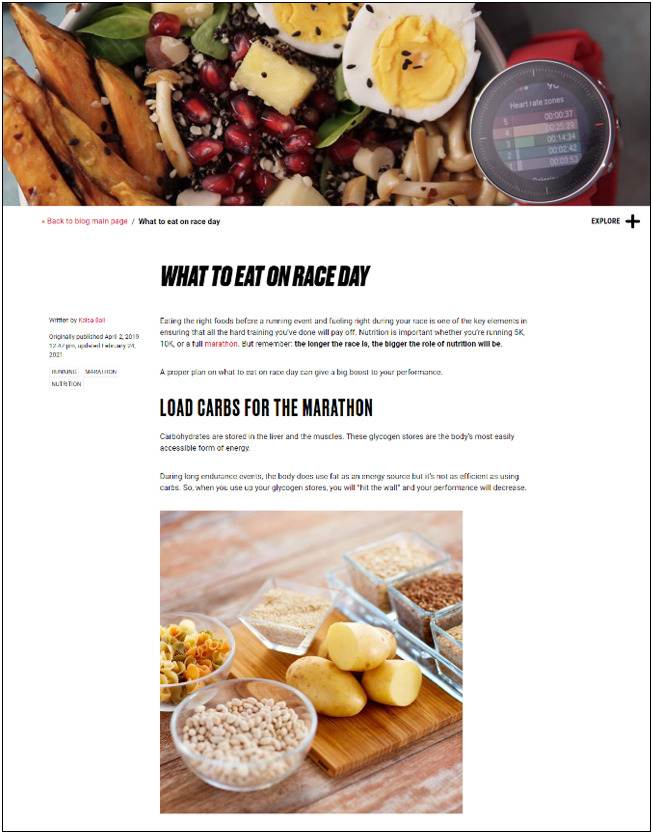
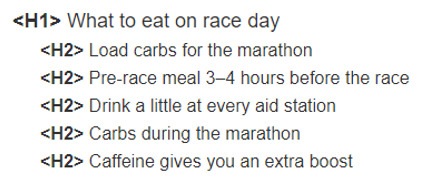
For example, the webpage “What to Eat on Race Day” optimizes subheadings (H2s) to include terms such as “marathon”, “carbs” and “pre-race” to inform search engines of the context the keywords “race” and “race day”. 

The page also includes an image of a marathon runner with alt text to describe the image with relevant terms (e.g., “energy drinks” + “carbs” + “race day”).

Pages that gain the most visibility and attract the most site visitors for a specific keyword in specific context begin to earn authority for that keyword (i.e., it is understood by search engines to be the most relevant and authoritative result for that keyword in that context), and will garner a top spot on the search engine results page.

The 4 Types of Search Intent

There are 4 common types of search intent:

1. Informational Search Intent: this is when a user is looking for information, such as definitions and explanations. The results for these search intents are usually How-To, What, and Why types of evergreen content (e.g., Wikipedia pages, blog posts, and instructional videos).

Examples: “what is tomato sauce?,” “types of beer,” “history of Spain”

2. Navigational Search Intent: users with this search intent want to go to a specific place, such as a site or a physical location, or even a specific spot on a webpage

Examples: “YouTube,” “Starbucks,” “compare electricity pricing”

3. Transactional Search Intent: this search intent signals someone who wants to complete a transaction of some kind. Usually, the user already has a specific idea in mind (branding, product, pricing, etc.) more than any other type of search intent and is ready to convert or make a purchase.

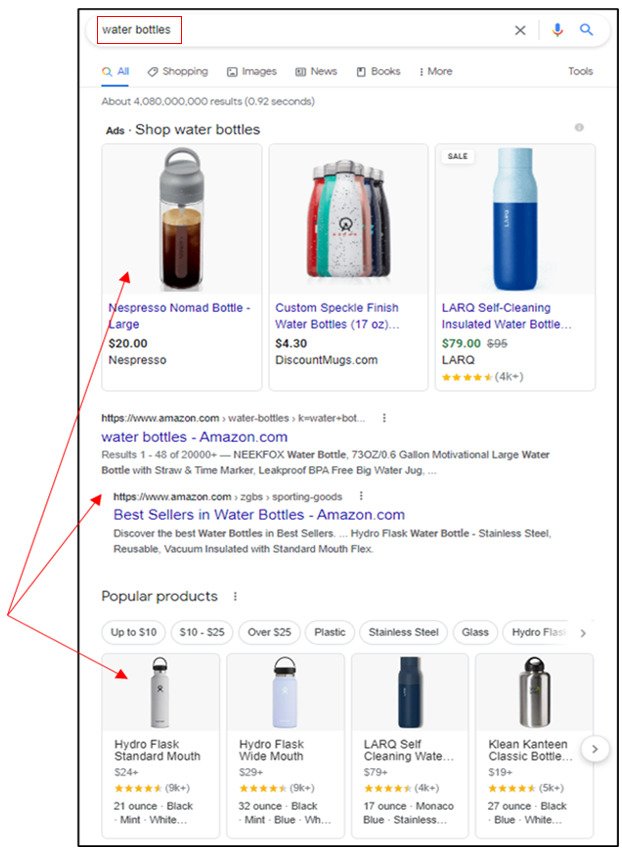
Examples: “water bottles,” “AAA batteries,” “Apple tablets”

4. Commercial Search Intent: this type of search intent is to investigate or research something with the aim of eventually completing a transaction of some kind. The difference between transactional search intent and commercial search intent is customer readiness. With transactional search intent, the customer is ready to transact now, as where with commercial search intent, the customer intends to transact at some point in the near future. This is also distinct from informational search intent, which usually aims to find evergreen content that doesn’t have a time limit or seasonality. Keywords with commercial search intent usually contain qualifiers such as “discount,” “deals,” “best,” or a date.

Examples: “deal on tires,” “wine discount,” “best washing machines 2022”

An Example of Search Intent

The keyword “water bottles” has transactional search intent, meaning when someone searches online for “water bottles” they are likely searching with the intent to purchase water bottles. Therefore, the best, most relevant, and authoritative search results for this keyword would be product pages on e-commerce sites, versus a Wikipedia page defining “water bottles.”

When thinking about content strategy, search intent can help determine the best content type and page outline for a topic. Taking intent into consideration helps ensure you are creating content that is relevant and useful to the target audience.

How to Determine a Keyword’s Search Intent

1. Analyze SERP Results for Your Primary Keyword

Once you have selected a topic to target, you may have also already selected a primary keyword to craft your content around (i.e., “water bottles,” “marathons,” “net zero”).

To begin analyzing the search intent of this primary keyword, you should start by searching for your keyword in a search engine to see the top SERP results. This will help you understand how search engines are interpreting the context of your content.

For example, let’s say you are interested in creating content for the primary keyword “net zero” in the context of how to invest in net zero stocks.

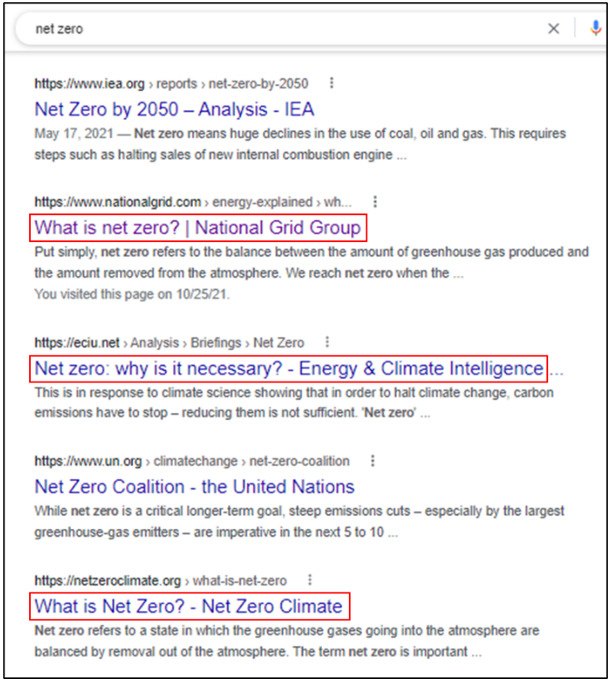
First, search for “net zero” to see the top organic search results for “net zero.”

Analyze the meta titles for how the topic “net zero” is being addressed (i.e., there is a lot of “what is,” “why,” or informational content).

Analyze the sites and companies themselves to understand your top competitors for this topic (i.e., which sites or companies are ranking authoritatively for “net zero”).

It can be observed from the SERP results that “net zero” is dominated by energy companies and industries delivering informational “what is” or “why” content. This is slightly off mark for the content you want to create (i.e., how to invest in net zero stocks), but initial SERP analysis of your primary keyword helps you understand the type of search intent associated with your primary keyword, the preferred content type for this keyword or topic, and top-ranking competitors (that can used for competitive analysis for your content).

2. Build Your Keyword Cloud

After checking your primary keyword in the SERP, you can start to brainstorm keywords to build out your keyword cloud or cluster. These will be long-tailed keywords related to your primary keyword with added qualifiers to further specify your content’s intent (i.e., to create content on how to invest in net zero stocks).

For example, long-tailed keywords for your “net zero”+“invest” keyword cloud may include (with the bolded word as the search qualifier):

  • invest net zero” (monthly search volume: 10)
  • “net zero investing” (monthly search volume: 50)
  • “net zero stocks” (monthly search volume: 50)

Each of these long-tailed keywords carries slightly different search intents, which will help inform which search qualifier carries the search intent best for your content. Ideally, in the research process, your initial, general primary keyword will be replaced by a more long-tailed, niche keyword.

Once you have a list of long-tailed keywords you think are aligned with your content’s intent, you can analyze the search intent of these long-tailed keywords by searching for them in search engines as you did with your primary keyword.

3. Map Out the Spectrum of Search Intent

Once you have a better understanding of the search intent behind your long-tailed keywords, you will find your keyword cloud changing to re-prioritize keywords that have search intents that are not aligned to your content intent or to help spur ideas for more long-tailed keywords that prove to be aligned with the needs of your content.

You can now start mapping out a spectrum of search intent to track which keywords and search intents are best and closest to your content goals and which are furthest away.

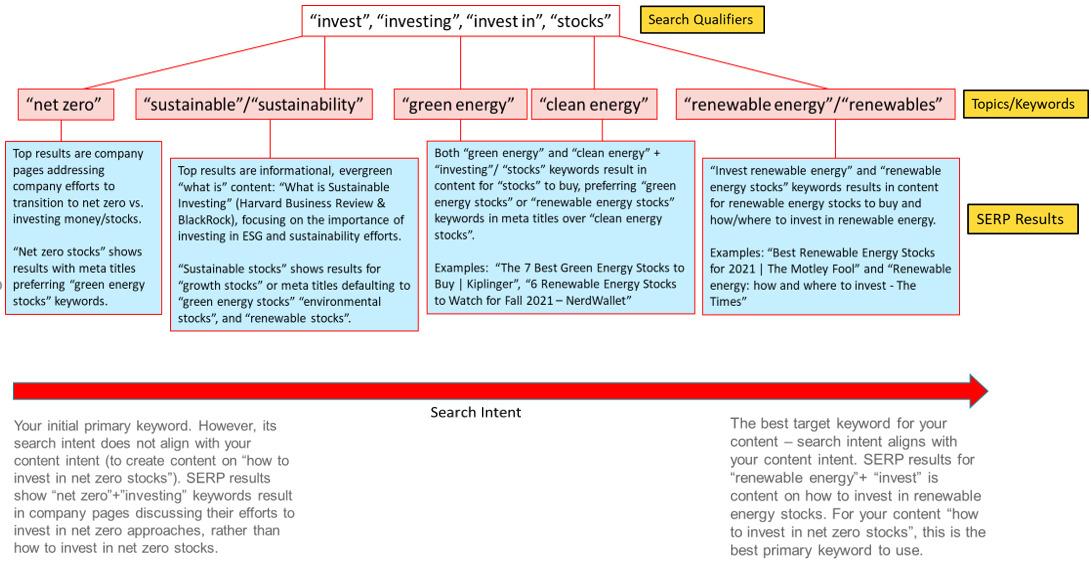
This diagram shows one way to map out keywords, their search qualifiers, and SERP results to determine their search intents. In this example for “net zero,” you can see the progression of search intents on a spectrum, from “net zero” and “sustainability” keywords (which contain search intents furthest away from your content goal) to “green energy” and “renewable energy” keywords (which contain search intents closest to your content goal).

Tip: refer to your spectrum of mapped-out search intents to create content for other keywords your current content goals are not targeting.

Optimizing Content for Search Intent

Once you have fact-checked the search intent of your primary keyword, you can begin creating or optimizing your content to that primary keyword and its search intent.

Again, search engines are much more intuitive when it comes to understanding a keyword or topic and they consider the context of a keyword.

This includes optimizing on-page and off-page factors such as:

  • Headings: H1s and H2s. H2s or sub-headings offer opportunities to address top and relevant topics your content should address to best meet target audience needs.
  • Links: A mix of internal and external links to relevant pages you want search engines to understand are associated with your content. Internal links also offer the navigational benefit of moving your user through your site to other relevant topics or to a call-to-action.
  • Anchor Text: Think of anchor text like street signs, informing you of your route and destination – search engines use anchor text to understand how content is connected and why they are referencing and associating with each other. This helps illustrates to search engines a holistic understanding of your topic.
  • Images: Like the example for the keyword “race” used earlier in the article, using images not only creates engaging content for the reader but offers opportunities to feed to search engines more hints to better understand your content – i.e., including an image of a marathon runner on your page about “race day” eliminates confusion for search engines that the content is about marathon races not “ethnicity.
  • Image Alt Text: Finally, image alt text offers opportunities to include descriptive and keyword-rich text about the content on your page and helps search engines index the page correctly for searches on Google Image.

While there are many factors determining the performance, rank, and authority of content on the web, understanding how to discover the search intent of your keywords and topics, and how to create or optimize your content to those search intents, will put you on the path to creating relevant, useful, and authoritative content for your readers.

Google AdSense Guide: increase earnings and escape low CPC

30-second summary:

  • There are many factors that affect your AdSense performance right from content quality, ad placements, media selection, and so on
  • High traffic doesn’t directly indicate high earnings, in fact, some of your practices may be equivalent to handing out money to your competition
  • Here are six informed steps to help you earn more from AdSense

Throughout this guide, you’ll learn how to increase your Google AdSense earnings by making some very simple changes and by following a few simple tips. In my personal experience, this can help skyrocket your AdSense CPC and results can increase your AdSense earnings by more than five times.

Your aim and objective throughout should be to gradually increase your AdSense CPC and CTR little by little and by following these simple tips you are bound to see results.

Don’t forget to keep on testing and your AdSense earnings will surely increase over time. Just don’t give up quickly!


1. Content is king on the internet and also on AdSense

The reason content is placed at the top of all the other tips is because it is the single most important rule to follow on your journey through SEO and internet marketing. It is the first thing your visitors, advertisers, and bots (ad bots and crawl bots) will notice after coming to your webpage.

If you are providing your users with low quality or outdated content, Google will rate your website much lower and your CPC (the bids advertisers make to appear on your website) will greatly fall. This can also get you smart-priced, even if you generate quality traffic on low-quality content.

So remember, always provide your readers and visitors with something unique and worthwhile which will actually acknowledge rather than something which has already been posted on a thousand other websites.

2. Ad sizes and placements are decisive

Do not neglect the placement and size of your Google AdSense ads as they play an important into delivering a better user experience and thus, improving your AdSense earnings.

“While creating ad sizes and placements, user experience and ad viewability should be the center focus”, explained SEO expert Boris Dzhingarov, in an email interview.

“Some placements and ad sizes will disrupt users, particularly if they’re covering content. Others, however, will fail miserably as the users never see them leading to a decrease in AdSense revenues”, he added.

So the question now is: where should you place your ad and which of Google’s display ad sizes are best for your business? The answer is pretty simple, place two ads inside your blog posts (or content) and one outside the post. Keep one 336 x 280 large rectangle ad on the top of the blog post just below the title and place the second ad in the middle of the blog post as a 468 x 60 sized banner. The remaining unit can be placed to the right of your post inside your sidebar.

Position your AdSense ad units as such to not annoy your visitors by popping right in their faces. Instead, perfectly fit inside your content, or in positions that you aim to get more clicks from.

For example, a site that provides file downloads can have an AdSense Ad Unit right near the download link to get a High CTR.

3. Monitor and limit the use of AdSense ad units

Have you tried limiting the use of your AdSense ad units? The biggest difference I myself have noticed is that by reducing the ad units which had the lowest CTR you can quickly and easily increase your AdSense CPC.

What usually happens is if you don’t have enough content to support all the ad units is that lower-paying ads start showing on your websites. This may increase your click-through rate (CTR) and bring in more clicks but because the ads may not be relevant to your website (public advertisements). This results in your CPC falling and your AdSense earnings decreasing. If you are increasing your ad units ultimately you are making it easier for advertisers to be shown on your website meaning an even lower CPC (because of low bids).

Remove the low CTR ad units and replace them with the higher paying ad units which have a higher CTR and your earnings will rise automatically.

Trying these tips for a couple of days will make you notice a real improvement and an important increase in low AdSense CPC.

Google AdSense Custom Channels will be necessary to keep track of things. This will give you a precise and clear idea of the best-performing ad slots. Measure the CTR, CPC, CPM, and earning of every ad unit.

Create custom channels for every ad slot and monitor their performance for at least two weeks to get an idea of things. If you keep changing ad units too often without testing them thoroughly you might get inaccurate results and miss out on better opportunities by placing your ads elsewhere.

How this is going to help in increasing your AdSense CPC?

Remove the low-performing ad units from your website (Compare CTR and final earnings of different units). Google should now serve better ads to other remaining ad slots which are performing well, so your earnings and CPC will increase.

4. Enable both text and image, media-rich ads

Always enable both text and image ads on your websites. Never limit your ad visibility to ‘Only image/media-rich ads’ or ‘Only text ads’ as this will lower the bids for advertisers to appear on your website. This directly means low AdSense CPC.

If you enable ‘Both text and image ads’ AdSense will automatically show the ad with the highest bid on your website which means a higher CPC for you.

In short, the more advertisers that are bidding to appear on your website the higher your AdSense CPC will be.

5. Keywords, keywords, and more keywords!

Try researching to find keywords with ‘High AdSense CPC’ and a ‘High Search Volume’. Searched globally using the Google Adwords keyword tool. Search, search and search some more to find specific keywords which have low competition, high CPC, and high search traffic.

After researching you can start creating your website pages, blog posts, and articles on such high-value keywords. Always use these keywords naturally at the beginning, the middle, and the end of your content. It is also very useful to add them to your headings or tags.

Try not to bother with keywords that pay a few cents and those that have a low CPM. Ideally, I would recommend grabbing keywords with a CPC higher than $2.50.

This should be the most important part of your mission. You would never want a page that earns one dollar from five to 10 clicks. Rather you want a page that pulls an impressive four to five dollars out of just two ad clicks, or maybe even $40 dollars out of just eight clicks!

If you don’t concentrate on your keywords, even if you have a lot of traffic you will be wasting it and not earning a substantial amount. Imagine this as handing out money to your own competition! By targeting the right keywords you can make a lot more with a lot less traffic.

Research on the Google keyword tool today and increase your Adsense CPC and earnings.

6. Reduce fraud, accidental, and useless clicks

Do you have an ad unit placed near the top of your content that gets a high CTR? Can this also be because of the awkward location that some people end up clicking on your ad by mistake? When this happens, the visitors often back out or close the ad. This is counted by Google as either an accidental or fraud click.

You may temporarily get earnings from these clicks but they will most probably be reverted due to the low-quality nature of the click.

So always try to minimize any accidental or useless clicks on your AdSense ad units and NEVER ask your friends or family to click on your ads!


Jacob M. is a copywriter, marketing blogger, inbound marketing consultant, and founder of Write Minds. He can be found on Twitter @jmcmillen89.

Subscribe to the Search Engine Watch newsletter for insights on SEO, the search landscape, search marketing, digital marketing, leadership, podcasts, and more.

Join the conversation with us on LinkedIn and Twitter.


Categories SEO

2021 State of SEO Webinar: Research Results

In mid-November we hosted a webinar reflecting on the search-related events of 2021 and looked ahead to what changes may come to search engines in 2022. We recapped major updates the search engines implemented and how those changes impacted results and the countless brands that rely on organic search. Check out a recording of the webinar.

During the live event, we asked our 750+ attendees about their experiences and perspectives on 2021 along with their plans for 2022. Respondents include people across a diverse range of marketing disciplines from SEO to demand generation, digital marketing, content development, IT and executive management, and across multiple industries including e-commerce, retail, software, manufacturing and finance. Here’s what they had to say.

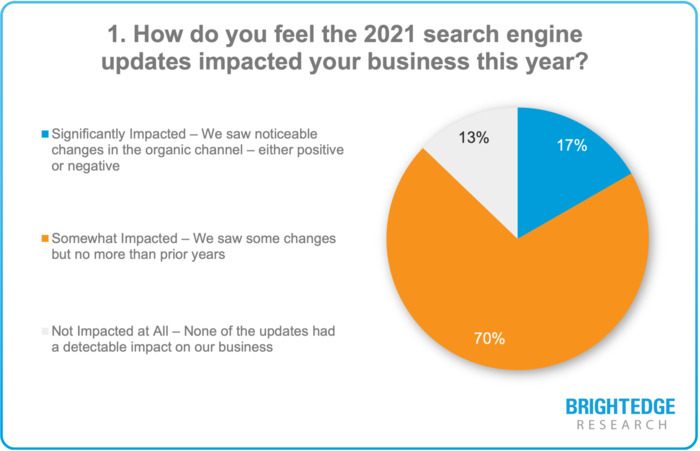
1. How do you feel the 2021 search engine updates impacted your business this year?

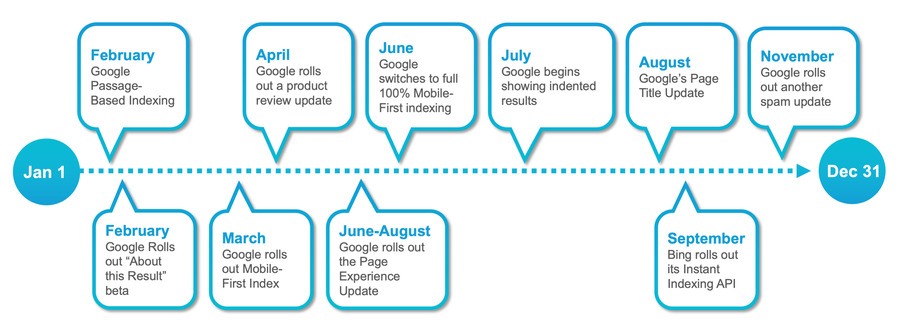
Per the timeline above, it was a busy year for the search engines. In the webinar we touched on the major search engine updates and asked our audience how those changes impacted their businesses. A minority – 13% – of respondents noted no impact to their business. A full 87% of respondents saw some impact, with 17% seeing significant impact.

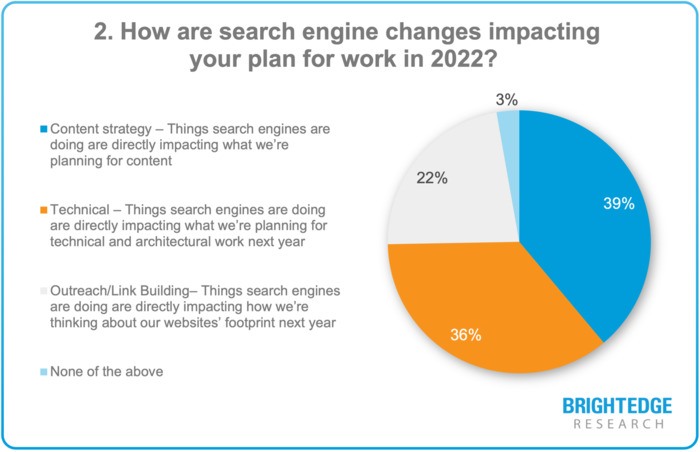
2. How are search engine changes impacting your plan for work in 2022? ​

Our audience is paying close attention to the changes in search and adjusting their plans for 2022 accordingly. Only 3% of respondents noted no impact on their 2022 work plans.

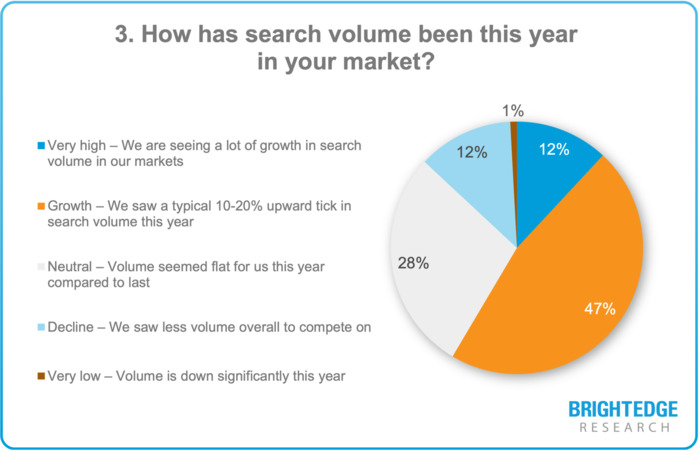
3. How has search volume been this year in your market? 

A majority of respondents (59%) described growth in the search channel this year. Only 13% of the audience saw a decline in the channel for 2021. 

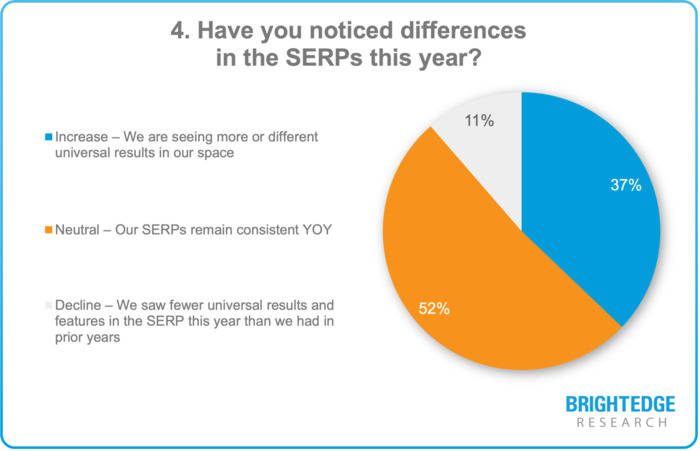
4. Have you noticed differences in the SERPs this year?

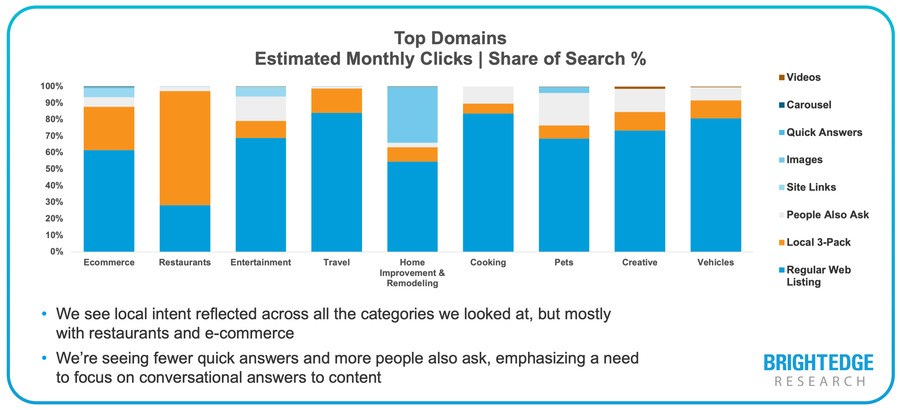
When we looked at the types of results presented in the SERPs for the top domains, we noted some changes compared to prior years including increased local intent reflected across all market segments, fewer quick answers and more people also ask results. 

Our audience’s experiences were mixed. A slight minority (48%) saw some differences in the SERPs with 11% seeing fewer universal results and features and 37% seeing more universal results and features. More than half (52%) did not note any differences in their search results.

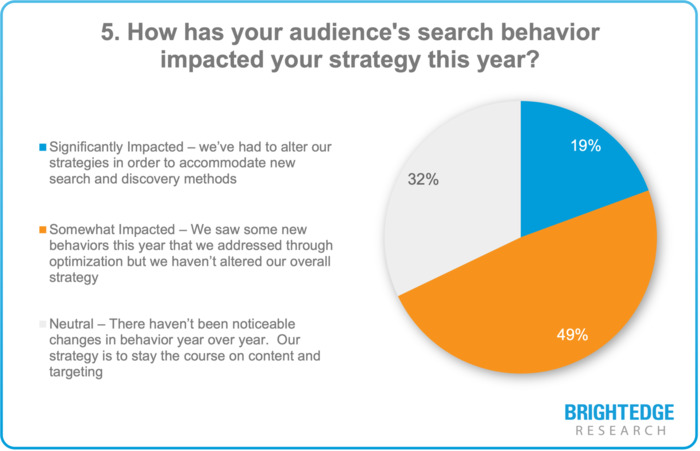
5. How has your audience’s search behavior impacted your strategy this year? 

More than two-thirds of respondents (68%) have had to address changes in their audience’s search behavior at some level. Just under half of respondents (49%) were able to handle behavior changes through optimization, while nearly one in five (19%) made additional adjustments in their strategies to accommodate search behavior changes. 

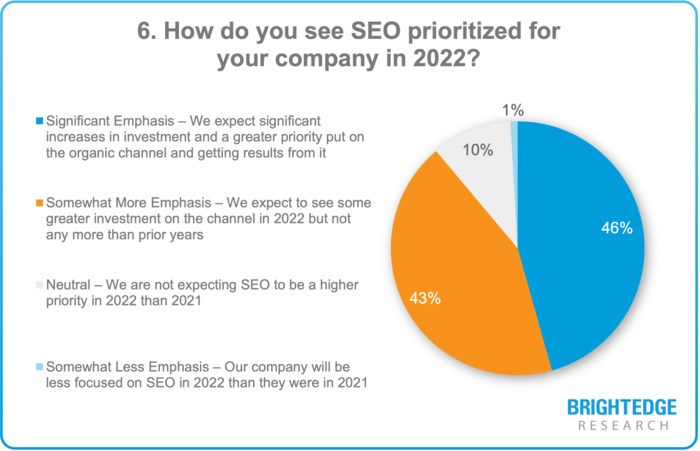
6. How do you see SEO prioritized for your company in 2022? 

In 2022, SEO will take on greater importance in a vast majority of respondents’ companies (89%). Notably, nearly half of respondents (46%) expect the organic channel to be an area of significant investment in the new year.

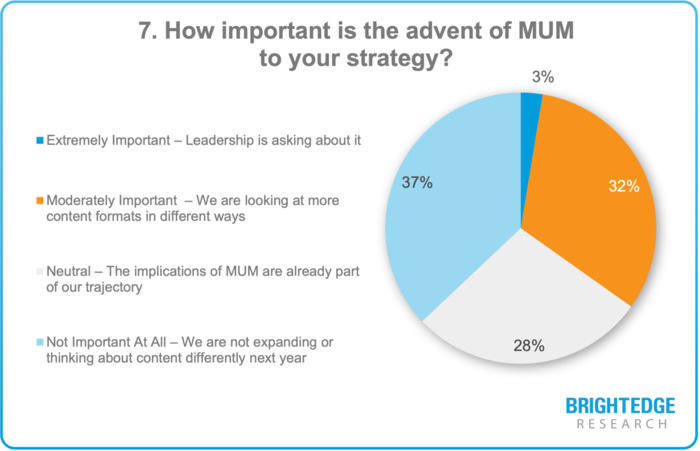
7. How Important is the advent of MUM to your strategy? 

Earlier this year, Google introduced its Multitask Unified Model (MUM) technology designed to help users accomplish more with fewer searches. The company described MUM as 1,000 times more powerful than its current search model, BERT, and says it will begin rolling it out over the next few years.

We noted in the webinar that MUM reinforces the need for quality content and creates a virtual mandate that all content (video, images, PDFs, etc.) have SEO and query-intent factored into their development. Though it’s early days for the new search model, we asked webinar participants to what extent MUM is factoring into their strategies.

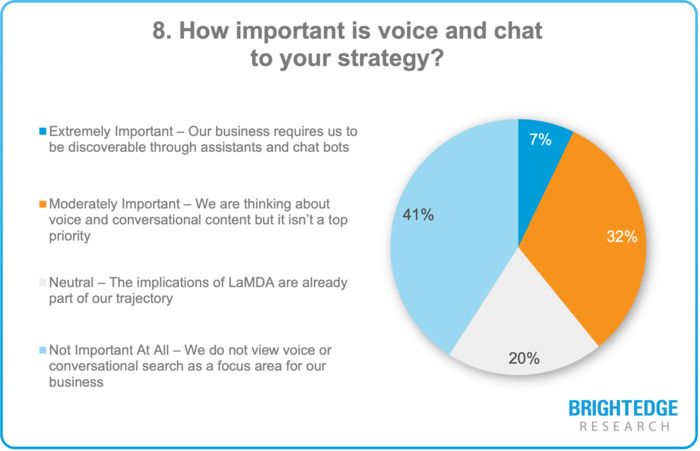
8. How important is voice and chat to your strategy? 

Google is deeply focused on understanding search intent, decoding not just the content of a search, but the context. While details are still sparse, its announcement of LaMDA (Language Model for Dialogue Applications) in May 2021, crystallizes its interest in facilitating AI-driven conversation, an application highly dependent on understanding context. With this increased focus on voice and conversation from the organic search leader, we asked our audience to chime in on the role of voice and chat in their search strategies.

The results reflect the developing nature of the technology with 41% of respondents putting no emphasis on voice or conversational search, 52% of the audience noting some level of planning around it and only 7% of respondents placing significant emphasis on voice and conversational search.

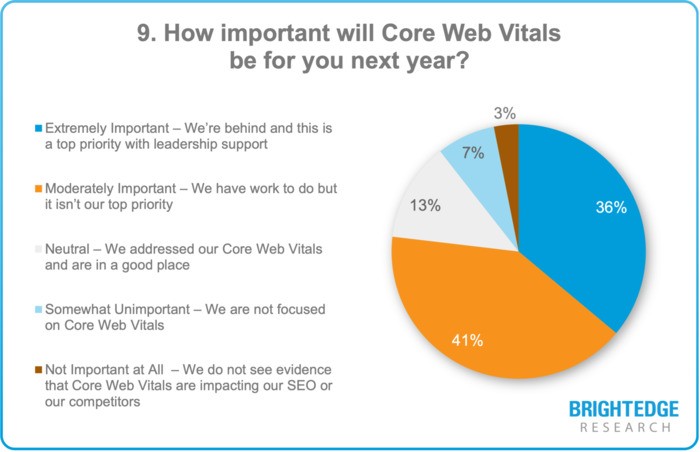
9. How important will Core Web Vitals be for you next year? 

Core Web Vitals rolled out in 2021 and places greater emphasis on key user experience metrics including how quickly a page begins to “paint” in the browser, how soon a visitor can interact with the content and how stable the content is once it begins to load. Most importantly for companies that rely on the organic search channel, Core Web Vitals is a search ranking factor.

Many companies began work to improve their sites for Core Web Vitals this year. To better understand our audience’s progress, we asked them how important Core Web Vitals will be for them in 2022. The vast majority (90%) have completed or are prioritizing their work to support Core Web Vitals. Roughly three-fourths of the audience (77%) still has work to do, while just 10% are not prioritizing it.   

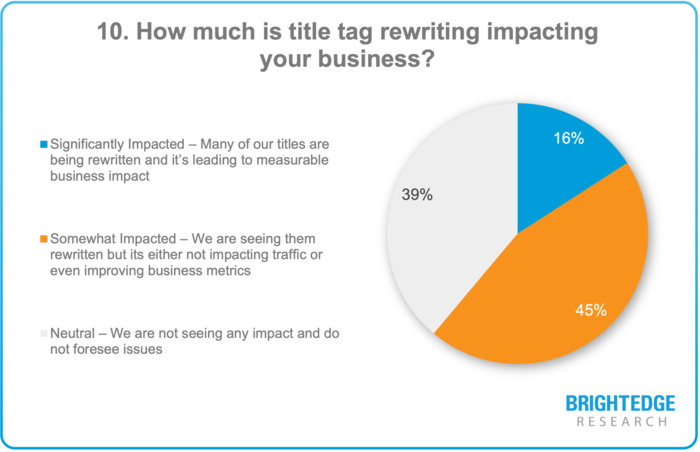
10. How much is title tag rewriting impacting your business? 

In August of this year, Google announced a change in the way it handles title tags, confirming that it rewrites tags to better reflect what it believes to be the context of the content. As we noted in the webinar, Google’s rewritten tags can impact your search ranking negatively. The best thing you can do is write title tags that focus on the core intent of the page, avoid keyword-heavy title tags and ensure the query intent you’re trying to capture matches what your page provides. 

Just under half of our poll respondents (45%) have observed rewritten tags, but did not note any negative consequences, but another 16% of respondents noted measurable business impact for the changes. We advise keeping an eye on title tag changes as these numbers may begin to shift as more tags are rewritten.  

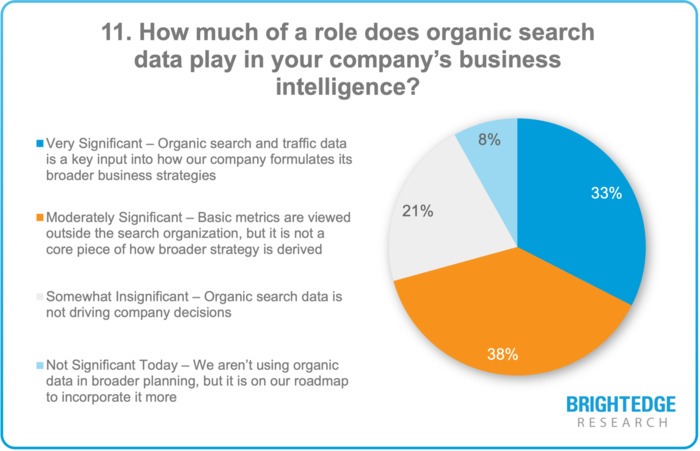
11. How much of a role does organic search data play in your company’s business intelligence? 

Organic search is a rich source of consumer tastes and intent. Now, as the quality of user data from other digital channels diminishes in the face of privacy concerns, we expect organic search data to take on greater importance as a source of business intelligence. We wanted to understand to what extent search data is a factor in our webinar attendees’ business intelligence operations. 

According to respondents, most (79%) said search data is or will be part of strategy planning. Notably, roughly one-third (33%) of those polled described search data as “a key input into how our company formulates its broader business strategies.”

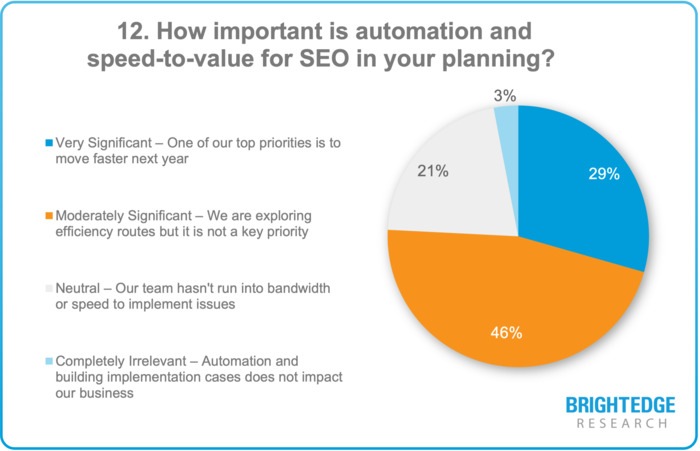
12. How important is automation and speed-to-value for SEO in your planning?  

Finally, we predicted that SEO teams will need to find ways to do more and do it more quickly as conversational and contextual updates create more search paths, major updates released in 2021 like Page Experience and Mobile-First reach their full impact in 2022, and SEO becomes a bigger input into other channels. 

We wanted to see if our audience’s plans reflect the same level of urgency for SEO that we are forecasting. One-quarter of respondents do not share our outlook that automation and greater speed-to-value are key SEO priorities in 2022. However, among the 75% that share our outlook, 39% (29% of all respondents) are making automation and speed-to-value a top SEO priority in 2022.

Looking Ahead to 2022:

We received a number of questions from participants during the webinar, and in the coming days, we’ll address a number of them in a follow-up post. Keep an eye out for answers to these questions:

  1. From BrightEdge’s research, have you seen what, specifically, the three spam updates in 2021 were targeting? 
  2. Since the quality of content is king, is it still necessary to have long articles if one short article is more relevant?
  3. Is there any preparation you suggest we should take for SEO markup on pages behind a newspaper’s paywall?

What we can safely say about 2022 is that the year will continue to bring the types of changes to organic search that make us grateful to work in such a dynamic space. Much of the progress will come from the updates and new technologies introduced in 2021 as they continue to roll out and impact more content. At BrightEdge, we pay close attention to how the evolving search landscape generates new opportunities and potential impact for our customers. Bookmark our blog for ongoing guidance on new changes and updates to search throughout 2022. 

To better understand how BrightEdge can help your business, schedule a demo today.

Four Google SERP features for ecommerce SEO

30-second summary:

  • Holiday season shopping is on and your ecommerce store whether a local shop or an international ecommerce brand needs visibility for sales
  • How do you jump right in front of your potential customers and drive sales in a highly competitive space?
  • SEO pioneer, former Pepperjam founder, and serial entrepreneur, Kris Jones shares a practical ecommerce SEO guide

There is perhaps no type of business that is more primed for SEO than ecommerce companies. Think about it: where a local law firm can put up a billboard or buy ad space in a regional newspaper in addition to doing SEO, ecommerce businesses essentially have one resource available to them, the internet.

That’s where they do 100 percent of their business, and it’s where they’re going to reach the customers they want. So, ecommerce companies should spend a lot of time getting their SEO just right. One crucial way of doing that is to optimize your site to appear in Google’s various SERP features.

There are so many ways you can tell users about your business just from the SERP even before they get onto your website. And the information you present could mean all the difference between capturing your ideal traffic and losing it to competition.


Therefore, to market yourself in the best light to all potential customers searching for your products, you have to optimize your website specifically for the SERP features that drive conversions.

How do you do it? Here are four of the most vital Google SERP features for which you should be optimizing your ecommerce business’ SEO.

1. Rich cards

Back in 2016, Google introduced a new mobile SERP feature called rich cards. By using structured data, SEOs could make a business’s results “richer,” that is, more visually appealing, clickable, and therefore more likely to generate an organic click.

If you search for a certain type of product, results marked up with the proper language tell Google to show the product along with an image that can help users know if they want to explore more. Users simply swipe to see more items.

Now, why am I recommending a SERP feature from 2016?

It’s because in the first quarter of 2021, mobile traffic accounted for almost 55 percent of online traffic worldwide, and that number is only going to increase. Basically, mobile search results are even more relevant today than they were in 2016.

With that in mind, how can you optimize your ecommerce products for rich cards?

You need to use the JSON-LD method of marking up your products. You can then test your work with the various free rich results tools on offer from Google.

2. Google Images results

Somewhat related to rich cards is the need for ecommerce businesses to optimize their content for Google Images results. Relevant images will appear at the top of a SERP, before any organic results.

A good product description does indeed go a long way, but don’t forget to think simply, as well: if customers can see clear, high-quality images of your products, that will help your credibility along, and hence drive conversions.

How do optimize for Google Images results? Well, Google doesn’t read images like it reads text, so it’s all going to come down to how you prepare your images on the back end.

First of all, ensure your images are originally yours. You don’t stand much of a chance trying to rank for stock photos.

Next, give your photos descriptive file names that tie into the pages where they will be placed. In the case of ecommerce, since you’ll probably have a series of photos for each product, give the image files titles that reflect the product, with words separated by hyphens.

Here’s an example: unisex-sneakers-blue-brandname-yoursitename

And don’t forget to provide descriptive alt text to each image in case it can’t load and be seen.

Finally, be sure you’re not uploading huge image files that will weigh down a website. Compress them down as small as you can to give your site enough breathing room while still ensuring the images show what you need them to show. Check out this comprehensive guide on image optimization.

3. Rich snippets

Wait a minute, you might say, why are you talking about both rich cards and rich snippets?

With ecommerce products, rich cards will stop you at the images. You can choose to go a step further for appropriate products by optimizing for rich snippets.

Rich snippets add in extra details about your products. These get placed inside your search results, under the meta title, and above the meta description.

To get rich snippets on your product results, you’ll use structured data just like you did for rich cards. You can choose which information to enter based on what specifically can grab your potential customer’s attention and satisfy their search query.

For ecommerce companies, it makes the most sense to optimize your rich-snippet products for prices, in-stock status, sales, different brands, customer reviews, and star ratings.

Think about each of these features. Doesn’t it make sense that a customer searching for this type of product would want to see this information from your online store?

Rich snippets are one great way of reaching users with extra information without the need for the users actually to click on your result. You’re taking the most concentrated bits of data about your product offerings and jumping right out onto the SERPs at the user.

Sure, you can choose not to do this for your products. But if your competitors are, who do you think stands the better chance of getting a click and making a sale?

Rich snippets are just good ecommerce SEO, plain and simple.

4. Sitelinks

Finally, you should attempt to optimize your site for SERP sitelinks.

I say “attempt” to optimize because this isn’t a SERP feature you can just click on and off, like alt text or structured data.

So we’re all on the same page here, sitelinks are the clickable buttons below your result’s metadata on a SERP. They typically offer opportunities for users to navigate directly to sections of your website.

In the case of ecommerce, the most logical sitelinks you would want to get listed in your result would be for your most popular product categories.

But again, I’m saying “would want” because sitelinks are chosen by Google’s algorithm. That doesn’t mean you can’t influence which sitelinks Google places there. Which pages Google links in your results is based primarily on your site’s navigation.

As SEOs, we always recommend having a direct and easy-to-navigate website structure. It helps the user experience, supports navigation, and prompts Google to crawl your pages.

Other things that help Google crawl your site include keyword-optimized content, smart internal linking, and simple, intuitive menus.

It is through these elements that you stand your best chance of defining what your SERP sitelinks will be. When you tell Google which pages are most important to you and your customers, the search engine will respond in kind by generating helpful sitelinks.

This is yet another example of having your SEO jump right to the SERP at users without them having to do anything.

And when you’re in the competitive ecommerce space, that really matters.

Go forth and optimize

Businesses always have it tough when going up against the competition. Whether you’re a local shop or an international ecommerce brand, there’s always someone else trying to beat you at your own game.

While SEO can never make anyone do anything, we put ourselves on the best possible footing when we take the above steps to optimize our websites for the SERP features.

If you’re not doing these things already, you’ll want to get started as soon as you can! And then sit back and watch what happens.


Kris Jones is the founder and former CEO of digital marketing and affiliate network Pepperjam, which he sold to eBay Enterprises in 2009. Most recently Kris founded SEO services and software company LSEO.com and has previously invested in numerous successful technology companies. Kris is an experienced public speaker and is the author of one of the best-selling SEO books of all time called, ‘Search-Engine Optimization – Your Visual Blueprint to Effective Internet Marketing’, which has sold nearly 100,000 copies.

Subscribe to the Search Engine Watch newsletter for insights on SEO, the search landscape, search marketing, digital marketing, leadership, podcasts, and more.

Join the conversation with us on LinkedIn and Twitter.
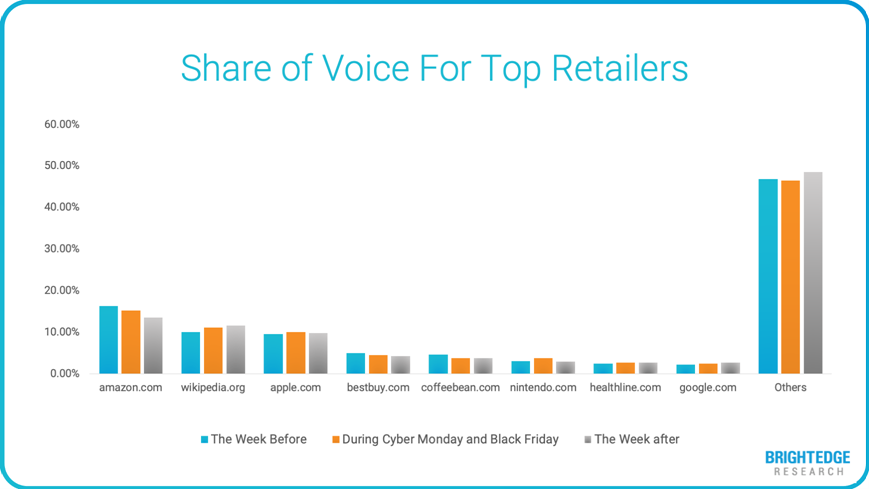


Categories SEO