Tested: Is Joomla Good For SEO In 2021?

This is the fifth post in our series where we test the on-page SEO of the world’s most popular CMS systems.

We previously covered WordPress, Wix, Squarespace, and GoDaddy.

And this week we’re turning our attention to Joomla.

Disclaimer: The tests in this article are based on Joomla 3. They were performed shortly before the very recent release of Joomla 4. The Joomla 4 changelog states, that it includes SEO improvements. Hence, the results might already be outdated. We’ll follow up with an update.

That said, read on to discover:

  • how well setup for on-page SEO Joomla (Joomla 3) is out of the box,
  • how you can configure your Joomla site to rank higher in Google

Table of Content

Let’s get started with a summary.

In Summary: Is Joomla good for SEO?

Joomla is an open source CMS. You’ve got full access to the underlying code, and can also create your own plugins/extensions to modify the system’s core functionality.
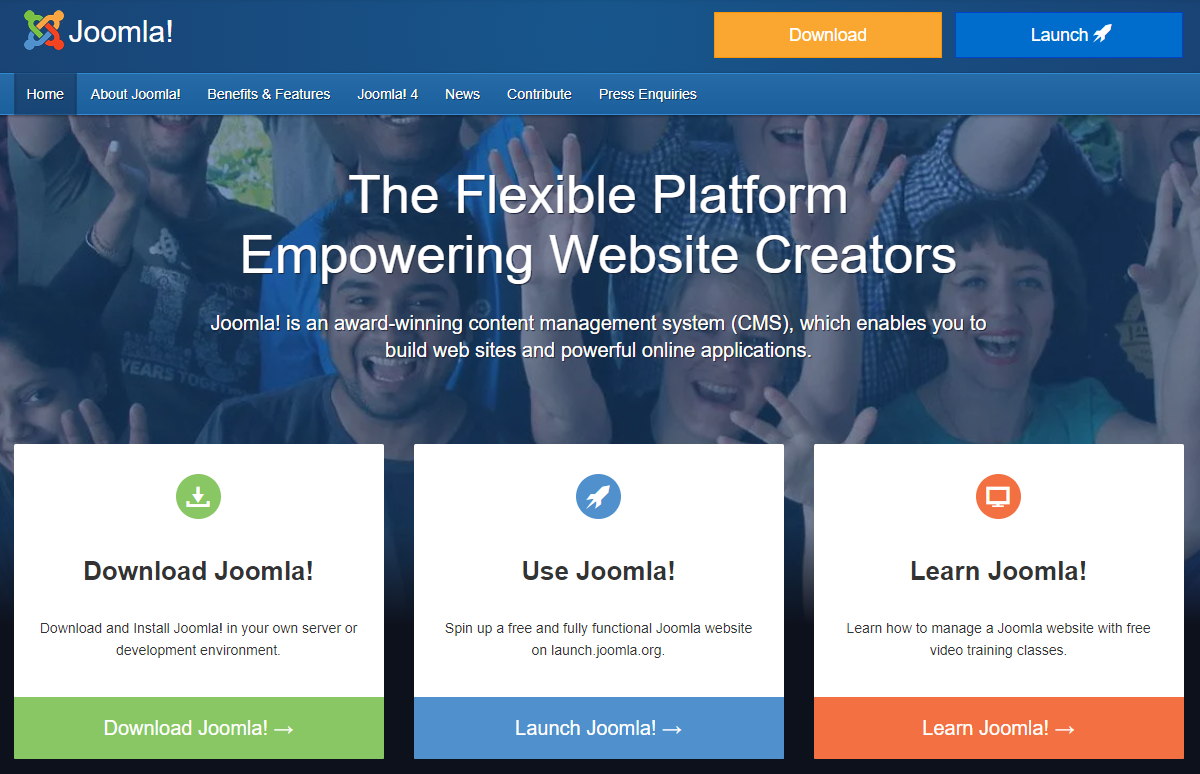
joomla

So with some coding chops (and the luxury of time) we would wager that there’s nothing you can’t do to fully SEO optimize your Joomla site.

But with that being said, in this series, we’re focusing on the out-the-box SEO functionality of the major CMS systems. Give or take a few plugins/extensions, we want to keep our hands (and website) reasonably clean.

The good news?

Joomla does tick most of the on-page SEO boxes. You’ll need at least one extension. But that’s no different to WordPress, where you’ll have to install an SEO plugin like YOAST to fully optimize your site.

So what’s the bad news?

Well, Joomla’s SEO extensions are just not in the same ballpark as their WordPress counterparts (although that may soon change – see “Which Joomla SEO extensions did we try?” below).

You can control most of the elements you need to control. But the process is comparatively unintuitive and cumbersome. Everything is just going to take you longer to optimize than it would on a WordPress site.

And generally, that’s the feeling we have with Joomla as a CMS. While the front end is fine, the back end feels dated, tired — almost like an abandoned project (although it’s not).

According to W3Techs, Joomla still has a 3% CMS market share. But we suspect that market share is mainly made up of legacy sites, as a quick glance at Google Trends shows us Joomla’s popularity has been on a serious decline for at least the past 10 years.
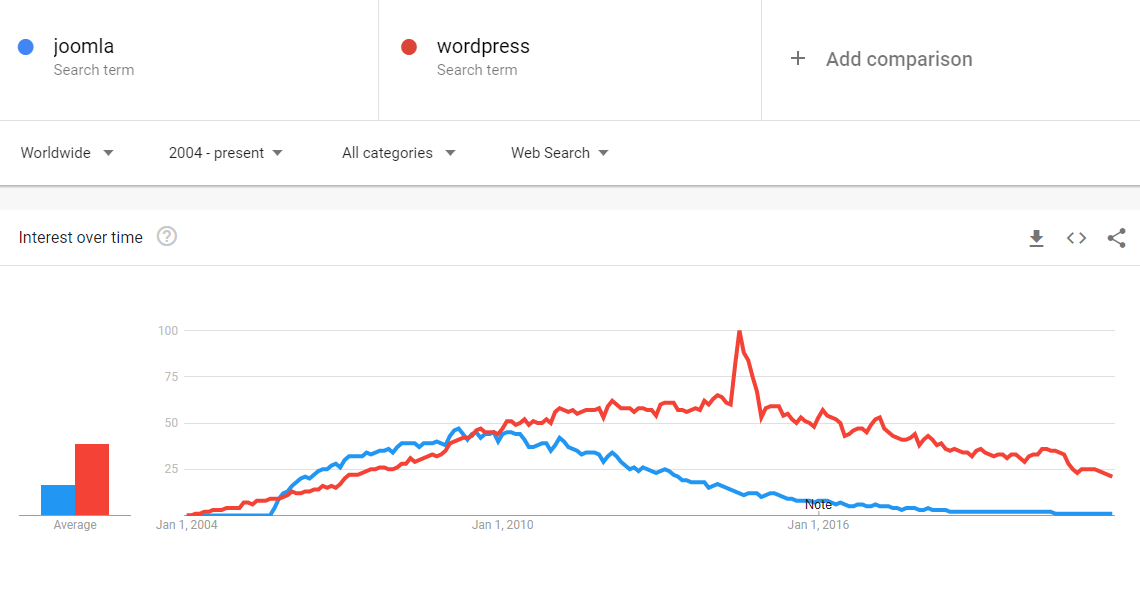
google trends - joomla vs wordpress

But let’s circle back round to the question at hand:

Is Joomla good for SEO? Yes.

Although you might lose a little bit of hair while optimizing your site.

And when you’re done, you’ll probably ask yourself why you didn’t just choose WordPress like everyone else has since 2010….

Before moving on with some detail, here’s a quick summary of what you can and can’t do with Joomla.
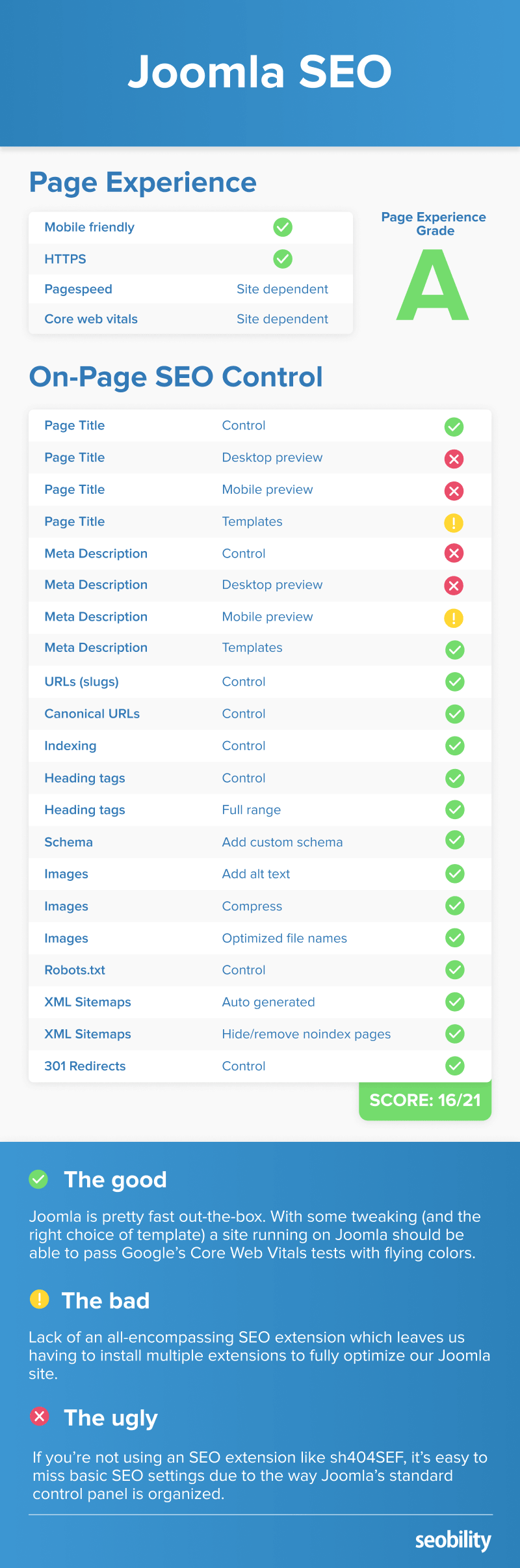
Joomla SEO Scoring

How we tested Joomla for SEO optimization

Like WordPress, it’s difficult to test Joomla in isolation as much of its SEO performance will be down to individual configurations (i.e. host/server) and choices (templates/extensions).

But as with our previous tests, we tried to keep extensions/plugins to a minimum, configuration to as close to “out the box” as possible, and opted for popular templates.

Here’s what we did:

  1. We set up a small test site on a Digital Ocean server with the same specs as the server hosting our previous WordPress test site
  2. We added demo content similar to our other test sites
  3. We tried out 3 Joomla SEO extensions (and settled on one)
  4. We tested 2 of the most popular Joomla themes (Helix Ultimate, and the default Protostar)
  5. Tests included manual review, running the site through our own SEO audit tool, and testing using third party tools such as Google’s PageSpeed Insights and GTMetrix.

Which Joomla SEO extensions did we try?

Choosing an SEO extension for our Joomla test site was tougher than we expected. Why? Because there’s no real community consensus on what the current best extension actually is.

Additionally, while our preference would have been to use a free SEO extension, we found that it was only premium extensions that gave us anywhere near the level of SEO control we were looking for.(and there was another, very recent fly in the ointment that we’ll cover below)

So in the end, we purchased and tried out the three extensions below:

  1. Joomla sh404sef
  2. Firecoders Route66
  3. 4SEO

The most promising was/is 4SEO, which is made by the same people who make sh404sef.

It’s a relatively new extension that’s as close as you’ll get to a WordPress SEO plugin like YOAST for Joomla. There’s decent snippet previews and you can control most on-page SEO elements:
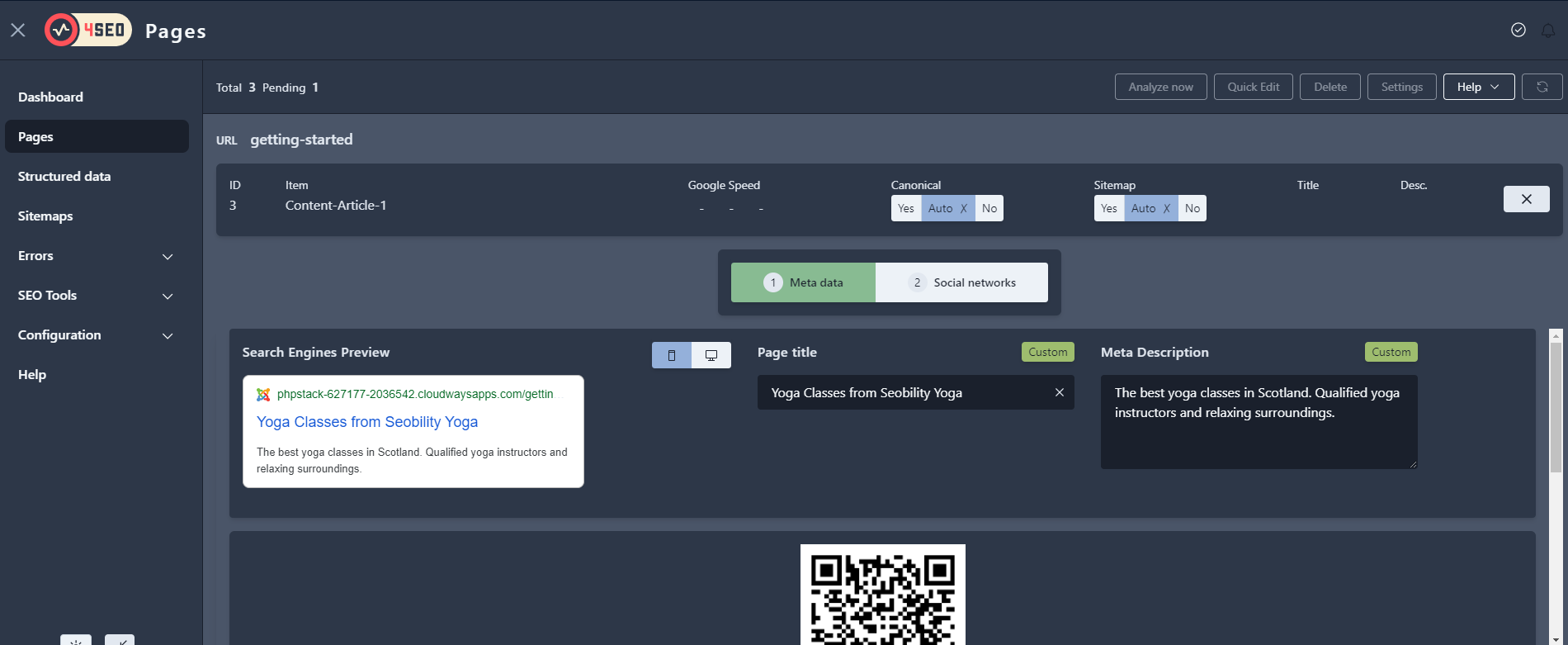
4seo interface

But as promising as it looks, unfortunately we found it a little buggy to recommend at this stage. We’ll be keeping an eye on it though, and suspect it will be our Joomla SEO extension of choice when we come to update this article.

Route66 from Firecoders also looks the part (with some nice on-page analysis reports), but was lacking some of the basics.

So in the end we settled on sh404sef, which has most of the functionality we’re looking for and has long been one of the most popular Joomla SEO extensions.
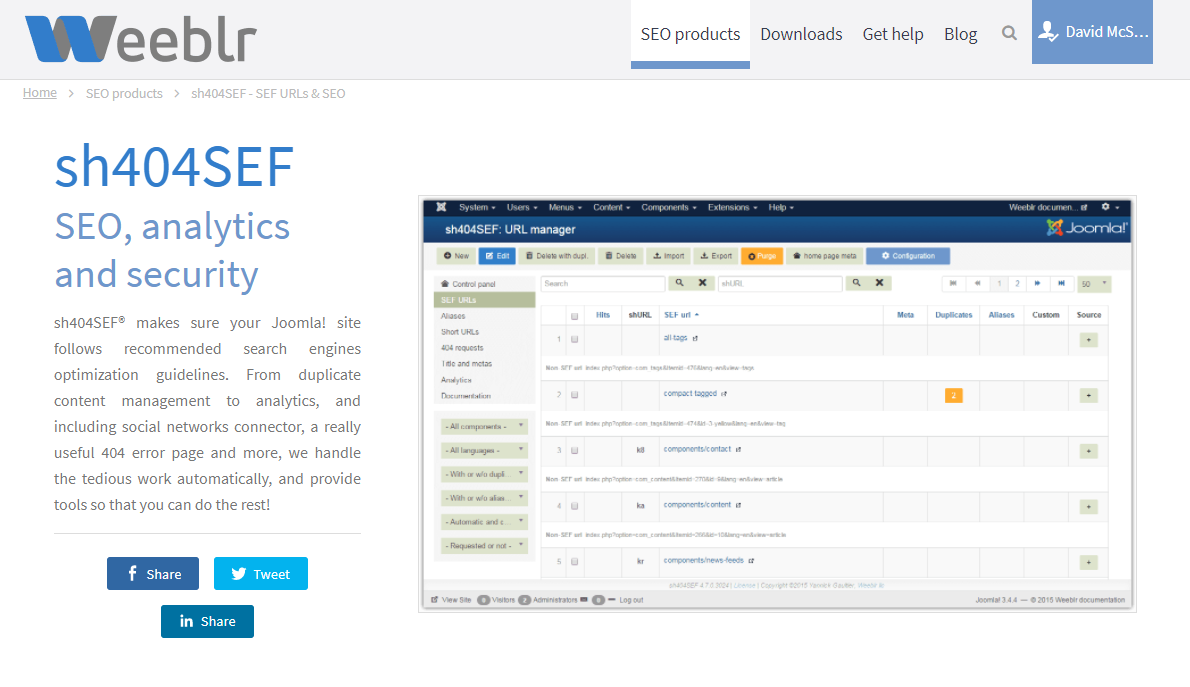
sh404sef

And it’s sh404SEF we’ll be using in our examples below.

But there’s a problem:

Weeblr (the company behind sh404SEF) recently announced that the extension may not be compatible with Joomla 4 and will no longer be updated.

Which means if you want to use it, you’ll probably need to stick to Joomla 3 for now.

We told you picking a Joomla SEO extension was tough!

Joomla SEO: The good, the bad, and the ugly

Before reviewing Joomla’s control of on-page SEO factors, let’s run through some of the SEO highlights (and lowlights) of the platform.

We’ll start with a positive.

Good: Joomla is pretty fast out-the-box

Our Joomla test site performed well in Google’s PageSpeed Insights, scoring an admirable 95/100 when running the Helix Ultimate template with minimal configuration.
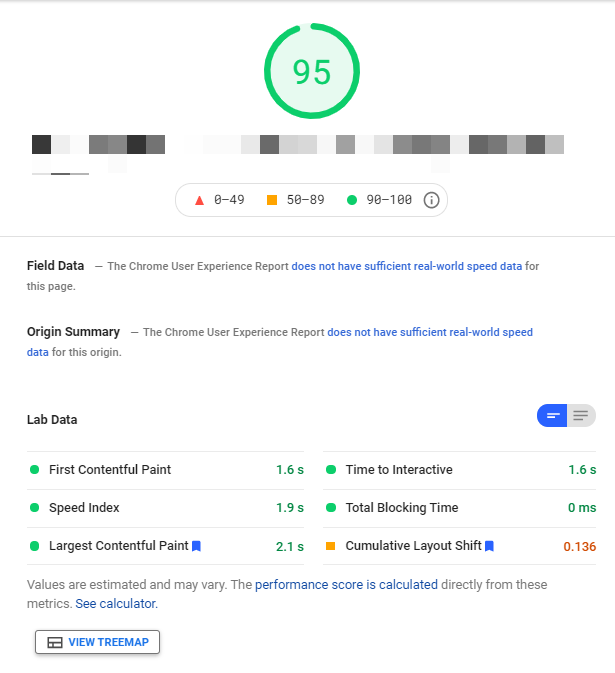
joomla pagespeed insights test

Note: the layout shift issue above was due to web fonts and would be a relatively easy fix.

In fact the only real speed optimization we did was to activate Joomla’s inbuilt caching module — which is literally a few clicks.

So with some tweaking (and the right choice of template) a site running on Joomla should be able to pass Google’s Core Web Vitals tests with flying colors.

Or in other words…

…if your Joomla site is slow, it’s probably your fault, not Joomla’s!

Bad:  Lack of an all-encompassing SEO extension

At the moment we don’t feel there’s a single Joomla SEO extension that includes all the functionality we would like. Which leaves us having to install multiple extensions to fully optimize our Joomla site.

But we do have high hopes for 4SEO from Weeblr. And we’ll be keeping an eye on it as it matures with Joomla 4.

Note: if you have any suggestions for Joomla SEO extensions that we might have missed, then please let us know in the comments and we’ll take a look.

Ugly: Out-the-box many basic SEO settings are buried

If you’re not using an SEO extension like sh404SEF, it’s easy to miss basic SEO settings due to the way Joomla’s standard control panel is organized.

For example, on an article, the SEO title is buried right at the bottom of the options tab…
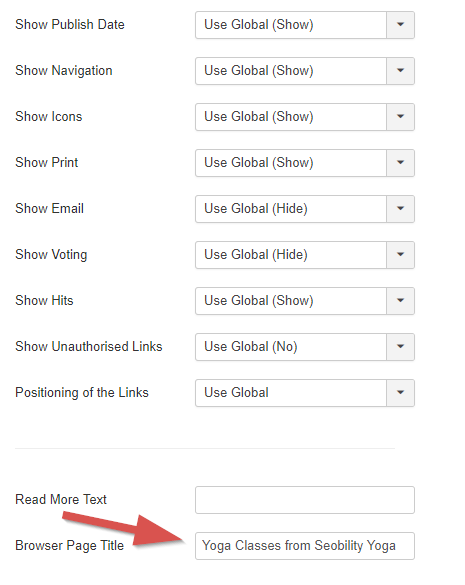
joomla seo title

…while the meta description is located under the publishing tab.
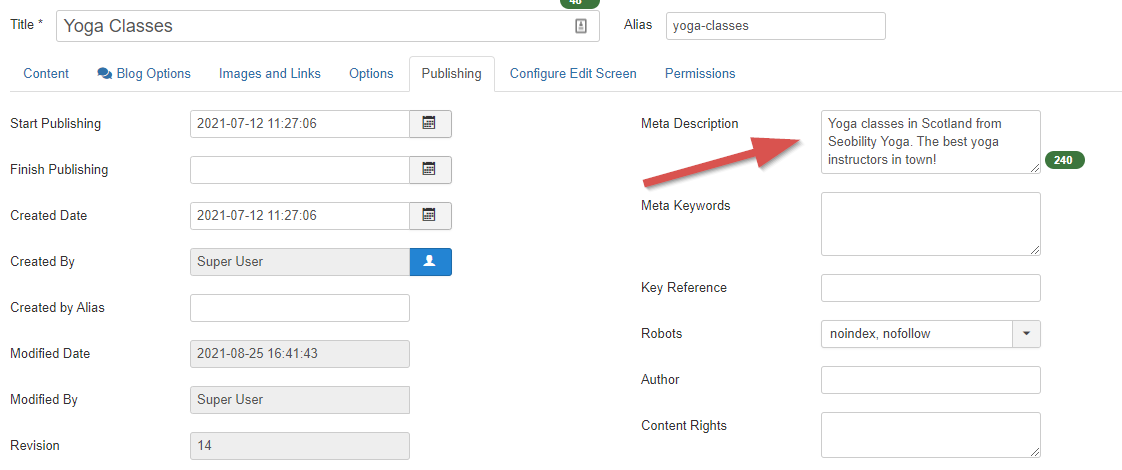
articles meta description

Wouldn’t it make more sense to have these in the same place?

On-Page SEO Fundamentals: How does Joomla measure up?

Now let’s turn our attention to control of some of the fundamental on-page SEO factors.

Does Joomla cover them all?

For the most part. Although visual feedback (i.e. snippet previews) and templating options are lacking, at least when using sh404SEF as your SEO extension of choice.

Here’s our summary again.

Joomla SEO Scoring

Note: having control of an SEO ranking factor is not equal to its optimization. SEO audit tools like Seobility offer advice on how to properly optimize each element, and find errors in optimization which may be holding back your site. See our SEO audit guide for more information on how to fully optimize your website.

SEO Titles and Meta Descriptions

Control in Joomla: yes

A page’s title continues to be one of the most important on-page ranking factors. And a well-written meta description can help you get more click-throughs (although Google won’t always use it).

Natively, Joomla lets you set custom SEO titles (called “Browser Page Title”) and meta descriptions for pages in the “Menu item” panel.

Menus > Your Menu > Select Article > Page Display > Browser Page Title
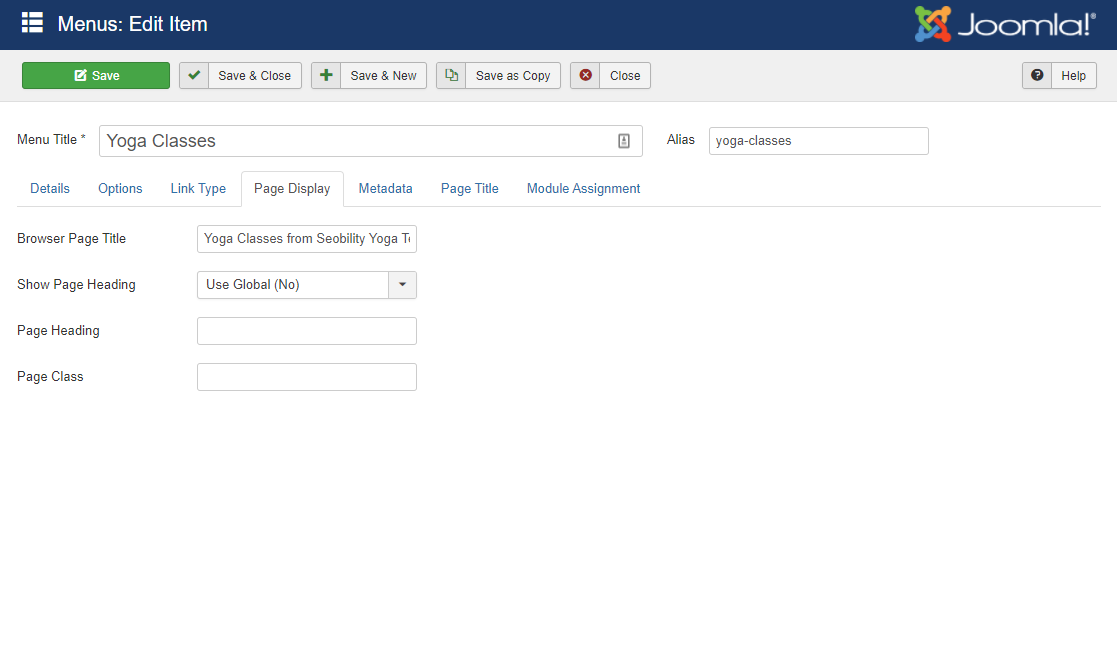
browser page title

Menus > Your Menu > Select Article > Page Display > Metadata > Meta Description
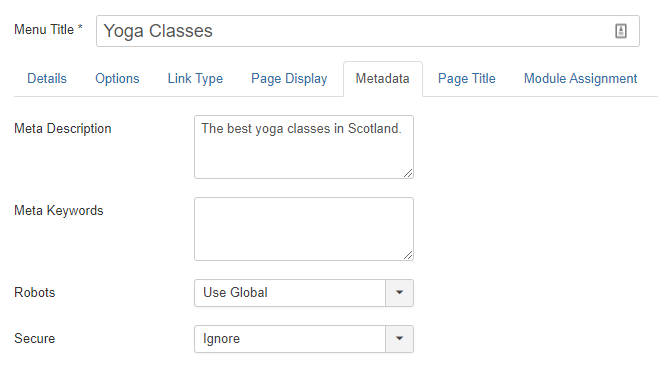
meta description

Or if you’re using sh404SEF, you can set SEO titles and descriptions (which will overwrite the native title) in the Titles and metas panel.

Components > sh404SEF > Titles and metas

You can either quickly edit titles and meta descriptions from the list screen, which is handy when you have several article titles you need to update…

title tag bulk edit

…or click on a specific article for more options.
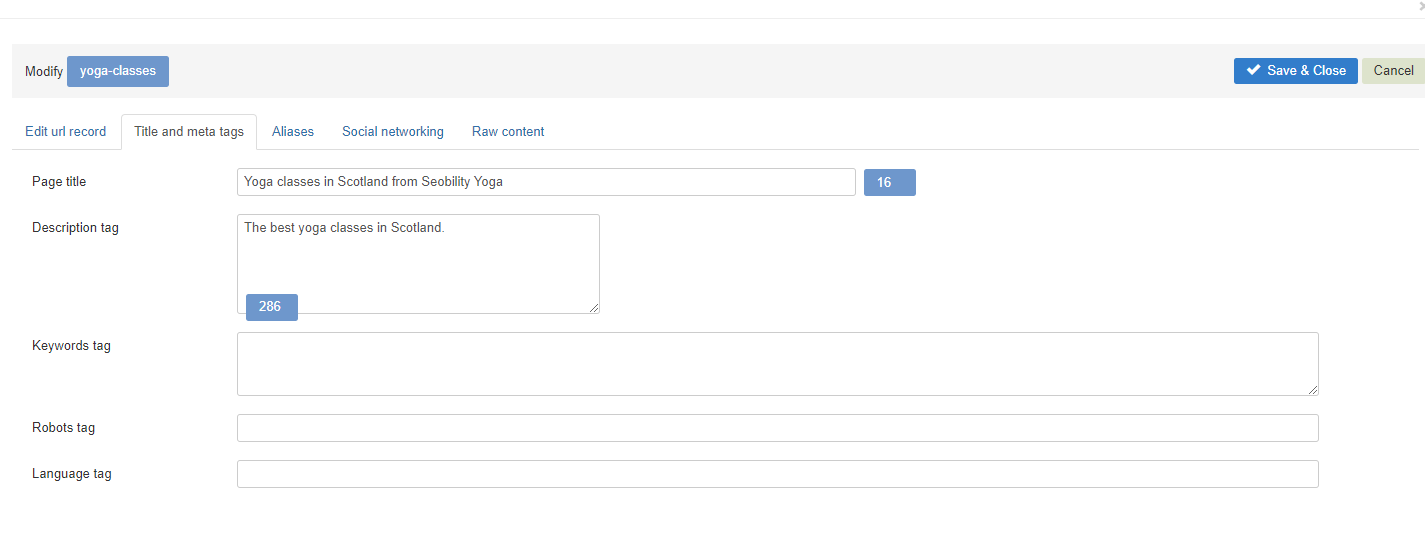
title tag edit

Either way, you won’t get a preview of how your snippet will look in search. So you might want to use our free snippet preview tool to test your titles and meta descriptions before editing in Joomla.
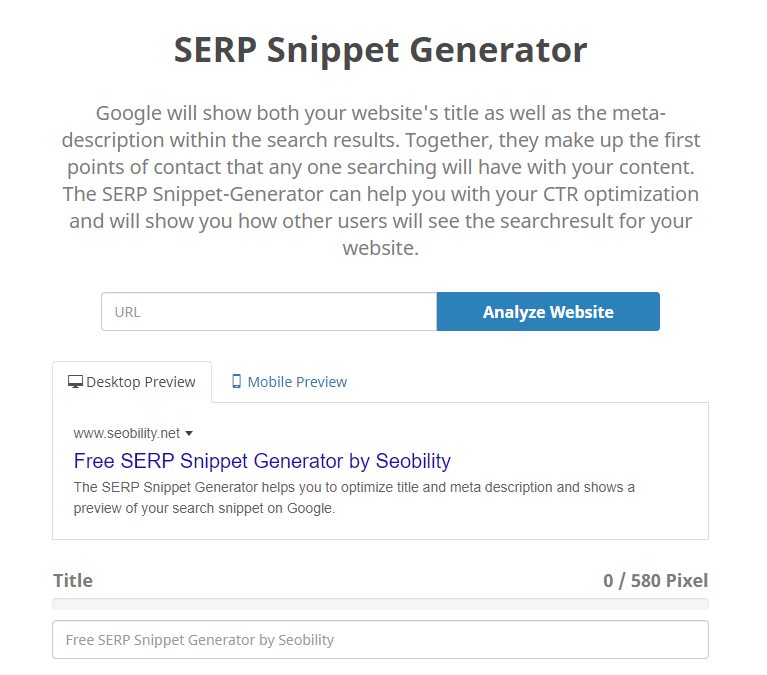
snippet generator

When it comes to templating titles, unfortunately there’s no easy way to do it.

You can choose to include your site name in your titles as a prefix or suffix in your site’s global configuration.

System > Global Configuration > SEO Settings
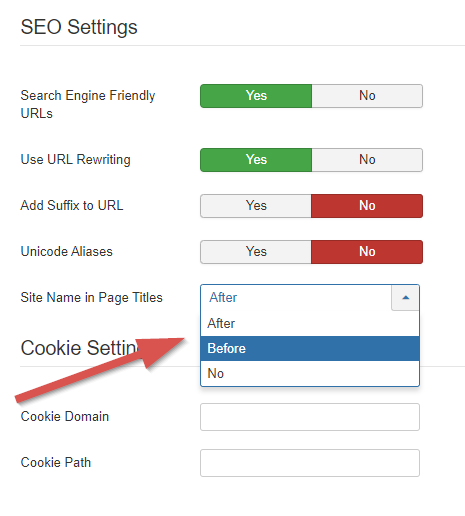
name in title

But again, this will be overwritten if you’re using sh404SEF.

And of course, if you want to write some custom code, you’re free to create a custom title (or meta description) format in your template (instructions here).

Note: natively you can also set titles/meta descriptions in the admin section of an article, which we already covered in the “good, bad, and ugly” section.

Learn more about SEO Titles and Meta Descriptions

Page slug / URL

Control in Joomla: yes

We recommend creating short, descriptive, 2-3 word slugs, including the primary keyword (or phrase) for each page. Use hyphens to separate words.

Joomla supports search engine friendly URLS natively (the process to activate them is detailed here), but we’d recommend using an extension (such as sh404SEF) for easier management.

Learn more about URL slugs/permalinks

Canonical URLs

Control in Joomla: yes

On smaller sites you probably won’t need to worry about this.

But if you have a series of similar pages on your site — i.e. targeting the same keywords, or with very small variations in content — there may be times when you’ll want to set a canonical (master) URL.

This helps to avoid duplicate content issues.

If you’re using sh404SEF, you can set a custom canonical URL in the page’s SEO panel.

Components > sh404SEF > Titles and metas > Select page > Edit url record
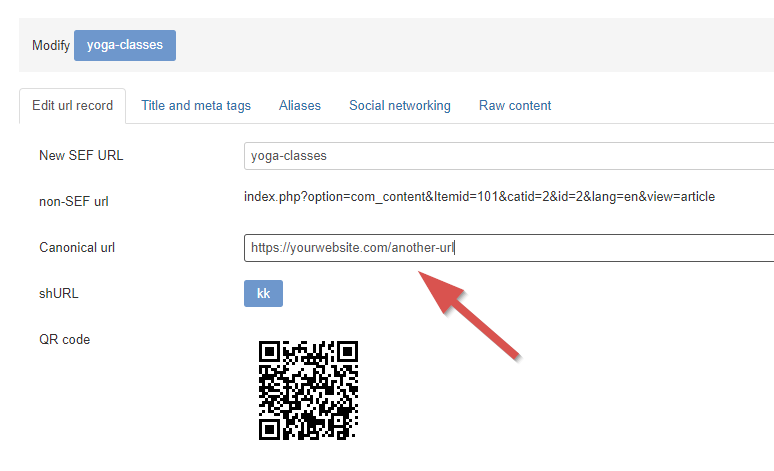
canonical url

Learn more about canonical URLs

Index control (robots meta tag)

Control in Joomla: yes

The robots meta tag instructs Google to either index (1), or not to index (2) a page:

  • <meta name=”robots” content=”index, follow”> – index this page please Google
  • <meta name=”robots” content=”noindex, follow”> – ignore this page please Google (but follow the links on it)

You don’t actually need the first one as (assuming your page meets their quality standards) indexing is Google’s default action. But it doesn’t do any harm to have it in place.

Joomla lets you set this in the “Publishing” tab of an article’s edit screen.
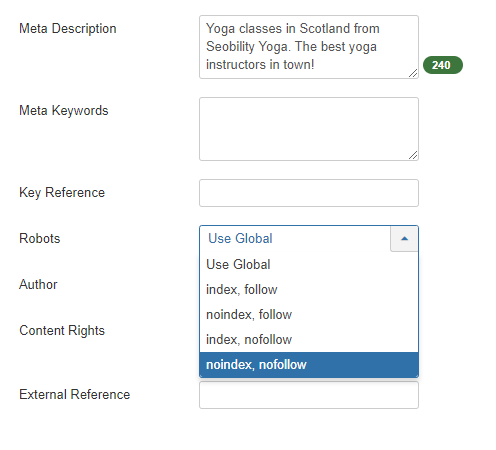
indexing options

Learn more about index control

Heading Tags (h1, h2, h3 etc)

Control in Joomla: yes

Heading tags (h1, h2, h3, etc) help Google understand the structure and topic(s) of your page.

They should be properly nested.

For example, an h1 tag would generally be the main topic (level 1), an h2 could be a subtopic (level 2), and an h3 could be a sub-sub topic (level 3) etc:

<h1>Pets</h1> (topic of the page)
<h2>Goldfish</h2> (subtopic)
<h3>Caring for your goldfish</h3> (subtopic of goldfish)
<h4>Clean your fish’s tank regularly</h4> (subtopic of caring for your goldfish)
<h2>Cats</h2> (subtopic)
<h3>Caring for your cat</h3> (subtopic of cats)

Joomla supports a full range of heading tags from H1-H6.
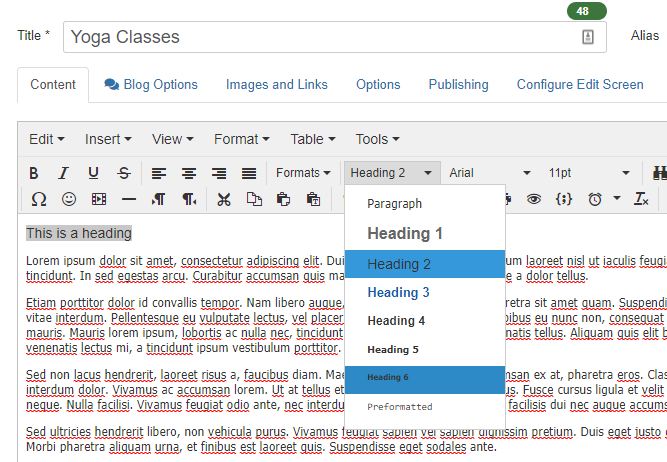
heading tags

As it should!

Learn more about heading tags

Structured data (aka schema)

Control in Joomla: yes

Structured data (also known as schema) can help Google understand:

  • the type of content on a page (i.e. recipe, review, product, article),
  • the entity behind the website (i.e. organization),
  • and can also be used to show additional search features (rich snippets)

If you’re not familiar with structured data and its impact on SEO, we recommend reading our rich snippets guide.

You’ve got several options for including custom schema on your Joomla website and pages.

First up, there are several specialized extensions, such as this one from tassos.gr (free and paid versions available).
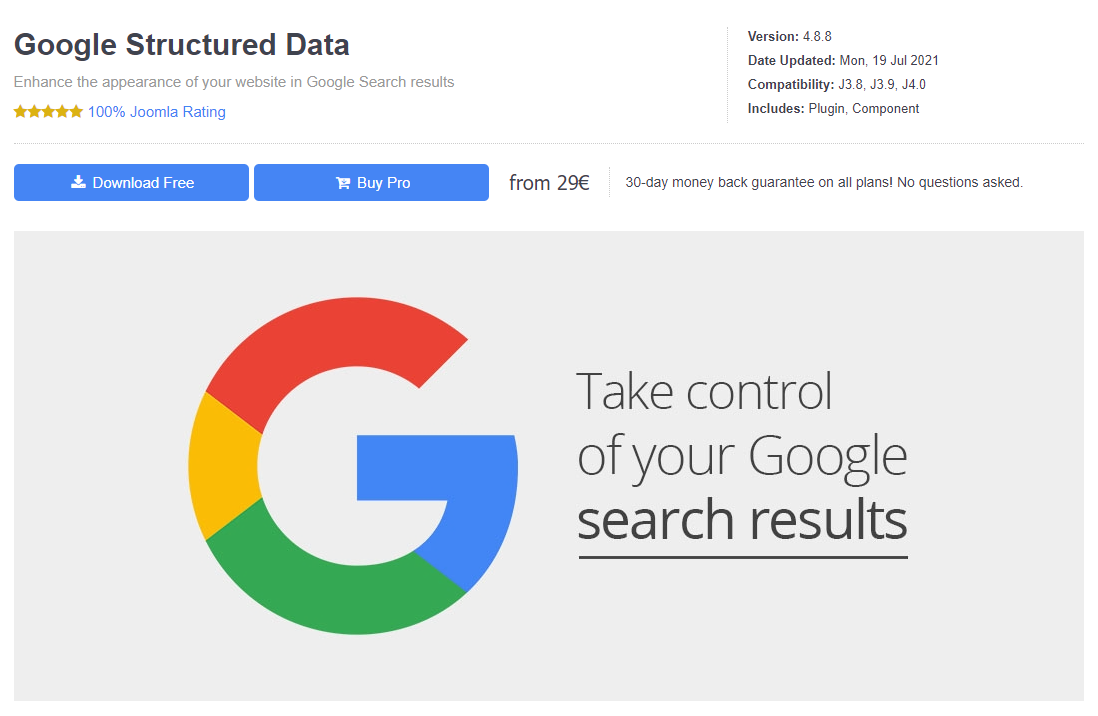
structured data extension for joomla

But if you want to minimize extensions, you can also generate page specific schema markup, then use sh404SEF to add it to an article.

You can use this free tool to generate a wide range of schema markup. For example, below we’ve created schema markup for an FAQ page.
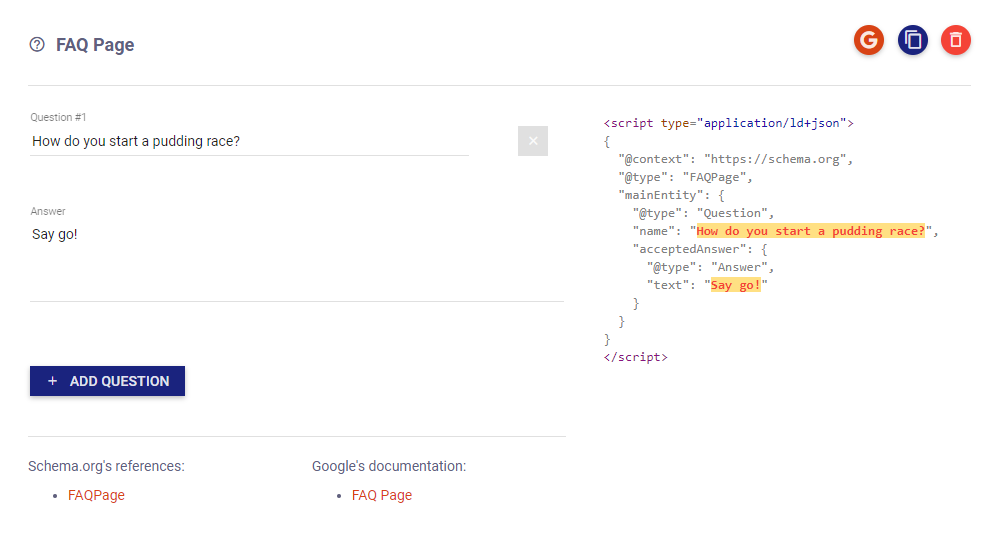
schema faq

Then simply copy and paste the custom schema code into the “Bottom of HEAD SECTION” box in the sh404SEF admin panel of the page you want to include it.

Components > sh404SEF > Titles and metas > Select page > Raw content
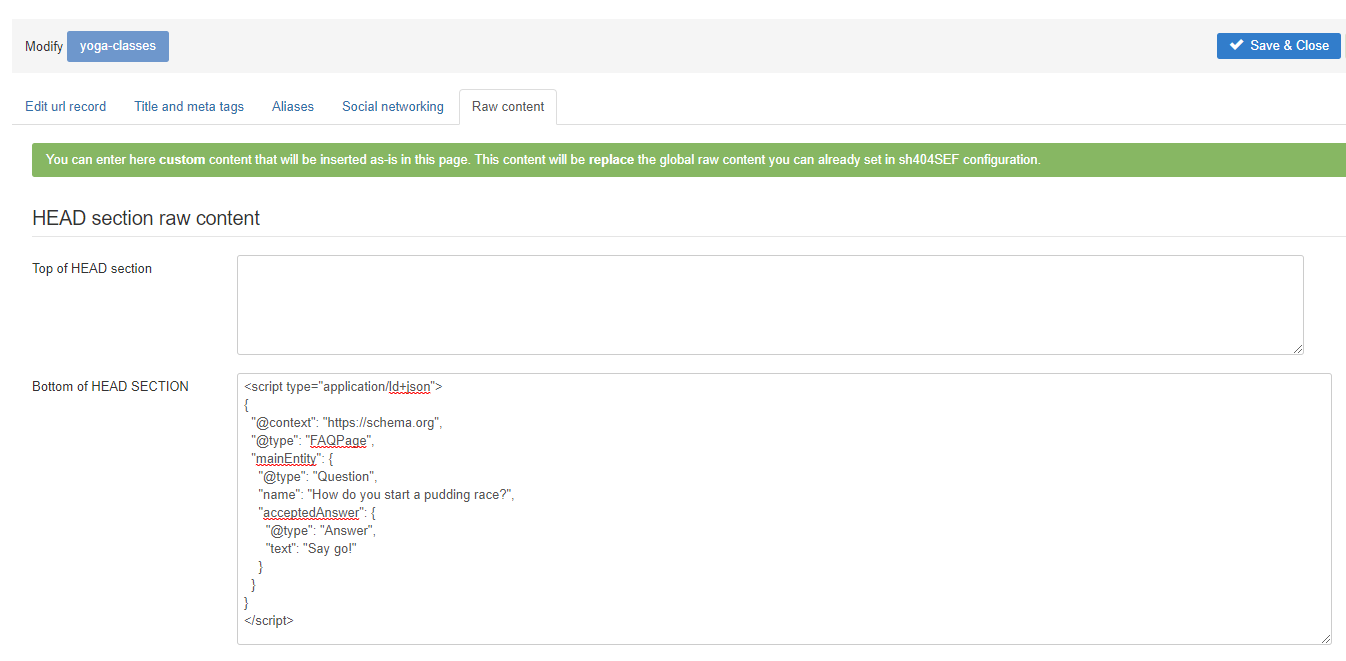
sh404sef head

Not the cleanest solution in the world perhaps, but it does the job.

Learn more about structured data and rich snippets

Image SEO

Control in Joomla: yes

The three most important elements of image SEO are:

  • Alt text (description of the image for screen readers and search engines)
  • File size (smaller = faster = better)
  • File name (we recommend using descriptive file names)

Joomla’s standard WYSIWYG editor supports alt text (they call it “description”)…
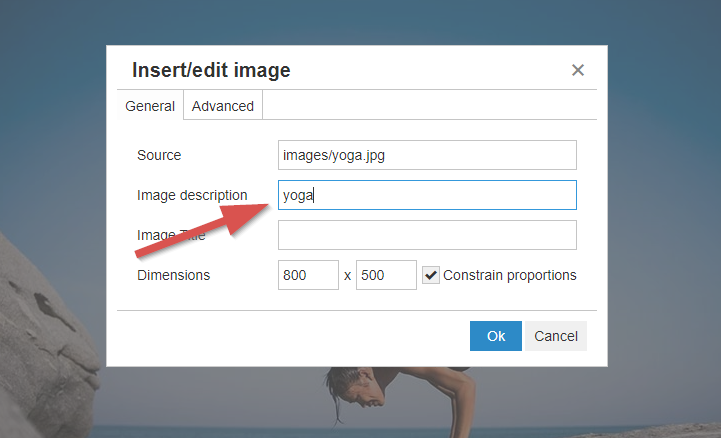
joomla alt text

…and they won’t mess with your filenames. So as long as you use a descriptive filename when saving before uploading to Joomla, that’s what you’ll get.

With regards to optimizing image file sizes, you’ll have to handle that in a different way.

Your options are to either:

a) make sure your images are compressed before uploading, or

b) install an extension to compress your images for you

If you go for option b, then the Image Recycle extension should do the trick.

image recycle extension

Learn more about image SEO

HTTPS

Do Joomla sites run over HTTPS? yes

HTTPS has been a confirmed Google ranking signal since 2014.

And in 2021 there’s really no excuse for any site to still be running over HTTP. Notwithstanding any SEO benefits, it’s unsecure.

Making sure your Joomla site runs over HTTPS is your (or your hosts) responsibility.

Learn more about HTTPS

Robots.txt file

Control in Joomla: yes

A robots.txt file allows you to stop search engine bots from accessing certain areas of your site.

For example, you might have a section with user-generated content that you don’t want crawled or indexed by Google.

Since Joomla is self hosted, you can use FTP to directly edit your robots.txt file.

Learn more about Robots.txt

XML Sitemaps

Generated by Joomla: yes

An XML sitemap helps Google find (and index) all the pages on your site.

You won’t get an XML sitemap natively in Joomla, but there are plenty of extensions that will help you create and manage your sitemap(s).

JSitemap (paid) is pretty comprehensive.

jsitemap

Learn more about XML Sitemaps

Are Joomla sites mobile friendly?

One word answer: yes

When designing your Joomla site there’s a good chance you’ll be focusing on how it looks on desktop.

But mobile traffic overtook desktop traffic in 2017. And Google now prioritizes the mobile version of your site for crawling and indexing.

Most Joomla templates are mobile friendly. And if yours is not…

…then it’s time to find a new one!

If Google does find any issues with the mobile version of your website, they’ll let you know in Search Console.
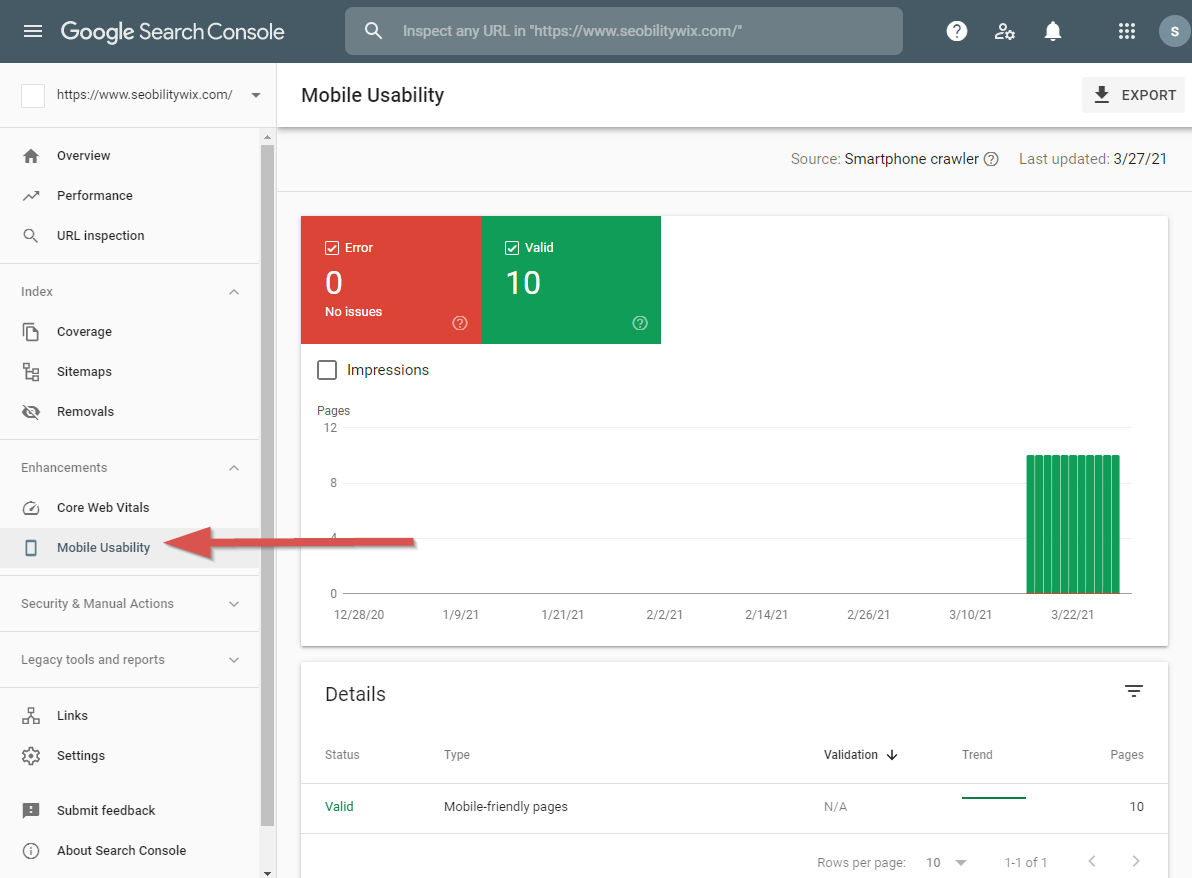
mobile issues - google search console

So keep an eye out.

In conclusion: Joomla is good for SEO, but feels dated

Joomla has been around for a long time, and has a relatively large community.

So it’s no real surprise that there will be a solution (be that with an extension or some code tinkering) for most technical SEO tasks that you want to complete.

But while there’s nothing you can’t do with a bit of knowledge, time, and probably money (most good extensions are paid) we do feel that many tasks are unnecessarily convoluted.

We don’t like having to install multiple extensions to get what we need done, and we would rather everything was managed in one area (i.e. you manage the metadata for an article in an article, rather than in a separate section).

And overall — as we intimated in our introductory summary — the platform just feels tired and dated to us. Joomla used to have the edge on WordPress when it came to managing multiple content types, section specific templating, and managing user privileges. But we think WordPress has now bridged that gap. Which leaves us wondering what Joomla’s current raison d’être actually is?

But ruminations over the platform’s future aside, and getting back to our focus on Joomla’s SEO capabilities, it’s definitely going to be possible to get your Joomla site fully optimized and ranking higher in Google.

So if you’re running a Joomla site, our recommendation is to:

  • run a full SEO audit (you can follow this SEO audit guide),
  • allocate time to fixing issues and optimizing your site (where possible),
  • focus in on creating high quality content that helps your users and fully answers their search queries,
  • build your site’s authority by earning high quality backlinks (check out our recommended link building tactics)

Next up we’ll be comparing the SEO pros and cons of each CMS we’ve reviewed in our series in a roundup post, where we’ll also reveal the best CMS for SEO in 2021. Sign up for our email list below to follow this series, and for loads more fresh SEO tips, tutorials, and guides straight to your inbox.

PS: Get blog updates straight to your inbox!

David McSweeney

David is our chief editor for expert SEO content at Seobility. Unsurprisingly he loves SEO and writing. He combines 20+ years of experience in SEO with the passion for teaching you guys how to optimize your websites the right way.

Categories SEO

How to reveal the business value of your SEO proposition

30-second summary:

  • Your SEO proposition plays a crucial function not just for your agency however likewise for your client’s service
  • Forecasting requires to be a star component of your client acquisition process– but how do you browse these tricky waters?
  • SEOmonitor dissects the whole idea procedure and action prepare for you
  • Here’s how to make sure realistic, practical, achievable, and mutually concurred spending plans and milestones are set with your customers

Customers often request a projection to estimate their ROI with this kind of marketing financial investment. Agencies are caught between developing a realistic service case and explaining that they’re all circumstances, not promises. Think of it like this– you both require to understand where you’re going, or you won’t have a hint when you’re there. However it’s all about how you set expectations from the start. This is where your SEO proposal plays an important function in client acquisition and experience.

Let’s think of the following scenario: a Client Service Director argues about the advantages of presenting a company case to a new lead to make the sell.

Yet, the agency’s CEO wants to make sure the preliminary internal examination is on point. After all, it makes sense to adjust your design first and then reveal the opportunity.

With the ideal forecasting method in location, you can do both and prove your SEO services’ service worth.

The huge question is how to go about it.

Material created in collaboration with SEOmonitor.

What does SEO success mean for your customer’s business?

To buy SEO, a customer requires to understand how that method translates into sessions, conversions, and ultimately earnings. As an agency, you require to link the service metrics with the non-brand organic traffic and keyword ranks– the data that you straight impact.

Keywords are influenced by lots of variables that you require to think about when developing a credible methodology to create practical SEO situations.

And even before that, the method you do your keyword research study influences those scenarios:

  • What is the customer’s market trend like?
  • What is their company pattern? Are they in a development stage, or are they plateauing?
  • What is their market share in regards to natural real-estate (their exposure compared to their competitors)?

Comprehending the opportunity for growth

The competitors’ keywords space analysis

It’s typical sense, but it can in some cases escape the customer’s focus– showing them who their genuine online competitors remain in regards to inquiries and search intent.

A fragrance shop, for example, will be in tight competition with big retailers such as Amazon more than contending fragrance shops, deciding to use online services.

Exploring the customer’s domain in connection with the rival landscape will offer you an introduction of the overlapping and non-overlapping keywords, together with their crucial attributes (search volumes, seasonality, etc.). This is one significant way to comprehend which keywords deserve introducing into your SEO proposal and ulterior strategy so as not to get sidetracked by misguiding keywords.

Continuing our fragrance shop example, although the client may want to focus on a particular set of keywords, you’ll have the ability to make a compelling, data-based argument on why it’s essential to enhance non-overlapping keywords. Let’s say you learnt that a rival to our fragrance store had committed pages for aroma-based fragrances, with listings that target”vetiver” or”white musk”. Duplicating this will not include changing the customer’s line of product and will include brand-new valuable keywords to the mix.

The customer’s market share

Another way to evaluate the customer’s service status quo is by utilizing the Visibility metric as a market share sign. Calculated as an impression share and weighted versus search volumes, it reveals you the growth capacity compared to the customer’s competitors and the overall shares.

As it’s revealed as a percentage, you’ll know where to focus your attention.

If it’s a competitive market, and the primary competitor has a Visibility of 70 percent, then improving the rankings for high-volume keywords in the top-three group will be a game-changer. You’ll also understand which keywords to pick for a winning SEO technique.

SEO proposal - Strategy

Transparent calculations for a practical timeframe After thoroughly looking into and choosing the targeted keywords at hand, modeling how the non-brand natural traffic may look if a particular efficiency is

achieved in a timeframe of six or 12 months will help your agency set the ideal expectations. To do so, you require to look at

  • all the variables affecting your keyword list: Search seasonality and the keywords
  • ‘year-over-year pattern How the inertial traffic affected by seasonality only looks (as if the site’s rankings would stand still)
  • The performance in time toward the SEO objective, calculated as rapid or linear
  • The average CTR curve calculated for the leading 10 positions for each mix of SERP functions and device segmentation, showing you the real clicks that manage to reach your customer
  • The long-tail keywords and their influence on forecasted traffic

With this design in mind, you get to estimate conversions and sessions instead of ranks. In SEOmonitor’s forecasting module, the estimate of the extra conversions is based on the approximated extra gos to multiplied by the matching conversion rate of each keyword consisted of in the calculation. You can confirm each input and output at a private keyword level and see what makes a too far-fetched or realistic scenario.

Therefore, you transform the packed notion of forecasting into a more concrete concept– different extra traffic circumstances which equate into possible business results, moving the discussion towards marketing added value.

To make a case for a specific circumstance, you can highlight what their traffic would look like with and without the proposed SEO project, being transparent about what entered into your estimations and what assumptions you’ve made.

Letting the client understand the total chance and what remains in it for their business will assist you set a commonalities for success.

Is it the ideal budget plan for the customer’s business now?

When your company builds a company case, another essential thing is to evaluate the direct connection between SEO performance and results, associated to an objective standard that both, you and the client can quickly evaluate.

Compare the SEO spending plan and forecasted outcomes to its equivalent in Google Ads, and you’ll have an external comparison revealing the worth that SEO brings. For instance, if the approximated Google Ads Value for your sensible scenario is $55,000 for 12 months, then a $500 to $700 retainer appears more plausible than a $1,500 one.

In contrast, if the estimated Google Ads Value reaches $250,000+ for the exact same 12 months timeframe, it’s clear that we’re talking about worldwide SEO on an extremely competitive market and a $5,000 to $7,000 retainer at least.

Determining the pricing for your client SEO proposal

Instead of guesstimations and the uncomfortable back and forth of developing a spending plan standard, you ‘ll now have an overview of where business is and how you can

contribute in regards to profits. So these calculations can assist you set the ideal rate for that client profile. Even if you select not to put that forecasting scenario in your proposal and rather negotiate KPIs after the SEO technical improvements are in location (the 3rd or fourth month of cooperation), you’ll have an important internal calibration tool at your disposal.

The forecasting workout helps examine if the brand-new client’s goal is worth it and keeps your agency accountable for the SEO strategy you propose.

Is the campaign going in the right instructions?

An initial business case with variable circumstances helps the firm define success for the brand-new customer. Then, it’s just as crucial to track the SEO campaign’s progress once it’s in location. Forecasting is simply a method to estimate a possible future and set “a north star” for both of you. The rest depends upon how the method evolves against the shifting context.

Here’s where re-forecasting plays a significant part.

Maybe the firm decides to share KPIs for the first time in the 4th or 3rd month of partnership after implementing the audit requirements. Or it’s time for the quarterly evaluation, and the preliminary SEO technique and subsequent forecasting are scrutinized. Either way, it’s crucial to revise and adjust.

Perhaps there are new keyword lists to include and model into a traffic scenario or a digital PR chance to contribute to the general strategy. Maybe the customer has extra product and services that they want to optimize that weren’t consisted of in the starting plan.

For instance, coming back to our fragrance store and its pandemic challenges, it’s essential to touch base regularly to see what new opportunities are in store. They might be aiming to branch off in the home fragrance industry but do not understand just how much demand remains in their target audience. As their SEO firm, you can re-pitch an SEO project based on search information for “house perfumes” and develop a innovative digital PR project with that hook.

This action of the client relationship-building process is an included benefit in proving how you’ve developed business worth and what more you can do.

Summary

Successfully communicating your proposed SEO campaign’s worth is crucial for potential customers to decide if– the rate is right, the

  • timeframe is right,
  • the ROI deserves it
  • . It’s also a way to keep yourfirm accountable and truthful. A credible forecasting method aids with all of the above, as you get to: Establish a typical definition of what success
    • looks like– rankings achieved for relevant keywords, Visibility accomplished versus competitors, and other established factors which straight equates to additional traffic, conversions, income Establish a practical spending plan based on
    • the client profile and its Google Ads comparable value Keep track of the SEO objective and re-forecast when
    • it’s the case to change the method SEOmonitor’s forecasting module supports SEO agencies

    to do all that with reliable information and all the needed variables, taking into consideration seasonality, YoY patterns, and more. Plus, with the Google Slides integration, you get a Proposal Builder that instantly pulls the forecast data and transforms your service scenario into a pitch-ready presentation. The forecasting module is just one of the services SEOmonitor establishes for firms to get, manage, and retain more appropriate clients. Sign up with

    us in our mission to bring more openness to the SEO industry!

    More about:

Influencers in today’s SEO

30-second summary:

  • With search getting more sophisticated there will be a strong relation in between user signals and influencers
  • Google’s Multitask Unified Model (MUM) and the AIDA (Attention, Interest, Desire, Action) design will impact search intent and influence a company’ search visibility
  • Intellifluence’s CEO, Joe Sinkwitz describes crucial ideas surrounding the effect of influencers on website rankings in modern-day SEO

One brand-new to SEO might presume that the only function influencers play when it pertains to ranking is in the kind of bloggers supplying evaluations and links through guest blogging. If we were to sector search into simplistic containers of links, content, and the cumulative user signals associated with how a visitor communicates with links and material, the future role of influencers is going to skew far more towards the user signals pail.

Historically, influencers have actually been viewed as a paid social channel add-on for B2C and D2C companies, only more just recently taken seriously for their ability to affect B2B purchases. Their usage cases are even more flexible than the initial presumptions and presumptions connected to worth, with anticipated payment varies to match that adaptability based upon audience sizes and channel selection. As an SEO, it is easy to understand how influencers that preserve blog sites in your specific niche would work when going through a PR-driven outreach campaign for link purposes. To understand how influencers can impact the result of a site’s rankings external to the links generated, it’s essential initially to understand a couple of crucial concepts.

Material produced in collaboration with Intellifluence.

Targeted peer personalities

Within the realm of material marketing, an online marketer would look for to establish out personalities in order to correctly structure material with the appropriate hooks and worth proposals. For ease in understanding how to produce a sample buyer personality, consider the following procedure:

  1. Provided you’re not operating on a brand name brand-new website, look into your previous 100 customers– if you have enough data, you can be more select and granular out your most perfect customers.
  2. Based on the buyer contact’s e-mail, use a tool such as Clearbit to produce a list of their social media accounts. Where they keep social accounts is simply as crucial as to their level of use and subject matters.
  3. Who do these clients desire be? Are they continuously seeking out services? Whom do they follow to get these services? A quick hack in this is to sort their fans by audience size as reliable influencers tend to have a bigger following than the majority of their industry peers.
  4. Digging even more, who influences those subject specialists? Which sources do they consume?
  5. Who are your perfect customer’s peers? On one hand, you’ll likely have some of that information right away when analyzing the audience information. If you do not, LinkedIn Sales Navigator makes segmentation rather basic based on their filters and question improvements, allowing you to select extremely comparable people to your targets.
  6. Repeat the above process as essential to generate a big sufficient dataset that you can apply pivots on in a worksheet, in order to identify buyer personality commonalities.

Once targeted personalities are produced based on those characteristic commonness, we can use them in order to positively impact those user signals. Here are a couple of simplistic pieces for the sake of brevity.

Navigational queries Through several experiments, we know that spikes in navigational queries can have a spillover impact on rankings for non-navigational queries. As Google is introducing Multitask Unified Model(MUM)to understand intricate questions, the more favorable impacts we as SEOs can supply on revealing that these navigational inquiries likewise have transactional and informative signals connected with them, the much better the intent and for that reason browse the ordering will be on the desired transactional terms.

How does this work with targeted peer personas? It can be as easy as employing influencers that exist regularly enough in the sum audience data to your targets to share out beneficial details related to your service or product, particularly writing out the trademark name. Each time we’ve run campaigns of this type, the navigational questions spike. This alone is extremely helpful, however there’s more power to these peer influencers.

Repeat dwell

Having a user specifically look for your brand and click the result is a great primary step. What could be better? Consistently spending and going to time on-site. I acknowledge that we’re simplifying here but structuring a project with peers that follows the design of Attention, Interest, Desire, Action (AIDA) permits you to introduce the trademark name for navigational questions then pepper the target market through those peer influencers with intriguing truths and use cases.

In this phase of the campaign, the direct links from social posts could be utilized as we can all most likely agree that our Chrome and Android data is being used to continually refine future searches. The goal of this phase is to drive repeat usage of the website. Some business activity might very well occur, which is a bonus offer, however not the KPI.

Influencers in today's SEO - Finding influencers

Query fulfillment The final stage of the AIDA design moves from desire to action, and our goal is to turn our navigational questions into transactional rankings. Equated to how MUM may perceive this, a user that seeks out a result navigationally, go back to the result from another channel, and then returns with a transactional inquiry modifier is most likely satisfied with the question result and hence that website should be shown more frequently.

How does that work with the influencers? The third design of posts from the peer influencers to your purchaser personalities can again go back to mentioning your brand name and including a specific worth proposition to produce that action. It might be a coupon code, a time-specific call-to-action for a deal, a giveaway, or any combination of the sort. By now focusing on a specific transactional modifier with your brand name, a percentage of those mixed questions will take place, leading to action being taken, which is the definition of question fulfillment. You’ll have effectively utilized influencers to influence how Google perceives the website for future transactional questions.

Joe Sinkwitz is CEO at Intellifluence.

Four methods to improve page speed and master Core Web Vitals

30-second summary:

  • Websites that rank well on Google tend to have a higher Core Web Vitals score
  • There are 3 core web vitals that comprise most of the site’s overall page speed rating
  • Focusing on user experience in website design and marketing campaigns might give you an one-upmanship
  • This detailed guide prepares you for the rollout of the new Google Search algorithm update

Google’s most current significant upgrade to its search algorithm focuses significantly on the user experience through a new set of ranking aspect metrics, called Core Web Vitals. Early results from Core Web Vital audits expose that the typical website performs below these new requirements. Searchmetrics’ research revealed that, on average, sites might minimize page load time by nearly one second by getting rid of unused JavaScript.

This offers a fantastic chance to outperform other websites by boosting your own page rankings.

Here is whatever you require to understand about Core Web Vitals plus four basic steps to improve your metrics.

Content developed in partnership with Searchmetrics.

What are the Core Web Vitals metrics?

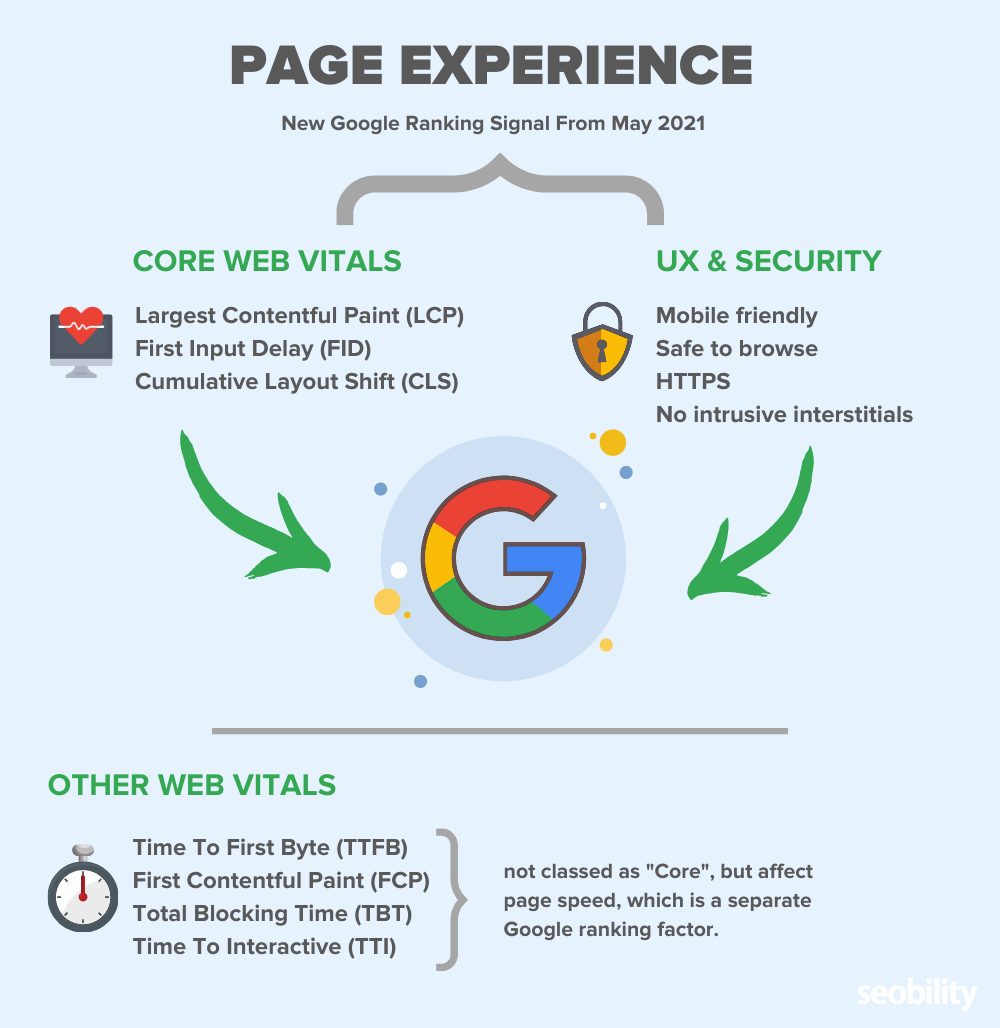
Core Web Vitals are an extension of Google’s page experience signals that consist of mobile-friendliness and HTTPs. The three Core Web Vitals metrics procedure loading performance, interactivity, and visual stability, which Google consider as offering a precise representation of a real-world, user experience.

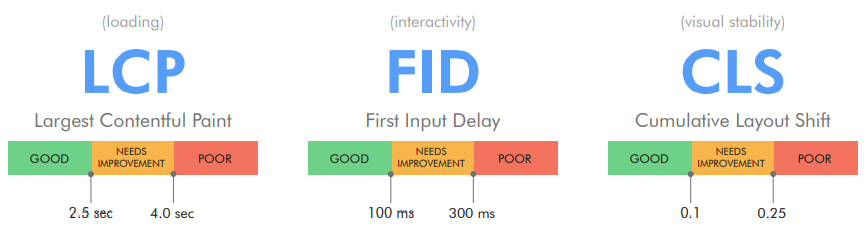
  1. Biggest Contentful Paint (LCP) measures the packing time of the largest image or text obstruct noticeable within the user’s viewpoint.
  2. Input Delay (FID) measures the interactivity on the page by computing the time from when a user initially communicates with the site to the time when the internet browser reacts to that interaction.
  3. Cumulative Layout Shift (CLS) describes how much the content shifts during page rendering.

How to examine your page speed insights

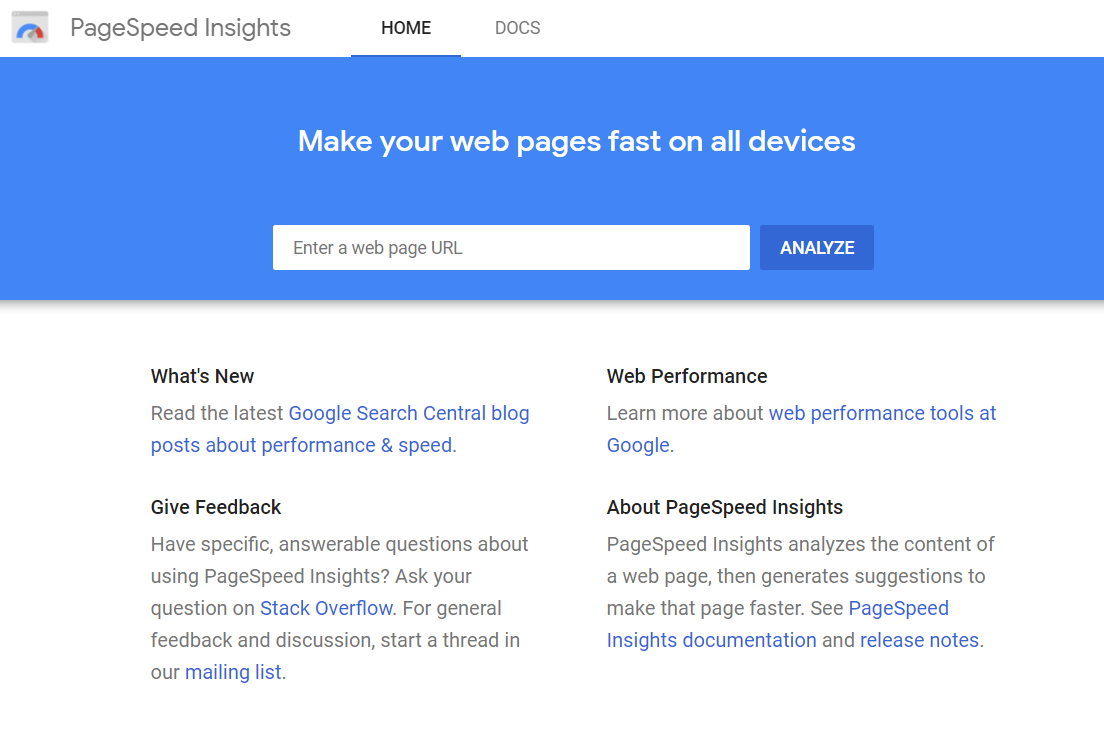
There are numerous online tools that examine your page ranking score, consisting of PageSpeed Insights, Chrome User Experience Report, Lighthouse Audit, and Search Console. These websites procedure page speed in different aspects and display the outcomes using a traffic signal system. PageSpeed Insights offers a breakdown of the results and highlights locations of improvement.

What does “great” performance mean in numbers?

To offer a great user experience, LCP should occur within 2.5 seconds of when the page first begins loading. Pages must have an FID of less than 100 milliseconds and keep a CLS of less than 0.1.

Sites, like Wikipedia, have the greatest page speed rating due to a light-weight method to website design, using generally text and optimized images. Websites that rely heavily on video content and images are slower to load and make for a poor user experience. Therefore, there is a balance to strike in between style and user experience.

See where your website ranks. Check Out PageSpeed Insights and enter your URL. Keep in mind: The top number is your Lighthouse score, also referred to as PageSpeed rating, determining from absolutely no to 100. While it’s a great general criteria for the performance of your website. It’s not completely associated to the 3 Core Web Vitals metrics, which should be viewed as an analysis of LCP, FID, and CLS.

How to improve your page speed

Passing is thought about getting a “great” rating in all three locations. Making small changes can improve the page speed score by as little as one 2nd, which can move the website from a “poor” or “requires enhancement” rating in LCP to a “great” one. Lowering load time will make users better and increase traffic to the website.

Tom Wells, innovative marketer at Searchmetrics, states,

“Anything that’s not required on a website shouldn’t exist.”

Putting it merely, identifying and getting rid of elements that are not utilized or have a substantive purpose could enhance the website’s page speed score.

1. Extra-large images

Badly enhanced images are among the main causes impacting a site’s LCP score as this is typically the largest element to load. Ecommerce companies and those who rely greatly on images might have poorer LCP ratings due to the page rendering of multiple high-resolution images.

Enhancing these assets by using responsive design or next-gen image formatting such as WebP, JPEG 2000 and JPEG XR can improve ball game by lowering rendering time. Typically, images can be condensed to a much smaller sized size without affecting the quality of the image. Totally free resources like Squoosh can do this for you.

2. Dynamic content and advertisements

Filling ads on a web page is among the primary reasons for a bad CLS score. This can be down to components on the page shifting to accommodate dynamic ads, that makes for a bad user experience.

Using a smart implementation method such as allocating size attributes or CSS aspect ratio boxes for all ads, videos, and image aspects is one method to decrease content moving. Some companies might utilize a plugin or coding at the top of the website to put the ads. This could lead to a slower site, impacting the user experience negatively and indirectly affecting rankings.

Also, never place content on top of existing content, except in response to specific user interactions as this ensures any design shift that happens. For instance, when you click a CTA button and a kind appears is an exception.

3. Plugin-centric web economy

Plugins can imitate “plaster over the cracks” to fix website issues, says Wells. Regardless of creating a short-lived repair, it can decrease and impede web performance as all the code needs to load prior to the user is able to totally engage with the website.

Utilizing plugins can increase server request counts and increase javascript execution time. All these aspects can decrease the website’s FID score.

“Often we search for innovative fixes and solutions but sometimes it’s as basic as deleting what’s not needed,” says Wells.

Eliminating some plugins, specifically unused ones, can improve the reactivity and speed of the site.

4. Excessive code

Google encourages focusing on the overall website performance.

“It’s important for well-scored and responsive sites to be as light-weight as possible,” says Wells.

“The more things that a server has to load, the slower that load time is going to be general.”

While unused CSS and JavaScript may not straight impact the page speed rating, it can still impact the site’s load times, develop code bloat, and adversely impact user experience.

When should I start?

Google’s rollout of the brand-new algorithm began in mid-June, so it’s worth getting a start on reviewing how well your site scores on pages speed tests. Sites that rank well tend to have greater Core Web Vitals scores and this pattern is set to continue as Google places higher focus on user experience.

Desire more Core Web Vital insights? Check Out Searchmetrics’ Google Core Web Vitals Study April 2021.

Introducing: The Content Marketing Hub 2.0, A Free Library of Content Marketing Resources for 2021

I’m super excited to announce the completely updated Content Marketing Hub.

We launched the first version of Content Marketing Hub last year.

Since then, we’ve made hundreds of edits, additions, improvements and updates.

This new resource 30+ covers pretty much everything you need to know about content marketing all in one place… including content promotion, copywriting, blog design, content repurposing, and more.

You can check out the new Content Marketing Hub 2.0 right here:

Visit The Content Marketing Hub

This new resource library contains 62,438 words, 580 screenshots, as well as 100+ professionally designed illustrations, visuals, charts and templates.

Backlinko – Content Marketing Hub 2.0

I’m super happy with how Content Marketing Hub 2.0 turned out.

And I hope you get a ton of value from it.

Check out The Content Marketing Hub 2.0.

Here’s What’s Included

The Content Marketing Hub is broken down into 6 main categories:

  • Content Marketing Fundamentals: Here’s where you’ll learn (or get a refresher) on the foundational elements of content marketing. You’ll learn how to develop a content strategy, the different types of content marketing you can use, and how to come up with topic ideas.
  • Content Production: Learn how to produce content that people will want to read, link to and share. You’ll learn how to write compelling copy, develop a content calendar, design your content, and use repurpose content for more traffic.
  • Blogging and Written Content: Here’s where you’ll learn how to publish blog posts that get results. In this section I cover how to create 10x content, listicles and posts that focus on content curation.
  • Multimedia Content: Podcasts. Videos. Visuals. They’re all important (and growing) parts of content marketing. You’ll learn how to create the type of multimedia content that your audience wants to consume.
  • Content Promotion and Distribution: Learn how to spread the word about the content that you publish using email outreach, social media, blog SEO and more.
  • Content Marketing Tools: Here’s where you’ll learn how to use some of the most popular content marketing tools on the market, like HootSuite, Google Analytics and Buffer.

Visit The Content Marketing Hub 2.0

What Do You Think?

I’d love to hear what you think about the new Content Marketing Hub 2.0.

Specifically, I’d like to know:

What’s the #1 thing you want to learn about content marketing right now?

Also, I plan on adding even more helpful resources to the library soon.

So let me know if you have any topic ideas or suggestions.

The future of gaming and streaming: a networking and SEO arsenal

30-second summary:

  • As the world starts to return to normalcy, the gaming and live streaming industry need SEO, social networking, and online marketing for continued growth
  • I spoke with industry influencers Alinity, Matt Rehwoldt, and eUnited’s General Manager and VP, Matt Potthoff on the industry’s current scenario, the obstacle course for amplified audience engagement, and the budding need for innovation

Over the past five years, the boom of the live-streaming, esports, and gaming industries has been stealing headlines not only in the tech industry but also in mainstream media.

That boom only increased its radius during the pandemic, which saw astronomical highs in terms of viewership numbers for the Amazon-owned Twitch streaming platform, Google’s YouTube, and even Facebook Gaming, who jumped more aggressively into the marketplace with the acquisition of Microsoft’s Mixer platform during the summer of 2020.

Since then, much of the world has started getting back to more normalcy, which means that studios are back to work on big project games, esports teams are heading back to regular competitions, and the streaming landscape continues its evolution.

Despite the boom, the industry lacks some key ingredients

But despite the impressive numbers, the industry as a whole still lacks some key ingredients that can not only take the industry to the next level, but also improve the business landscape of content creators as well.

More often than not, the industry is splintered off into a number of sectors that, aside from annual conventions and events, don’t often regularly network efficiently.

Compounding the limitations of networking efficiency is the void in marketing practices such as search engine optimization (SEO) and traditional internet marketing that content creators and brands are leaving on the table.

Some of the core complaints among streamers and content creators, among others, is – the lack of discoverability provided by their platforms, and how their growth seems bottlenecked and capped due to the lack of visibility.

Furthermore, content creators and brands often find themselves in the cycle of social media posting, which can lean heavily into monotony and automation – two major factors that drive down engagement.

Sure, you can blame the platforms themselves and you would be partially right. Social media platforms are a wide net of interests and demos, so posts may not hit at high percentages consistently. Streaming platforms seem to be staying the course, which is smart business as it has proven to be profitable, even during the most challenging economic crisis in nearly a century.

That leaves content creators, esports teams, game studios, and the industry as a whole, at a crossroads. Where innovation has seemed to bypass the needs for more connected networking and growth potential, many are forced to double down on the work despite the lack of return just to stay afloat.

Natalia Mogollon, better known as Alinity, is one of the most popular streamers on the Twitch platform, boasting over one million followers to her channel and had leveraged the platform to build one of the more recognizable brands in the streaming industry.

Streaming and content creators

To get an objective perspective on the matter, I caught up with gaming content creator, Alinity and Matt Rehwoldt, former WWE wrestler and content creator.

Alinity on gaming and the need for networking, content creation, SEO

“In regards to networking with other creators, I feel like most creators currently use Twitter for that”

“The problem is that I don’t know which creators are genuinely interested in networking and which just want interactions in order to increase their following. It’s probably 50-50.

“But again, I think the market for small to medium size creators is huge. People that are starting to grow and want to meet other creators”

And it’s the market that remains largely untapped or maximized.

Outside of the most famous streamers in the world, many streamers may be stuck under a ceiling or bottlenecked when it comes to growth, and that is where the streaming side of the industry needs to evolve.

A few years ago, professional wrestler and content creator Matt Rehwoldt was involved in the WrestleMania 34 United States Championship match between Randy Orton, Bobby Roode, Jinder Mahalm, and Rusev, performing in front of over 78,000 people in New Orleans, Lousiana.

And while Rehwoldt is back in the industry with promotions such as New Japan Pro Wrestling and rumored to be heading to Impact Wrestling, the ‘Drama King’ has carved out a home for his brand on both Twitch and YouTube.

Despite his name recognition and work on some of the biggest wrestling stages in the industry, the limitations that platforms present can still negatively impact his content.

Matt Rehwoldt on the gaming industry and the need for SEO skills

“The biggest challenge facing content creators is always discoverability,”

“Twitch struggles with this the most and it’s been said to death by any “How To Grow On Twitch” video you see on YouTube – which is the very point. You need to bring people to Twitch from other sources as their search and discoverability is extremely limited.”

“Here I’ll refer your readers to Alpha Gaming’s Harris Heller. He makes some great points about Twitch’s weaknesses with the most glaring being its searchability.

The inclusion of things like highlights or clips is very cool, but why can’t I search “Crazy FRAG” and find a whole list of clips around those search terms? Then through watching things like that I find new creators.  So there needs to be more searchable content on Twitch where you don’t have to just go to the search bar and type the exact name of the stream you’re looking for.”

“Browsability is key,” he said.

But Rehwoldt also points out that YouTube may present better discoverability but also has its own setbacks.

“YouTube is better but there you’re competing in an even larger ecosystem against clickbait warriors and what feels like the whole world”

he points out.

Rehwoldt goes on to point out how SEO is not only impactful but a valuable resource to learn and utilize.

“That said, if you can take the time to teach yourself a little SEO and how to use titles and keywords properly, it’ll help you a lot. It’s something I still struggle with and am learning too.”

But like many streamers, Rehwoldt has been frustrated with the issues that hold back his content. He stresses the importance of understanding that it all comes down to patience and hard work.

“I’m still learning,”

Rehwoldt says.

“My channels are growing but not nearly as fast as I’d like them to.  So for me, it’s more about keeping my mind right. Do good work that I love and the growth seems to come. Not letting myself get discouraged because some video or stream didn’t “pop off” is key too.”

“Everyone points to people like Ludwig or other creators who blew up seemingly overnight and then get frustrated when they feel like they make similar quality content and the same doesn’t happen to them.”

Well there are two things to consider here: First, that often those creators didn’t blow up from “nowhere” and they’ve been working hard either behind the scenes or prior to launching their content and got seen by the right people at the right time. A classic case of preparation meets opportunity.

Secondly, life is also full of incredible exceptions.

People who explode into stardom because they went viral etc.  But never ever try to compare yourself to the exception. I’ve known and spoken to so many creators, those who make a living at it, and it takes years of trying and putting out content that you later look back on and shake your head. Trial and error everyone. Have patience with your work and yourself.”

Esports

While SEO is not prominent in sectors such as streaming, and the collective industry as a whole, it has trickled in with regards to the Esports industry.

Matt Potthoff is the general manager and Vice President of eUnited, and a former professional esports player who has won championships as a player, coach, and general manager.

eUnited

“eUnited has blossomed into a staple esports organization in North America since its inception in 2016”,  Potthoff said.

“We have competed across many titles and have accumulated over $3 million dollars in prize winnings.

eUnited’s most notable championships are winning the 2018 Smite World Championship and the 2019 Call of Duty World Championship. We pride ourselves on growing amateur talent into championship contender players over numerous gaming communities.”

Part of their growth has been the incorporation of SEO and internet marketing through leveraging social media.

“eUnited does use elements such as SEO to increase visibility when selling merchandise or showcasing new sponsors. Additionally, we help players revise their stream titles and descriptions for better chances of obtaining new viewership when users are searching for different topics on Twitch”

Potthoff points out that the integration of internet marketing, SEO, and targeted social networking can provide results and those results can impact profitability.

“eUnited leverages streaming platforms to grow their players’ brands and sell ads to sponsors by utilizing their player’s streaming audience. Most sponsorship activations in esports that aren’t held in person are done over streaming platforms like Twitch”

Innovation and moving forward with solutions

Regardless of the sector of industry, it seems the problems remain the same, and some success can be rooted in the implementation of SEO and optimized networking.

  • But how does the industry innovate to address this?
  • How do content creators address the areas of need?
  • How do we implement better networking and more meaningful connectivity between these different sectors?

Many brands and content creators face hurdles with finding these solutions. They may not have the budget to consistently contract a quality Internet Marketing & SEO agency, and the SEO agency market certainly doesn’t hone in on these offerings.

So, what is the solution?

I considered all of this when I initially launched Gamactica in October 2018. I asked myself these same questions, and I saw the very issues pointed out in this article when I started streaming.

This is why the foundation of what we have been building with Gamactica is rooted in SEO, internet marketing, and intuitive social networking for the industry. Award-winning internet marketing company Elite Rank Media is the backbone of the internet marketing initiatives and processes. Since 2009, the company has been providing marketing services to brands around the world and has been recognized for its work in both Medical SEO and localized Miami SEO marketing, among others.

An industry where content creators, streamers, gamers, esports teams, esports players, game studios and developers, and cosplayers are spread out so distantly on the social space is one that needs the innovation of improved connectivity.

Our purpose is to provide a professional social network to streamline social networking, bring these sectors together more efficiently, and provides the tools and resources that empower these brands and content creators to reach new levels.

And these are the innovations that can help push through the ceilings, break through the bottlenecks, and clear the hurdles that everyone seems to face, regardless of the industry sector.

Gamactica is implementing those innovations.

“I think the idea is very interesting,”

Alinity says of Gamactica.

“Most current social media platforms focus on relationships with our followings, but a new focus towards networking is innovative. It almost makes me think of LinkedIn.

“I feel like it has a lot of potential for connecting brands and creators, I think there is a big need in that regard. It seems like some streamers are really well connected and get lots of sponsorships, whereas the new creators have no idea how to get these. I think there is a big untapped market within the creators with about 100-500 concurrents (viewers)”

she adds.

“They have more tight communities and often get overlooked but I think there is a huge potential for brand deals with high return on investment for brands, as they tend to be more connected with their viewers. This connection becomes difficult once you get over 1000 concurrent viewers”

she continued.

Alinity points out the vitality of the current market size, the need for better networking, and industry innovation.

“I think the market for small to medium size creators is huge. People that are starting to grow and want to meet other creators. I think the large “whale” streamers would be a good influence for smaller ones to join.”

During the journey of Gamactica, it has been key to stand out as a unique platform, and showcasing how it stands alone is vital to the continued growth.

“I love the idea of something like Gamatica”,

Rehwoldt said.

“But I will be blunt – I’ve seen many trying to compete in this niche space as well. I myself have been approached by several ‘gamer social media’ sites where you open an account, you can link all your streams, socials etc, and it involves you in a like-minded community with the idea that you can all discover each other.

“The key here will be offering something to truly stand apart! Think outside the box!”

And that outside the box thinking is structured in Gamactica’s platform, community, and directories. Streamlining popular social networking features and intuitively interweaving them with the marketing and branding impact that is needed on a larger scale.

“I do think a platform that offers a solution to increase visibility for players is needed,”

Potthoff said.

“My only problem is that a majority of the users are on platforms such as Discord, Twitch, and YouTube.”

“I feel anyone can be discovered in gaming,”

he added.

“It just takes the right moment and presence to take advantage of a situation. If another platform is increasing the odds for a player or company to be discovered, they should definitely sign up and take advantage of it.”

Pushing the needed innovations is at the core of Gamactica’s journey, and implementing the proper concepts while listening to the industry, as a whole, will shape its continued growth.

Not only is the focus on connectivity and marketing, but also helping structure the platform to help combat the harassment and toxicity issues that plague the industry, and also help empower female creators and brands that are operating in a male-dominated sector.

The future requires innovation to achieve growth and continued success, and that journey is what Gamactica is dedicated to continuing.

Stay tuned for more articles in this series.

Anthony DiMoro is CEO of Gamactica. He can be found on Twitter @AnthonyDiMoro.

Subscribe to the Search Engine Watch newsletter for insights on SEO, the search landscape, search marketing, digital marketing, leadership, podcasts, and more.

Join the conversation with us on LinkedIn and Twitter.

The importance of precise keyword trouble scores

  • 30-second summary: Keyword difficulty (KD) scores help digital marketers understand possible search engine performance
  • KD scores work in developing SEO strategies, removing ineffective keywords
  • Low competition keywords provide a benefit in drawing in traffic
  • Some KD computing tools might be incorrect due to the use of limited criteria
  • Semrush has actually developed a brand-new formula for KD score computations that it states has improved precision

With many companies contending for the very same audience, digital online marketers require to develop a targeted and highly efficient content technique to find a method through the crowded market and get in touch with possible clients. Keyword problem (KD) is a vital metric to assist marketers in developing a reliable SEO strategy for reaching the top of search engine results pages (SERP).

Concentrating on a keyword with a low KD score can achieve faster results with traffic from search engines as there is less competition. Whereas keywords with a greater KD score will generally have even more competition in search results page, making it much harder to appear near the top of SERPs in the short-term. Long-lasting improvements are achievable but will take time and require several SEO steps to be carried out.

KD computation tools can figure out how reliable a keyword may be in search results. However, a lot can depend upon the SEO tools that digital marketers are utilizing. Such tools are not always precise due to the restricted parameters that can vary from designer to designer. The result is that the KD computation might be incorrect and even lead a digital marketer to think that their keywords will carry out better in practice than in truth.

Content created in collaboration with Semrush.

Semrush, an online exposure management platform company, has developed what it says is a tested formula to achieve an accurate KD portion rating based upon in-depth research study into SEO patterns and client feedback.

How Semrush’s Keyword Difficulty platform works

This year, Semrush released an upgraded version of its KD metric. The brand-new formula was the result of comprehensive lab screening by the business’s team of data researchers and engineers. They studied patterns of SERP activity for approximately 120,000 keywords, covering more than 100 parameters and differing contexts to determine an accurate KD worth. Alongside this, the teams analyzed the information to identify the problem that keywords would deal with in using SEO to appear on the very first page of search results.

The 3 steps to translate your SERP standing and opportunities

Semrush’s platform has 3 steps to determine the formula.

1. SERP analysis

The very first includes SERP analysis, where the median worth is identified for 3 metrics throughout URLs on the very first page of search engine result. The three mean worths are:

  • The number of referring domains pointing to the ranking URLs
  • The authority score of the ranking domains
  • The ratio of follow/no-follow links to the ranking URLs

2. Keyword criterion analysis

The second action is an analysis of keyword parameters. This considers the above SERP factors, along with a more detailed evaluation of private keywords. All elements are weighted differently in Semrush’s formula concerning the likelihood of influencing the first-page ranking.

The criterion weighted the greatest by some way is the average variety of referring domains for ranking URLs, totaling 41.22 percent. While the second-largest weighted share is the median authority score for ranking domains at 16.99 percent. Browse volume is 3rd with 9.47 percent, and the mean follow/no-follow ratio for ranking URLs is a portion lower in the fourth position at 9.17 percent.

Other criteria include featured snippets, branded keywords, and website links, with the weighted share becoming gradually smaller. Elements that can hurt the KD rating are keywords with a high word count and no SERP functions.

3. The estimations

The 3rd action is the estimation itself. The formula likewise adjusts for each nation, taking a nation’s population size and the variety of sites into account when computing the KD score based upon Semrush’s regional database.

What KD ratings indicate for your SEO efficiency

On Semrush’s KD platform, the user can enter approximately 100 keywords at a time to examine the KD score. Crucially, the platform can help the user find important low-competition keywords. KD scores can likewise be determined for both local and long-tail keywords. In addition, the tool enables the user to compare their SEO method with rivals to see what is carrying out well and determine any keyword gaps.

The outcomes supply the user with the KD score and suggestions on what they require to do next to get hits. At the lower end of the scale, scores of 0-14 percent are classed “very easy” with the greatest possibility of brand-new pages appearing near the top of Google rankings without the requirement for backlinks.

The next step up is 15-29 percent, which is considered “easy”. While there may be some competition, it stays possible to attain a high ranking for new web pages. This will require quality content based on the keywords.

Things get progressively harder as the KD ratings get higher. A score of 85-100 percent, for instance, is categorized “very difficult”, where keywords face the greatest competitors and the odds are stacked versus new sites breaking through. A ranking is still possible through features such as on-page SEO, link building, and projects to promote material. In this instance, pay-per-click advertising might show more advantageous.


To learn more about Semrush and its Keyword Difficulty platform download its recent whitepaper.

Google (Core) Updates in June and July 2021: An overview and recommendations

Google updates June July

Last updated on August 2, 2021

There’s been a lot going on in Google search during the last few weeks – the June 2021 Core Update, the Page Experience Update, two spam updates, the July 2021 Core Update and finally the Link Spam Update. That makes 6 officially confirmed Google updates since the start of June!

If you’ve noticed unusually strong ranking fluctuations from early June until late July, there’s a good chance that i’s related to one or multiple of these updates. To help you keep track of everything that happened during the last weeks, we will provide you with a clear overview in this article and we’ll also explain what you can do if you’ve been hit by one of the updates!

Table of Content

Overview of Google updates during the last weeks

Google released 6 officially confirmed updates since the start of June, including:

  • the June 2021 Core Update (from June 2 to June 12) which was slightly different from the typical core update…
  • the Page Experience Update (from June 15), making Core Web Vitals an official ranking factor
  • two unexpected spam updates (on June 23 and June 28)
  • the July 2021 Core Update (from July 1 to July 12) which is part 2 of the June 2021 Core Update
  • the Link Spam Update (from July 26) that aims to detect spammy backlinks more effectively

Let’s take a closer look at each of these updates.

June 2021 Core Update

After a six-month wait since the last core update in December, Google announced the June 2021 Core Update on June 2. For the first time in the history of core updates, it wasn’t rolled out at once but split into two parts, with the July 2021 Core Update following a month later (more on that below).

Google explained that some parts of the update were not ready to roll out yet, so they were moved to July.

After the official announcement, it took several days until the SEO community noticed the first impact:

But compared to previous updates, the reactions were spread over a longer period of time and the discussions weren’t as intensive as before. This actually makes sense as many SEO data providers found that the June 2021 Core Update took longer to roll out than usual. In the past, the impact of a core update was mostly felt within a shorter time frame.

As with almost every past core update, it was very hard to tell how exactly Google’s algorithm was changed. As the name suggests, a core update includes changes to the broad core of Google’s search engine, instead of adding or adjusting individual ranking factors (as is the case with the page experience update – more on that later).

But it’s still possible to analyze the industries and types of websites that have been targeted most by a core update. Here’s a short summary of the data about the June 2021 Core Update:

  • Searchmetrics found that many directories were among the losers of this update, along with fake-airport sites that seemed to be high-quality sites but actually contained lots of spam. Websites with thin content were also among the losers.
  • Data by Semrush shows that the categories health, autos & vehicles, pets & animals, science, and travel were hit the hardest.
  • This slightly contradicts another analysis by Sistrix which states that YMYL websites (“Your Money, Your Life”, e.g. health and finance topics) were affected below average. Instead, a lot of websites with a regional or local focus (e.g. business directories, city websites, etc.) were among the biggest winners and losers according to their data.

To summarize, the data on the June 2021 Core Update wasn’t as clear and to some parts even contradictory, in contrast to past core updates which were often very similar in terms of the categories and websites impacted.

Due to this different impact and the slow rollout, some SEOs (including us) concluded that Google may have changed the way that core updates are being rolled out. But part 2 of the update in July showed that this trend didn’t continue (at least for now)…

But before we go into more detail on the July update, let’s take a look at the second Google update that started in June.

Page Experience Update

Last year, Google announced that the Page Experience Update should be released in May 2021. After a short-term delay of one month, the rollout started on June 15 and will take until the end of August, according to Google.

With the Page Experience Update, Google’s “Core Web Vitals” are becoming an official ranking factor. Core Web Vitals are real-world performance metrics that Google uses to evaluate a site’s user experience.

google page experience

In our Core Web Vitals guide, we’ve explained how Google calculates these values and how you can optimize them on your own website.

So let’s move on to the next two updates right away!

Spam updates on June 23 and June 28

Google rolled out both of its spam updates in June within one day – unlike the core updates, which usually take up to two weeks. (Not to mention the Page Experience Update which takes Google more than two months to complete…)

Google didn’t share any details about the type of spam targeted by these updates. Instead, they only shared a general post about how Google was fighting spam in 2020 using artificial intelligence, along with this video:

What is certain, however, is that these are global updates that affected both web pages and images. Google’s goal with the spam updates is to further improve Google Search and make it safer for users. That’s why Google wants to remove spam sites from its search results that spread malware or try to deceive users, for example.

The overall impact of the spam updates seemed to be limited and smaller than with the core updates.

July 2021 Core Update

Google kept its promise and released part 2 of the June core update just in time on July 1.

Unlike the June update, which took a long time to roll out, the effects of the July update were felt almost immediately after the announcement. Most of the changes happened within a single day, while the effects of the June update were spread over a longer period of time. Nevertheless, most of the SEO data providers state that the July 2021 Core Update was the smaller one.

According to Semrush, the categories real estate, shopping, beauty & fitness, science, and pets & animals were hit the hardest in July. Although the latter two were among the most impacted categories in June already, only a small percentage of websites were hit hard by both updates.

According to Sistrix, many YMYL sites were affected, as with previous core updates.

Overall, the July 2021 Core Update seems to match the pattern of past core updates, both in terms of rollout and affected sites. Maybe the June update was only different because it wasn’t a “complete” core update, but just part 1 of 2. Either way, we are curious to see if the core updates will continue as usual in the future, or if there might be a turnaround after all!

Now let’s get to the grand finale of Google’s update series (at least for now)…

Link Spam Update

Google granted us only a few quiet weeks before they continued with the next update on July 26: the Link Spam Update. This update was announced in a post on Google’s Search Central Blog:

“In our continued efforts to improve the quality of the search results, we’re launching a new link spam fighting change today — which we call the “link spam update.” This algorithm update, which will rollout across the next two weeks, is even more effective at identifying and nullifying link spam more broadly, across multiple languages.”

So apparently, Google won’t actively penalize link spam with this update – it’s just not considered for ranking search results. However, the update can have negative effects for websites that profited from black hat link building before this update.

To date (July 30, 2021), no major impact of the update has been noticed and the SEO community has been rather quiet about it. Although there have been fluctuations in search results on July 29, it’s not clear whether they are related to the Link Spam Update. Google itself didn’t share any details about the impact of this update.

What you should do if you were hit

Let’s get to the most important part: What should you do if you think that you’ve been hit by one of the latest updates?

If your rankings changed to an unusual extent during the last few weeks, the first thing you should do is analyze the exact time frame in which this change took place. This way, you’ll hopefully be able to see which update hit you. This is important because you’ll have to focus on different actions for recovery, depending on the update that affected you.

Spam Updates

As far as the spam updates are concerned, you can rest assured: it’s very unlikely that you were penalized by these updates as long as you’re running a legitimate and trustworthy website that complies with Google’s webmaster guidelines (which we assume to be the case 🙂).

You still think that you were affected because you saw heavy ranking losses on June 23 or 28? Then the first thing you should do is make sure that your website is not hacked. Although this is very unlikely, it is a popular scam tactic to spread spam and malware through legitimate websites. Google explains how to determine if your website is hacked here.

If everything is fine and your website is not subject to a cyber-attack, you should check whether it might appear to be spammy at any point. You can find a list of possible reasons why your website may look like spam here. Besides that, we recommend you go through Google’s Webmaster Guidelines and make sure that you don’t violate any of them.

Page Experience Update

To date, there seems to be no measurable impact of the Page Experience Update. This is not surprising, considering that the update is supposed to take until the end of August.

Unfortunately, the slow rollout makes it very difficult to tell if you are affected by the update or not. That’s why you should make sure that you pass Google’s core web vitals in the first place. You can check your core web vitals using Google’s Pagespeed Insights, for example.

Google Pagespeed Insights

Did the tool show that your site needs improvement? Our Core Web Vitals guide explains frequent issues leading to poor performance and shows how to fix them. By following this guide, you’ll be perfectly prepared for the Page Experience Update! 🙂

Link Spam Update

In the announcement post of the Link Spam Update, Google shared some general recommendations about links and link building. As these are known best practices, we’ll only list the most important ones:

  • Link building tactics that violate Google’s guidelines on link schemes should be avoided.
  • Any outbound links on your website that you don’t want Google to follow should be properly tagged with the attributes “nofollow”, “ugc” or “sponsored”, depending on the type of link.
  • You should use the “sponsored” attribute for affiliate links and links in sponsored posts.

The post caused some confusion among SEOs as to whether affiliate links and links in sponsored content that are tagged with nofollow should be switched to sponsored.

Both John Muller and Gary Illyes from Google confirmed that this is not necessary and that Google simply appreciates if website owners use sponsored or ugc to share more information about the type of links they use. So, if you’re using nofollow for commercial links as well that’s totally fine and there’s no need to switch for now.

As with the spam updates in June, it’s very unlikely that you’ve been hit by the Link Spam Update as long as you’re not relying on spammy link-building techniques. If you still think that the update impacted your rankings, we recommend you to go through Google’s guidelines linked above and check whether you might have violated them in the past. If yes, you should avoid such tactics in the future.

Tip: In our link building guide, we’ve shared 15 white-hat tactics for building high-quality backlinks without risking guideline violations.

Core Updates

Let’s get to the tricky part – how to recover from Google’s core updates.

Unfortunately, Google keeps a low profile when it comes to its core updates. Google’s general recommendation is to ask yourself how you can improve the overall quality of your website.

Google shares some tips on that in this blog post. Most of these tips are related to E-A-T (Expertise, Authority, and Trust). You can find our own guide on E-A-T here.

It can also be helpful to take a step back and ask yourself what kind of content you have to create in order to provide real value to your visitors and how to present this content with the best possible user experience in mind. With core web vitals becoming part of Google’s algorithm, it gets even more important to optimize the user experience on your site.

Following these tips always makes sense, regardless of whether you’re faced with a ranking drop due to one of Google’s latest updates or whether you want to prepare yourself for future core updates.

If your rankings improved significantly, that’s great news! Google’s main goal with the core updates is to improve the overall quality of search results, so if you’ve profited from this update, Google apparently considers your site to offer high-quality content.

But you should still keep an eye on your rankings – as we’ve seen in the past weeks, Google is always up for an unexpected algorithm update. Constantly monitoring and optimizing your website is the key to long-term SEO success anyway!

We are always here to help you optimize your website: using Seobility you can find technical errors and on-page SEO issues. And on our blog and wiki, we regularly provide you with tips and guides for optimizing your website.

PS: Get blog updates straight to your inbox!
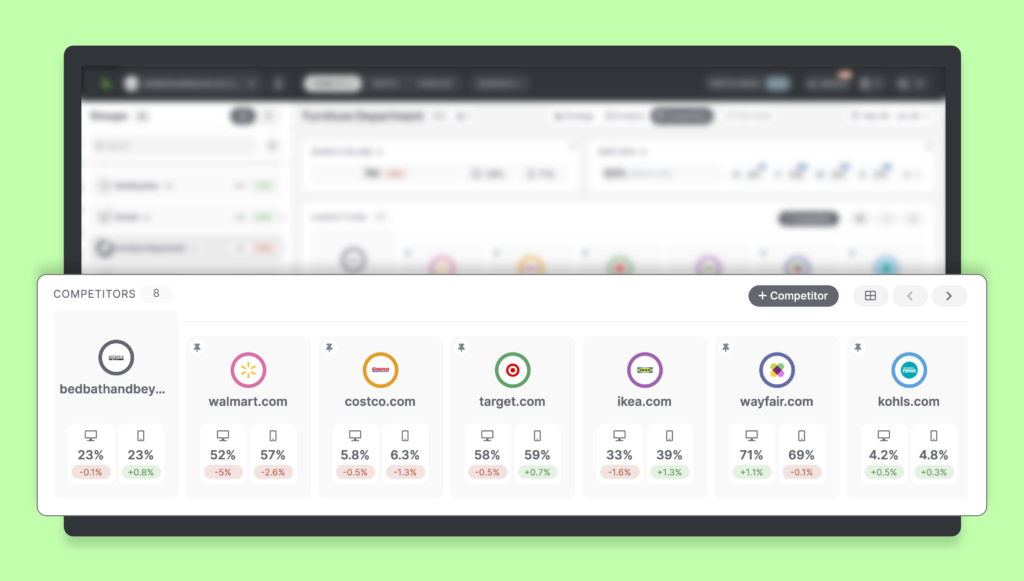
seobility

The Seobility team supports you gladly with any questions regarding Seobility and the search engine optimization of your website!

Categories SEO

New: Seobility Keyword Research Tool

keyword research tool

We’re happy to introduce a new tool today that has probably been the most requested Seobility feature ever: our brand-new free Keyword Research Tool!

As with all of our tools and features, our main goal was to develop a tool that’s easy to use and offers many helpful features. Keep reading to learn more about the different features and how you can use them for researching keywords!

Table of Content

Overview of the Keyword Research Tool

You can find the Keyword Research Tool in the list of tools in your Seobility dashboard:

tools for single page checks

Or you can just save the link as a bookmark: Free Keyword Research Tool from Seobility

On the tool page, you can choose from three types of analyses to search for relevant keywords:

  • Related keywords: This section lets you search for similar keywords related to your focus keyword in order to discover new content ideas.
  • URL/Domain: Analyze any URL or domain to find its best traffic sources.
  • Competitor analysis: Compare your own domain with up to two competitors to identify keywords that your competitors are ranking for but you are not, and more.

In the next sections, you’ll learn how to use each of these analyses and how they can benefit your keyword research!

Note: The Keyword Research Tool is still in open beta. Your feedback and suggestions for improvements are much appreciated – just send an email to support@seobility.net or let us know in the comments below!

Related keywords

This section lets your search for similar keywords related to your focus keyword. This research option is perfect if you’re looking for new content ideas around your core topic while considering a wide range of sources.

Just enter your keyword and change the country version of Google as required.

enter keywords

Next, click the “Keyword Research” button. Within a few seconds, you’ll receive a high number of keyword ideas from various categories, including:

Similar keywords directly related to the keyword you entered:

similar keywords

Questions related to the keyword that are frequently asked by search engine users:

questions related to the keyword

Related searches that Google displays in its search results:

related searches

Autocomplete searches suggested by Google as the term is being typed in:

auto complete searches

Related terms from the same broad category as the keyword entered (these keywords don’t have to be directly connected to the entered term):

related terms

In addition, you can use multiple sorting and filter options to narrow down the high number of keyword ideas as you wish. For example, you can explicitly search for keywords with high search volume and low competition to isolate the most promising keywords.

filter options

Another approach could be to search for short- and long-tail keywords by setting the number of words. Or you can use the “Exclude keywords” tab to specify terms that are not relevant to your website and should not be included in the results. Etc., etc., etc. … As you can see, there are multiple ways of refining your results!

Another useful feature: you can check Google’s top 10 results for each keyword without leaving the tool:

Google top 10 organic rankings

Here, you will also find important details such as the estimated monthly traffic of each URL, its domain rating, and the number of backlinks or referring domains. This will make it easier for you to assess the difficulty of achieving a top 10 ranking for the given keyword.

By ticking the box in the last column, you can select individual keywords from the list and export them as CSV or add them to your Ranking Monitoring Dashboard in Seobility.

how to add keywords to your Seobility project

URL/Domain

In the second section of the Keyword Research Tool, you can enter any URL or domain name to identify the keywords that this URL is ranking for on Google (in both organic and paid search results). This analysis lets you find your competitors’ top traffic sources which you can then add to your own keyword set.

(Please note that this is not an exhaustive list of all the search terms that a website is ranking for. We focus on the most important traffic sources here, so long-tail keywords may be underrepresented.)

domain analysis

For each keyword, you’ll be shown the domain’s ranking along with the estimated monthly traffic that this keyword drives to the website. As in the “Related keywords” section, you also have several filter options, which you can use to search for keywords that drive a lot of traffic to a competitor’s site, for example.

how to isolate keywords with the highest traffic

As in the first section, you can also analyze Google’s top 10 for each keyword and easily add your preferred keywords to your Seobility project.

Competitor analysis

Besides searching for keywords using a focus keyword or a domain name, the Keyword Research Tool also lets you do a detailed competitor analysis. This way, you can compare your site’s organic and paid rankings with up to two competitors. Just enter your own domain name and add your competitors as “Domain A” and “Domain B”.

competitor analysis

You also have to choose the type of analysis – Gap or Intersections.

The Gap analysis will list all the keywords that your competitors are ranking for but you are not. This type of analysis is great for discovering untapped ranking opportunities for your website.

Gap analysis of keywords

When choosing intersections analysis, you’ll get an overview of all the keywords that each of the domains entered is ranking for. This will show you where you’re already ahead of your competitors and where there might be room for improvement.

Using various filter options, you can again narrow down the results and quickly add your keyword set to your Seobility project.

How to get the most from the Keyword Research Tool

Whether you’re working on a content plan for your website or just looking for topic ideas – the Keyword Research Tool is perfect for finding attractive keywords to target with new or existing content on your website.

Using the search for related keywords, you can quickly create a broad and diverse keyword set. Then, you can complement this list with your competitors’ traffic sources, which you can find using the URL/Domain search and the Competitor Analysis. After that, you should take a close look at the keywords’ traffic potential and competition and then pick the most promising ones for your website.

We will provide you with a detailed Keyword Research Guide here on our blog soon. In this guide, we’ll explain step by step how to research and analyze keywords, how to optimize your content, and how Seobility helps you with each task. Follow us on our Social Media Channels (Facebook, Twitter, Instagram, Linkedin) or keep an eye on your Seobility notifications, so you won’t miss it!

Over to you – test the tool and share your feedback with us!

We hope you’ll find the Keyword Research Tool useful and that it will become a constant part of your keyword research process!
You can try out the tool here: Free Keyword Research Tool from Seobility

As mentioned before, the tool is still in open beta. So if you encounter any issues or if you have ideas for improvements, we would be more than happy to hear about them! Also, if you have any questions about the tool, our support team will be happy to help: support@seobility.net

Have fun playing around with the tool!

PS: Get blog updates straight to your inbox!
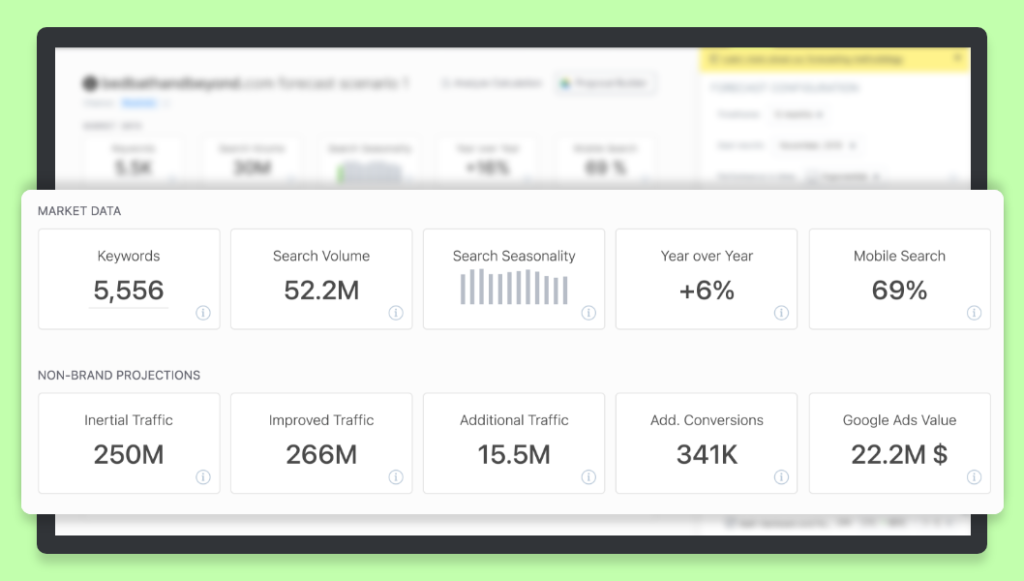
seobility

The Seobility team supports you gladly with any questions regarding Seobility and the search engine optimization of your website!

Will you reveal Gary Vaynerchuk assistance?

He is a buddy, he has 15 + million-plus social media followers, is Chairman of VaynerX, and active CEO of VaynerMedia– a digital marketing company you may have currently heard of. Go to SESlingshots.GaryVaynerchukMedia.com and get your website on Google’s very first page.

Seo (SEO) is the top kind of marketing in regards to return on investment so that means if you have a business or a website, search means more to you than anything else out there if you’re looking for more leads, sales, buddies, and clients. As a matter of reality, if you aren’t purposely and actively pursuing SEO for your company, you’re leaving more than cash off the table, you’re leaving your whole organization profile, evaluations and ultimately destroying your track record.

Material created in partnership with Gary V.

If you’re still asking, “What is seo”?– it’s the digital version of yellow or white pages. If somebody is trying to find something they generally utilize Google or another online search engine and type what’s on their mind. From there, whatever websites and keywords appear on the first results will get clicked.

Generally, if you have a website that’s selling t-shirts or sportswear you wish to be able to have your site show up on Google when somebody types up “red shirt” or “giants hat” (if you reside in San Francisco). The neat aspect of search engine marketing is that anyone can get it done, and save $1000s you would spend in other places otherwise. You can have a site up and running and use SESlingshots.GaryVaynerchukMedia.com to get your search terms ranked on Google as the very first lead to just 72 hours. It’s called backlink building and if done right, you can get links from other relied on pages that tell Google– your site is favorably referred to and belongs at the top of search results.

It’s a efficient and truly wise method and when again, it has the highest roi in contrast to any other kind of marketing or marketing to have actually ever have actually existed on the world. Visit SESlingshots.GaryVaynerchukMedia.com and use the search tool to find out what your site requires to succeed result on Google.

Click on this link to show Gary V your assistance: SESlingshots.GaryVaynerchukMedia.com